How to Build a Generative Media Pipeline with fal, Modal Labs, and ComfyUI in 2026
TL;DR
- A queue decouples the request from the result — it doesn’t remove the wait, it relocates it behind a webhook or a poll.
- A review gate is a separate component with its own approval state, not a checkbox inside the generation call.
- Compute platforms like Modal Labs and self-hosted ComfyUI carry different billing and security models than a hosted API — specify which one before the orchestrator depends on it.
The pipeline worked all week. Then the prompt template upstream changed one word, the queue kept accepting jobs exactly as designed, and by Monday morning the CMS held a stack of generated images nobody had approved. Nothing crashed. Nothing alerted. The system did precisely what it was built to do — generate, then publish — because nobody had specified that those two things needed to be different steps.
Before You Start
You’ll need:
- An AI coding tool for prototyping the orchestration logic (Claude Code, Cursor, or Codex)
- A working grasp of Queue Based Processing — submit, then poll or wait for a callback, never block on the result
- A clear definition of what “approved” means for your content before you wire the review gate
This guide teaches you: how to decompose a Generative Media Pipelines into four independently specifiable layers — orchestration, generation, compute, and review — so the AI tool building each one knows its exact contract.
The Pipeline That Shipped Before Anyone Looked
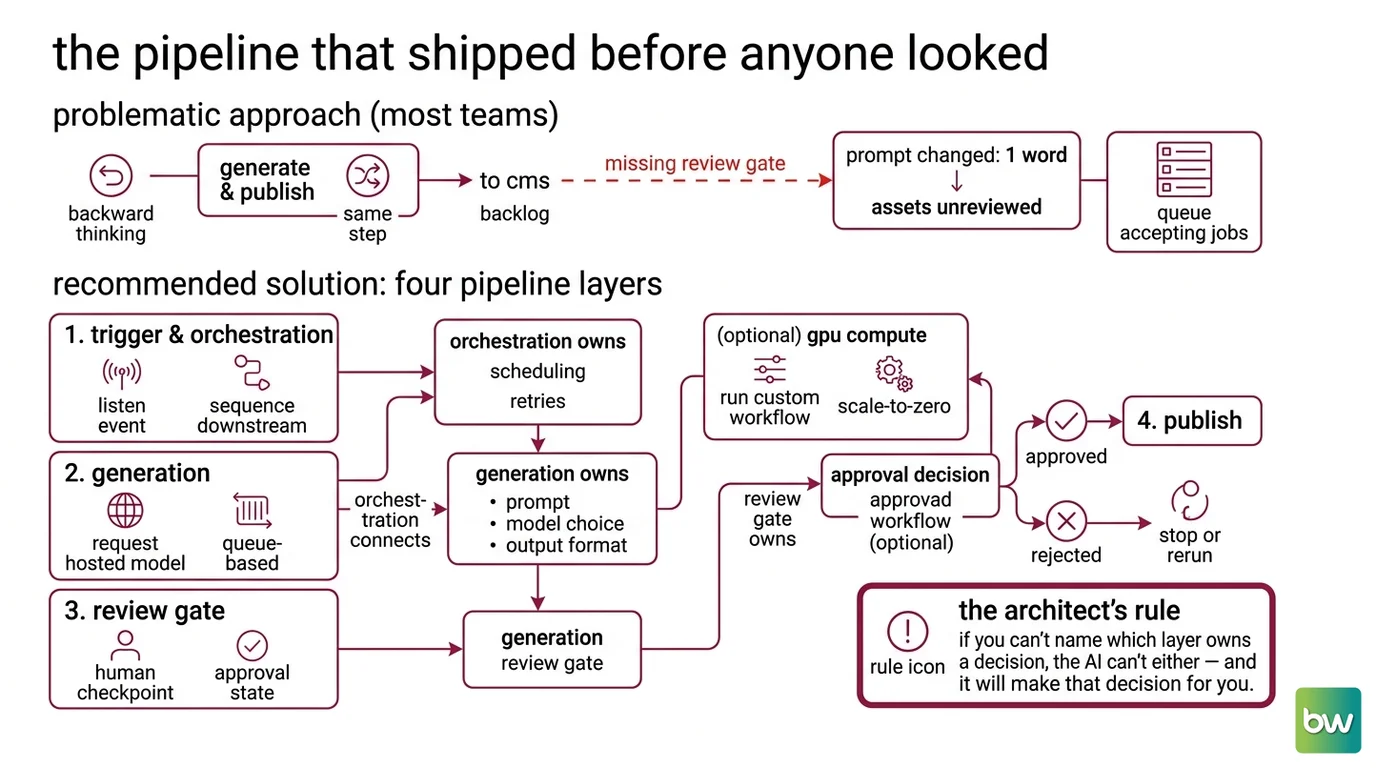
Most teams build generative media pipelines backwards. They wire the API call first, get an asset back, and bolt orchestration on top of it — the workflow tool triggers the model, the model returns a file, the file lands wherever it’s supposed to publish. The review step gets added later, if at all, because nobody specified it as its own component from the start.
It worked on Thursday. On Friday, the prompt template upstream changed one word, the queue kept accepting jobs, and by Monday the CMS held a backlog of generated assets nobody had reviewed — because generate and publish were the same step.
Step 1: Map the Pipeline’s Four Layers
A generative media pipeline isn’t one system — it’s four, each making a different decision. Treat it as one script and the AI mixes concerns: a retry policy that belongs to orchestration ends up hardcoded into the generation call, or an approval check gets skipped because nothing said it needed its own gate.
Your system has these parts:
- Trigger & orchestration — n8n (or an equivalent workflow tool) listens for the event that starts a run and sequences every downstream step. It owns scheduling and retries, not image quality.
- Generation — the Generative Media APIs call: a queue-based request to a hosted model. Owns the prompt, model choice, and output format — nothing else.
- Compute — when the hosted API doesn’t cover what you need (a fine-tuned checkpoint, a custom ComfyUI workflow), this layer runs the GPU job. Modal Labs does it with per-second billing and scale-to-zero; no opinion about what gets generated, only about running it and shutting down when done.
- Review gate — a human checkpoint between “generated” and “published.” Owns approval state, not generation logic.
The Architect’s Rule: If you can’t name which layer owns a decision, the AI can’t either — and it will make that decision for you, somewhere unexpected.
Each layer owns exactly one decision, and that boundary is what makes the system debuggable later.
Step 2: Specify the Provider Contract
The AI tool needs to know which provider it’s targeting and exactly how that provider signals “done.” Leave it unspecified and you get a coin flip between a call that blocks your orchestrator and an async one nobody checks.
Context checklist:
- Generation provider named explicitly: Fal AI, Replicate, or Stability API — each bills and queues differently, and an unspecified provider means the AI defaults to whichever it saw most during training.
- Async contract specified: webhook URL or a fixed poll interval.
- Idempotency key defined: a stable ID passed on every retry.
- Cost Per Generation ceiling per job — a runaway loop without a cap doesn’t fail loud, it just bills.
- Auth boundary specified for any self-hosted layer.
fal bills per output, not per second of queue wait — Flux Kontext Pro runs $0.04/image, Seedream V4 $0.03/image (fal’s pricing page). Pass a request_id on every call so a retry doesn’t bill twice (fal Docs). Modal Labs bills per second, scaling to zero when idle — Starter ships $30/month free credit, capped at 10 concurrent GPUs (Modal’s pricing page). n8n’s Community Edition is free and unlimited; the hosted Starter plan runs €20/month, billed annually, for 2,500 executions (n8n’s pricing page).
The Spec Test: If your context doesn’t name the auth boundary for a self-hosted component, the AI leaves the default in place — and the default is often none.
Self-hosted ComfyUI makes that default matter more — it ships with no built-in authentication, so any endpoint is callable by anyone who can reach it (ComfyUI Docs). Fine on a laptop, not once exposed instances were swept into cryptomining botnets — over a thousand in one campaign (The Hacker News).
Security & compatibility notes:
- ComfyUI core (CSRF + XSS): CVE-2026-6589 and CVE-2026-6592, both in versions up to v0.13.0. Update past that version; never expose the default port without a reverse proxy handling auth.
- ComfyUI-Manager (config injection): CVE-2026-22777 allows security-setting tampering via the popular manager extension. Fixed in v3.39.2 / v4.0.5.
- Modal Labs 1.0 migration:
modal.Stubnow raisesAttributeError(formerly an alias formodal.App); local-package automounting is gone — add packages toImageexplicitly;Sandbox.mkdir/Sandbox.rmare deprecated.
These are hardening patterns for a deployment you control — not a checklist for probing one you don’t.
Step 3: Sequence the Build — Generation Before Orchestration
Build order matters here, because each layer’s interface depends on the one before it being finished. Wire the orchestrator first and you’ll rewire it every time a downstream contract changes — early on, that’s constantly.
Build order:
- Generation layer first — wire fal (or whichever provider you chose) standalone, confirm the webhook fires and the idempotency key works.
- Review gate next — it depends on the generation layer’s output contract (file format, metadata) being stable.
- Compute layer (Modal Labs or self-hosted ComfyUI), only if the hosted API doesn’t cover your model — a drop-in replacement for the generation layer’s contract, not a parallel path.
- Orchestrator last — it depends on every other layer’s interface being final.
For each component, your context must specify:
- What it receives (inputs)
- What it returns (outputs)
- What it must NOT do (constraints)
- How to handle failure (error cases)
Skip this order and you’ll spend your debugging time in the wrong layer — the cause usually sits upstream.
Step 4: Validate Before You Trust the Output
“It works” isn’t a validation criterion — it’s an observation about one run you happened to check. Validate against specific failure symptoms so a broken pipeline tells you where it broke.
Validation checklist:
- Webhook delivery confirmed — failure looks like: jobs stuck in “queued” with no completion event, usually a firewall blocking the callback URL.
- Idempotency holds under retry — failure looks like: the same request billed twice for one asset.
- Review gate actually blocks publish — failure looks like: an asset goes live before its approval state flips.
- Cost ceiling enforced — failure looks like: a billing spike with no alert attached to it.
Each symptom should point at one layer — if it doesn’t, the boundary between layers isn’t as clean as the diagram suggests.
Common Pitfalls
| What You Did | Why AI Failed | The Fix |
|---|---|---|
| Called the generation API directly, no webhook or poll interval specified | AI defaulted to synchronous polling, tying up the orchestrator | Specify the async contract explicitly — webhook URL or poll interval |
| Skipped the idempotency key | A retried request after a timeout billed a duplicate asset | Pass a stable ID like fal’s request_id on every retry |
| Treated “generated” and “published” as the same step | Unapproved assets reached production — no separate state existed to check | Spec the review gate as its own component with its own state |
| Exposed ComfyUI’s default port without a reverse proxy | No built-in authentication — every endpoint was publicly callable | Bind to localhost; front it with a reverse proxy that handles auth |
Pro Tip
Every layer should be replaceable without touching its neighbors. If swapping fal for Replicate means rewriting your review gate, the gate was never a separate layer — it was generation logic with an extra step bolted on. Specify boundaries the same way you’d specify inputs and outputs: explicitly, before you start building.
Frequently Asked Questions
Q: How to build a generative media pipeline step by step? A: Decompose into four layers — orchestration, generation, compute, review gate — and specify each layer’s input/output contract before building. Build generation first, since every other layer depends on its contract; build the orchestrator last, since it depends on everyone else being final.
Q: How to use fal for queue-based media generation pipelines?
A: fal accepts an async request from a persistent queue and posts a webhook on completion, or you poll the status endpoint. Pass a request_id on every retry — it keeps a timeout-triggered retry from billing the same asset twice. Queue wait time itself is never billed.
Q: How to add human-in-the-loop review to an automated content pipeline? A: Specify the review gate as its own component, not a step inside generation — it owns approval state, and publish should only read assets whose state has flipped to “approved.” Build it after the generation layer’s output contract is stable, since the gate needs to know exactly what it’s reviewing.
Q: What tools are best for orchestrating AI content generation in 2026? A: It depends on whether you need a visual workflow tool or code-level control. n8n covers webhook-driven orchestration without custom code — wiring a fal or Replicate call takes minutes. For a fine-tuned model or a custom ComfyUI graph, Modal Labs’ scale-to-zero billing keeps the compute layer free while idle.
Your Spec Artifact
By the end of this guide, you should have:
- A four-layer component map (orchestration, generation, compute, review gate) with each layer’s owned decision named
- A provider contract checklist — async pattern, idempotency key, cost ceiling, auth boundary
- A validation checklist tied to specific failure symptoms, not just “it works”
Your Implementation Prompt
Paste this into Claude Code, Cursor, or Codex with the brackets filled in. It encodes the four-layer decomposition and build order from this guide, so the AI builds the review gate as its own component instead of folding it into the generation call.
Build a generative media pipeline with four independently specified layers, built in this order:

1. GENERATION LAYER (build first)
   - Provider: [fal / Replicate / Stability AI / other]
   - Async contract: [webhook URL / poll interval in seconds]
   - Idempotency: [request ID param + storage]
   - Cost ceiling per job: [$ limit + action when hit]
   - Output contract: [file format, metadata fields returned]

2. REVIEW GATE (build second, depends on the Generation Layer's output contract)
   - Approval states: [e.g. pending / approved / rejected]
   - Who approves: [human reviewer / auto-approve rule]
   - What "approved" unlocks: [name of the publish step]

3. COMPUTE LAYER (build third, only if the hosted API doesn't cover your model)
   - Platform: [Modal Labs / self-hosted ComfyUI / other]
   - Scale-to-zero required: [yes/no]
   - Auth boundary: [reverse proxy / API key / network isolation]

4. ORCHESTRATOR (build last, depends on layers 1-3 being final)
   - Trigger event: [what starts a run]
   - Tool: [n8n / custom code / other]
   - Retry policy: [max retries, backoff]

Validation: confirm (a) a generated asset cannot reach publish without passing through the Review Gate's approved state, and (b) a retried request after a timeout does not generate or bill a duplicate asset.
Ship It
You now have a four-layer map instead of one tangled script — orchestration, generation, compute, and review gate, each replaceable without rewriting the rest. The review gate is the layer most pipelines skip, and it’s the one that decides what goes live. Specify it like any other component, and the AI building it won’t quietly fold it into the generation call.
AI-assisted content, human-reviewed. Images AI-generated. Editorial Standards · Our Editors