How Law Firms, Hospitals, and Dev Teams Deploy Domain-Specific Prompting in Production in 2026
TL;DR
- The shift: domain-specific prompting moved from experimental to default infrastructure across legal, healthcare, and software development in early 2026
- Why it matters: three independent verticals reached production scale in the same window — this is a structural pattern, not sector-specific noise
- What’s next: the model-vs-prompting debate is settling; configuration strategy is the durable competitive advantage
The era of general-purpose AI as an undifferentiated tool ended quietly in early 2026.
Not with a product announcement. With deployment numbers.
Three verticals — legal, healthcare, software development — each crossed a production threshold at nearly the same time. The timing is not a coincidence. It is a signal.
The Same Bet, Made Independently
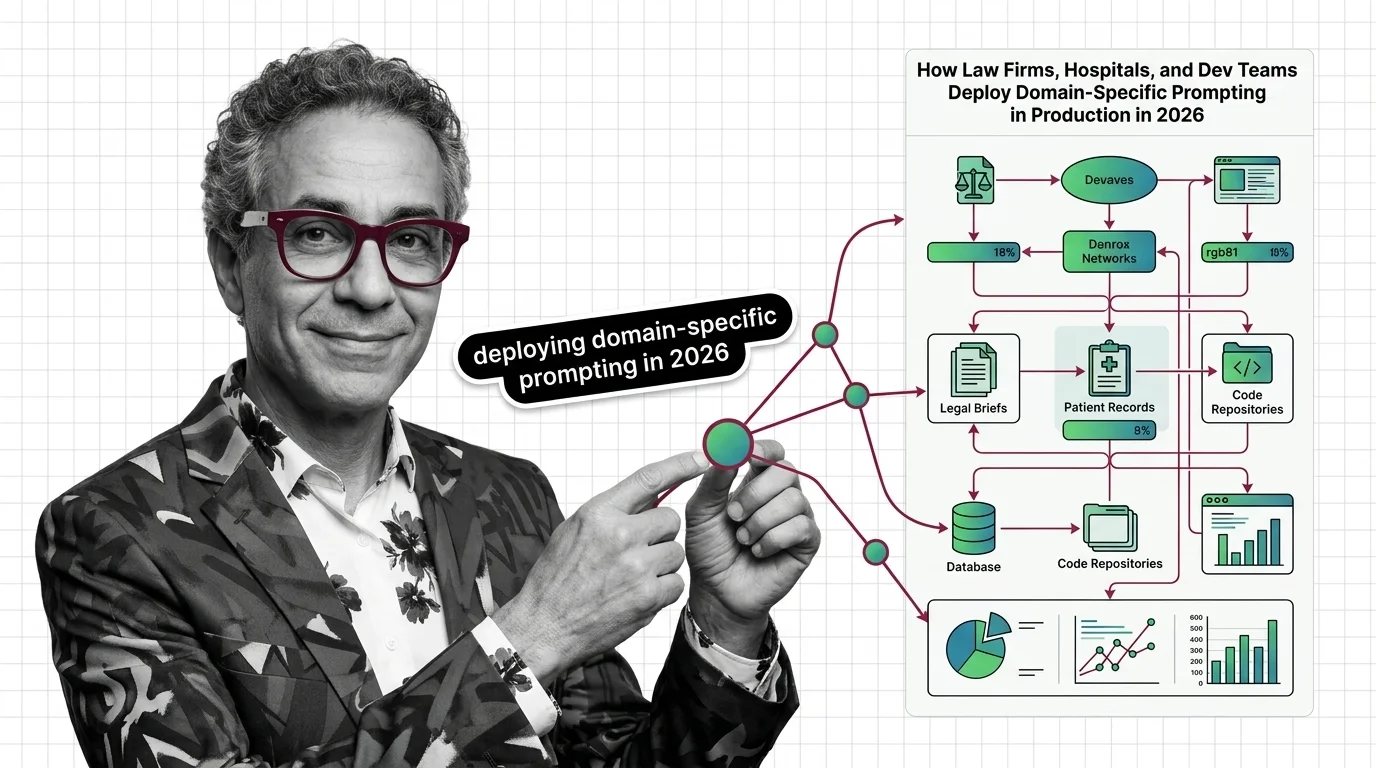
Three unrelated industries arrived at the same architectural conclusion in the same quarter: Domain-Specific Prompting is not a configuration detail.
It is the product.
Gartner projects that more than half of enterprise GenAI models will be domain-specific by 2027, according to projections cited by multiple analysts. In 2024, that figure was 1%. That is not a gradual trend. That is a market repricing its assumptions.
The verticals did not coordinate. They converged.
Law firms found that Knowledge Injection at the task level — jurisdiction context, client history, firm style guides — outperformed general prompting for contract review and litigation prep. Healthcare teams found that clinical System Prompts embedding ICD-10 coding rules and HIPAA constraints directly into workflows eliminated a category of compliance risk. Dev teams found that Context Engineering at the repository level — naming conventions, architecture patterns, security policies — made AI code suggestions production-worthy instead of a liability.
The conclusion was the same in all three cases: domain specificity is not optional.
You either tune your stack for your domain or you accept whatever the base model assumes about it.
Three Verticals, One Conclusion
Harvey AI now processes over 200,000 legal queries per day and handles more than 1.3 million files daily (Harvey AI Platform). More than 142,000 legal professionals worldwide use the platform, with over 25,000 custom agents deployed across 1,300+ enterprise organizations.
This is not a pilot program. This is infrastructure.
In healthcare, Nuance DAX Copilot runs across more than 150 health systems in the US, Canada, and the UK with Epic integration. Abridge reached over 200 health systems; UPMC deployed it to more than 12,000 clinicians enterprise-wide (Abridge). HealthBench — a new evaluation framework built from 48,562 rubric criteria written by 262 physicians across 26 specialties and 60 countries — set a new standard for measuring Prompt Engineering quality in clinical settings (Kili Technology).
One finding complicates the simple narrative: a 2026 Nature Medicine study found general-purpose LLMs outperform specialized clinical tools on medical benchmarks. The advantage is in the configuration layer, not the model. Role Prompting and Multi-Turn Prompt Design applied to general models can rival purpose-built systems — which means organizations that invest in prompt architecture outcompete organizations that invest in fine-tuning alone.
On the dev side,
GitHub Copilot made org-level custom instructions generally available on April 2, 2026 (GitHub Changelog). Teams now define architectural rules, security policies, and naming standards in a .github/copilot-instructions.md file that shapes every suggestion across the organization. Path-specific instructions and Copilot Spaces extend this further into the
Context Window for individual repos.
Multimodal Prompting and external domain injection via MCP — now GA in VS Code, JetBrains, Eclipse, and Xcode — replaced the extension model deprecated in November 2025.
Security & compatibility notes:
- GitHub Copilot Extensions deprecated (Nov 2025): Replaced by MCP, now GA in VS Code, JetBrains, Eclipse, and Xcode. Teams using extension-based domain injection must migrate.
- Claude Sonnet 4 in Copilot (deprecated May 2026): Teams with Sonnet 4-specific prompt styles must update configurations (GitHub Changelog).
- GPT-5.2 and GPT-5.2-Codex in Copilot (deprecated June 2026): Removed from most Copilot experiences; GPT-5.2 retained only in Copilot Code Review (GitHub Changelog).
- Opus 4.6 fast in Copilot (deprecating June 29, 2026): Deprecating across all Copilot experiences; replaced by Opus 4.8 fast (GitHub Changelog).
Teams that built their configuration layer before the market standardized it own the lead. Teams following platform deprecations are already playing defense.
The Configuration Layer Is the Product Now
The winners in this market are not the organizations that built the best LLMs. They are the organizations that built the best domain configuration stacks.
Harvey raised at an $11 billion valuation in 2026 (Harvey AI Blog). The market is not betting on a better model. It is betting on the workflow layer: agents, knowledge connectors, compliance guardrails, audit trails.
Anthropic launched Claude for Healthcare with FHIR, ICD-10, CMS, and PubMed connectors in January 2026, plus prior authorization and clinical trial agent skills. OpenAI launched HIPAA-compliant ChatGPT for Healthcare the same month (Medical LLMs Guide). Both companies moved simultaneously to own the vertical configuration layer — not just provide the base capability.
The in-house legal market followed the same pattern. Generative AI adoption among in-house legal teams reached directionally high levels by early 2026, according to industry reporting. Lexis+ with Protege replaced first-generation Lexis+ AI in early 2026 and was described as the fastest-growing product in LexisNexis history.
Firms that invested early in prompt governance — version control, evaluation frameworks, domain-specific benchmarks — now own institutional knowledge their competitors cannot replicate from a standing start.
Running Generic in a Compliance World
Any organization still evaluating whether domain-specific prompting is worth the investment has already lost a quarter.
Teams running generic prompts against compliance-critical workflows are generating the liability exposure. Law firms with no formal prompt governance are flying without logs.
Hospitals deploying ambient AI scribing without domain-calibrated guardrails are accumulating audit risk that compounds with every encounter. A 2024-2025 NEJM AI randomized controlled trial of DAX Copilot at UCLA Health — 238 physicians across 14 specialties — found real improvements in physician burnout scores and task load. The primary endpoint, time spent in notes, did not reach statistical significance (NEJM AI). Efficiency gains are real but narrower than vendor marketing implies.
You are either building the configuration layer or you are dependent on someone else’s assumptions.
What Happens Next
Base case (most likely): Domain-specific prompt infrastructure becomes standard procurement — not a differentiator — within 18 months. The advantage window closes as tooling commodifies. Signal to watch: mid-market vendors shipping turnkey domain-configuration templates at volume. Timeline: mid-2027.
Bull case: Teams that built proprietary domain configuration stacks early — custom agent libraries, firm-specific knowledge bases, compliance-validated context workflows — find the moat widens as general models improve. Better base models amplify better prompting stacks, not the reverse. Signal: enterprise contract renewals citing proprietary context assets as lock-in. Timeline: visible by Q1 2027.
Bear case: The Nature Medicine finding plays out at scale — general models with strong prompting strategies match or beat purpose-built domain LLMs across most tasks. The domain-specific model market consolidates to narrow niches where regulatory liability demands it. Signal: domain-specific LLM vendors face margin compression despite volume growth. Timeline: 2026-2027 evidence window.
Frequently Asked Questions
Q: Real-world examples of domain-specific LLM prompting in healthcare and legal enterprise 2026 A: Harvey AI deploys 25,000+ custom agents across 1,300+ enterprise organizations globally, processing over 200,000 legal queries daily. In healthcare, Abridge reached 200+ health systems with domain-calibrated ambient AI scribing. Both are production-grade systems built on general-purpose LLMs with deep domain configuration — not fine-tuned specialist models.
Q: How does GitHub Copilot use domain-specific prompting strategies for code generation and debugging?
A: Copilot’s org-level custom instructions (GA April 2, 2026) inject domain context via .github/copilot-instructions.md — architecture rules, security policies, naming standards. Path-specific instruction files extend this per codebase. MCP integration, now GA across VS Code, JetBrains, Eclipse, and Xcode, replaced the deprecated extension model for external domain injection.
Q: Domain-specific AI models vs general LLMs with specialized prompts: where is the market heading in 2026? A: A 2026 Nature Medicine study found general LLMs outperform specialized clinical tools on benchmarks. The market is converging on a hybrid: general-purpose LLMs as the base, domain-specific prompt configuration as the differentiator. According to Gartner projections cited by multiple analysts, over half of enterprise GenAI will run domain-specific configurations by 2027.
The Bottom Line
Domain-specific prompting is no longer a specialization choice. It is the production default in legal, healthcare, and software development.
Organizations that invested early in configuration infrastructure — versioned prompts, domain benchmarks, compliance guardrails — hold assets their competitors cannot replicate fast.
The window for differentiation is still open. It won’t stay open.
Stay ahead, Dan.
AI-assisted content, human-reviewed. Images AI-generated. Editorial Standards · Our Editors