GPT Image 1.5, Nano Banana Pro, HunyuanImage 3.0: 2026 Editing Race
TL;DR
- The shift: The top of the image editing arena has compressed into a four-model cluster — OpenAI, Google, and Tencent separated by a narrow Elo spread, not a generational gap.
- Why it matters: Open-weight editing models now sit one step below the closed frontier, not one generation behind. That changes what you build, self-host, or license.
- What’s next: Watch whether the next open-weight release cracks the top-3. That is the line between “catching up” and “caught up.”
Image editing stopped being a two-horse race between OpenAI and Google somewhere in Q1. A Tencent Hunyuan Image model sitting in the top-4 of the AI Image Editing arena — on open weights — is a signal the market hasn’t fully priced in yet. As of April 2026, the Elo spread between the #1 and #4 models on Artificial Analysis is tight enough that benchmark noise could reorder them tomorrow.
The Editing Arena Just Compressed Into a Four-Model Race
Thesis: The 2026 image editing frontier is no longer a closed-source monopoly — four models (three closed, one open-weight) now share the top of the Artificial Analysis leaderboard inside a narrow Elo band, and that compression changes the build-or-buy math for every team shipping creative tooling.
Twelve months ago, the editing race looked settled. OpenAI and Google owned the top. Open weights were a distant echo — fine for hobbyists, nowhere near production-grade on high-fidelity edits.
That gap is gone.
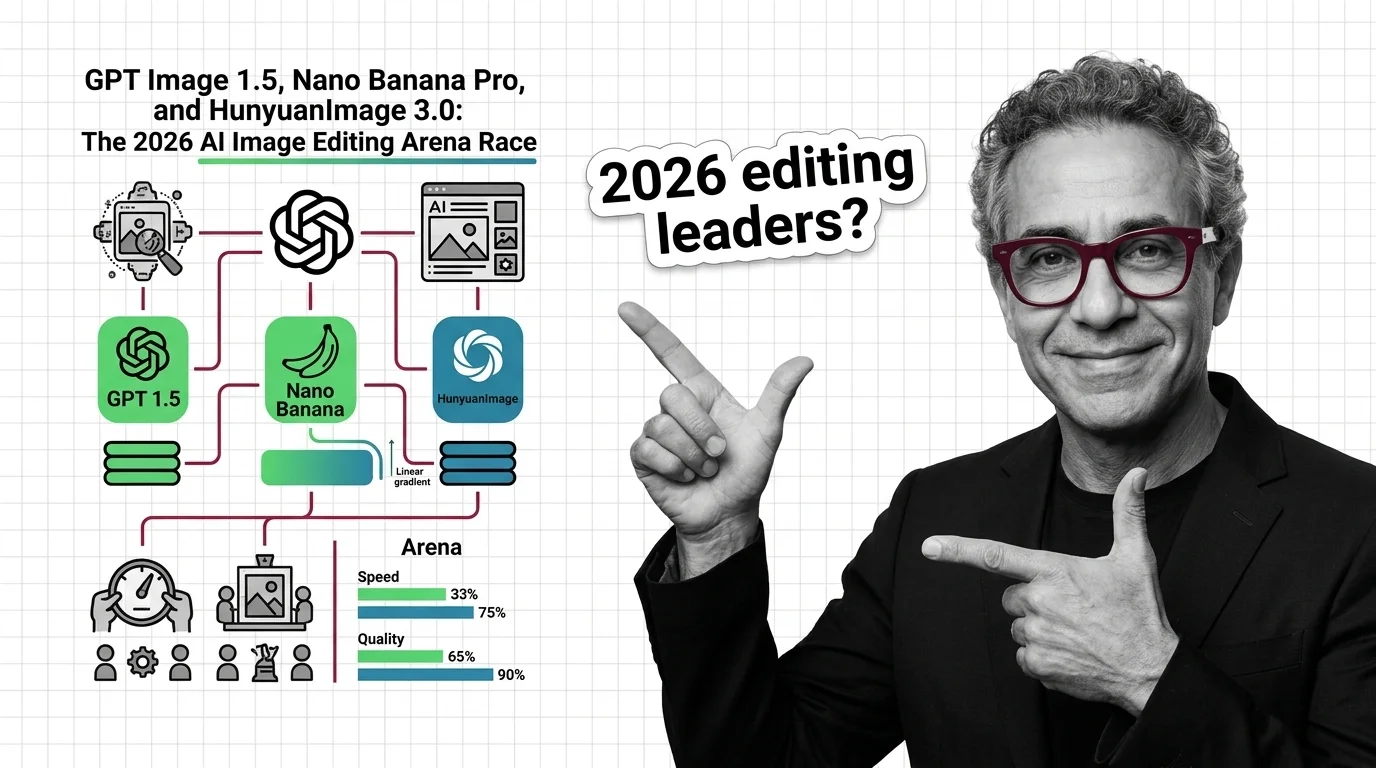
As of April 2026, GPT Image 1.5 (high) leads the Artificial Analysis Image Editing Leaderboard at Elo 1254, Nano Banana Pro sits at 1240, Nano Banana 2 at 1226, and HunyuanImage 3.0-Instruct at 1220 (Artificial Analysis). A 34-point spread across the top four is inside the noise floor of blind pairwise voting. That is not four models. That is one cluster.
And one of those four is open weights from Tencent.
Three Independent Releases, One Direction
The evidence doesn’t sort by date. It sorts by what each release proves.
Signal 1 — OpenAI compressed its release cycle. GPT Image 1.5 shipped to ChatGPT and the API on December 16, 2025, roughly 4x faster than its predecessor and preserving composition and lighting across successive edits (TechCrunch). OpenAI’s image family went from quarterly drops to continuous refinement.
Signal 2 — Google bet on grounding, not just pixels. Nano Banana Pro launched November 20, 2025 as the Gemini 3 Pro Image model: up to 4K output, 14-image consistency, 5-person resemblance lock, Google Search grounding, and SynthID watermarking baked in (Google Blog). The #3 slot on the editing arena belongs to its Flash sibling — meaning one Google family holds two of the top five positions.
Signal 3 — Tencent proved open weights are no longer a handicap. HunyuanImage 3.0 landed September 28, 2025. The Instruct variant — a native multimodal autoregressive MoE at 80B total parameters with 13B activated across 64 experts — shipped January 26, 2026 and placed fourth in the editing arena via Fal hosting (Tencent GitHub). Open architecture, frontier-tier quality, and a 34-point deficit to the leader. That’s not catching up. That’s caught up.
Three labs, three architectural bets, one leaderboard tier.
Who Moves Up
Closed-source editors who treat the API as a product, not a demo. OpenAI and Google are both shipping continuous updates against a live benchmark, not a marketing calendar. That flywheel is hard to beat without matched training compute.
Hosting providers. Fal, Replicate, and Together AI don’t care which model wins — they capture margin on whatever ranks. HunyuanImage 3.0-Instruct’s arena entry via Fal is the template: open model + managed inference + serverless billing = a business.
Open-weight labs with real compute. Tencent, Alibaba ( Qwen Image Edit Plus 2511 at Elo 1150, a 20B model with built-in LoRA and improved multi-person consistency per Alibaba Cloud), and Black Forest Labs ( Flux.2 [klein] 9B at Elo 1154, released January 15, 2026 per VentureBeat) are all within striking distance. They don’t own the frontier — they own the license flexibility the frontier doesn’t offer.
You’re either building on these four architectures or you’re building on a stack the arena has already passed.
Who Gets Left Behind
Legacy products OpenAI and Google already announced dead. DALL-E 2 and DALL-E 3 retire May 12, 2026 — OpenAI is consolidating everything into the gpt-image-1.5 line (OpenAI Deprecations). Google Imagen across all versions shuts down June 24, 2026, replaced by the Gemini Image family (Firebase AI Logic). If your product still has a DALL-E 3 code path or an Imagen endpoint, you have weeks, not quarters, to migrate.
Mid-tier proprietary editors with no training-compute story. Products that once competed through fine-tuning and UX can’t match the closed frontier on quality or the open frontier on license. ByteDance’s Seedream and Adobe Firefly are positioned differently — one on ByteDance’s infrastructure, the other on licensed training data — but neither appears in the Artificial Analysis top-5 editing ranks as of this writing.
Stacks locked to pure Diffusion Models. Every model inside the current top-4 leans autoregressive or multimodal-AR. The open-weight diffusion challengers sit roughly 60 to 70 Elo points back. That gap is closable, but the architecture bet has already been placed.
The middle of the market is where the margins evaporate.
What Happens Next
Base case (most likely): The top-4 stays clustered within a ~50-point Elo band through the rest of 2026. One more open-weight release — likely a Qwen or FLUX successor — cracks the top-3. Signal to watch: An open-weights model crossing Elo 1225 on the Artificial Analysis editing arena. Timeline: Within the next two quarters.
Bull case (for open weights): A Tencent or Alibaba release reaches parity with Nano Banana Pro. Enterprise procurement pivots toward self-hosted editing for regulated sectors. Signal: Open-weights entry inside Elo 1240, plus a major enterprise deployment announcement. Timeline: Before end of 2026.
Bear case: OpenAI and Google pull ahead on quality and feature depth — grounding, watermarking, safety. The gap to open-weight reopens above 50 Elo points. Signal: A new closed model above Elo 1280 with no open counterpart. Timeline: H2 2026.
Frequently Asked Questions
Q: What are the leading AI image editing models on the Artificial Analysis arena in 2026? A: As of April 2026, GPT Image 1.5 (high) leads at Elo 1254, followed by Nano Banana Pro at 1240, Nano Banana 2 at 1226, HunyuanImage 3.0-Instruct at 1220, and grok-imagine-image at 1213 (Artificial Analysis). Rankings drift daily — verify against the live leaderboard before committing.
Q: Where is AI image editing heading in 2026 and beyond? A: Toward a tight multi-lab cluster at the top, with open-weight models operating inside the same quality band as closed frontier editors. Expect tighter integration with LLM context (grounding, world knowledge) and more licensing differentiation, not larger raw quality gaps.
The Bottom Line
The editing frontier narrowed from two labs to four in six months, with one open-weight entrant inside the cluster. Watch the next open-weight release and the Elo spread between positions one and four. Your team is either wiring editing capability behind a vendor-agnostic interface, or it’s locking in a vendor that the arena may overtake before the next invoice clears.
Security & compatibility notes:
- DALL-E 2 and DALL-E 3 retirement: Retiring May 12, 2026. Migrate to gpt-image-1.5 before that date.
- Google Imagen shutdown: All Imagen versions shut down June 24, 2026. Migrate to the Gemini Image (Nano Banana) family.
AI-assisted content, human-reviewed. Images AI-generated. Editorial Standards · Our Editors