GPT-5.5, Gemini 3 Deep Think, and Qwen 3.5 Omni: Multimodal Benchmark Results and the Omni Model Shift in 2026
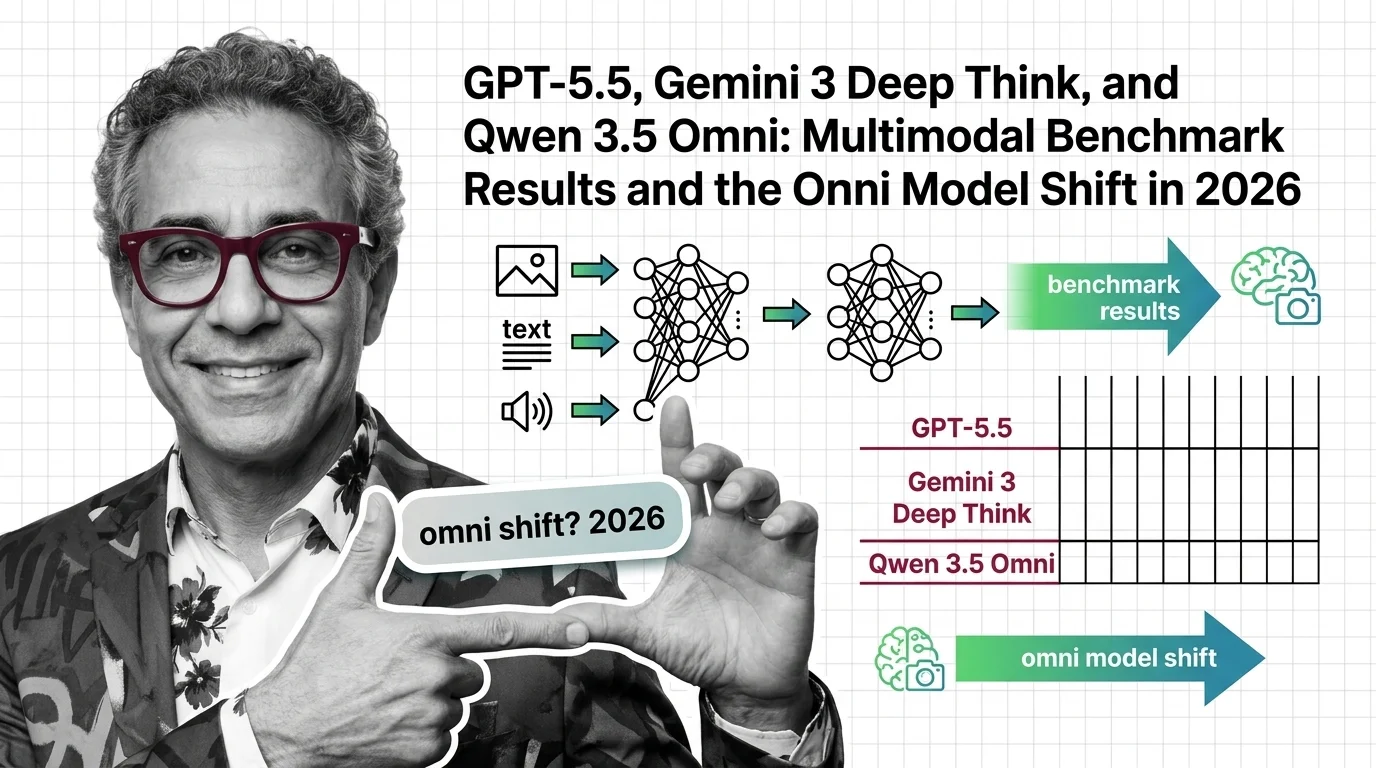
TL;DR
- The shift: Multimodal benchmarks saturated at 81–83% MMMU-Pro in April 2026 — the real competition moved to architecture scope, not accuracy scores.
- Why it matters: GPT-5.5 bets deep on structured vision; Qwen3.5-Omni and Gemini 3 Deep Think bet wide on native audio, video, and real-time speech — two fundamentally different definitions of what multimodal AI is for.
- What’s next: Any application still routing modalities through separate pipeline steps is carrying architectural debt. The native omni model is no longer experimental.
Four frontier labs shipped major multimodal updates inside a 60-day window ending April 2026. When the benchmark dust settled, the three major proprietary models clustered at 81–83% on MMMU-Pro. That looks like a draw.
It’s not a draw. It’s a fork.
The models cluster on the same number through structurally different architectures — and they’re heading in opposite directions. Understanding the split is more actionable than memorizing the leaderboard.
The Benchmark Is Saturated. The Race Moved Elsewhere.
Thesis: MMMU-Pro at 81–83% no longer separates the frontier — the differentiator shifted to architecture scope: which input modalities a model handles natively, and at what cost.
Multimodal Prompting has meant text plus image for two years. That framing is becoming obsolete.
GPT-5.5, launched publicly April 23, 2026 (OpenAI Blog), handles text and image only. No native audio. No video. What it does with those two modalities is remarkable: 92.1% on ChartQA, 96.2% on AI2D, 91.5% on DocVQA (Digital Applied, April 24, 2026). It led the April 2026 frontier on every structured-visual-reasoning benchmark.
Qwen3.5-Omni, released March 30, 2026, accepts text, image, audio, and video simultaneously — and outputs both text and streaming speech in 36 languages. Weights are open. Fine-tunable. Self-hostable. Qwen3.5-Omni Flash starts at $0.52 input / $2.86 output per 1M tokens (Alibaba Cloud).
Those are two different products wearing the same “multimodal AI” label.
Three Labs, One Direction
Gemini 3 Deep Think launched as a standalone model on February 12, 2026 with a 2M-token Context Window. It led the April 2026 frontier on video — 78.4% Video-MME versus GPT-5.5’s 71.2%, a seven-point gap — and on audio understanding at 84.7% (Digital Applied). Its ARC-AGI-2 score of 84.6% was independently verified by ARC Prize at the standalone launch (Google Blog).
Qwen3.5-Omni’s architecture runs a Thinker-Talker dual decoder with Hybrid-Attention MoE at 30B total parameters, roughly 3B active per token (Qwen3.5-Omni Tech Report). Its 256,000-token context window covers about 10 hours of audio or 400 seconds of 720p video. First-packet latency on the Plus tier: 435ms for audio, 651ms for video — production-viable numbers.
Meanwhile, OpenAI deprecated chatgpt-4o-latest on February 16, 2026 (OpenAI Docs). Teams referencing GPT-4o in System Prompts, hardcoded API calls, or orchestration logic need to migrate now.
Google announced Gemini Omni at I/O in May 2026 — any-to-any world model generation including synchronized audio with video (Google Blog). The trajectory is explicit.
Three independent labs. Three moves in the same direction in the same quarter. That’s not coincidence. That’s where the market is going.
Who Moves Up
Clinical and technical teams building workflows that process multiple data types simultaneously. Healthcare applications combining radiology images, pathology reports, and consultation audio in a single context are a natural fit for native all-modality input models — a deployment pattern that active medical AI research identifies as a primary direction for 2026.
Document-heavy enterprises on Claude Opus 4.7. On DocVQA — Visual Question Answering on dense documents — Opus 4.7 scored 93.0%, leading the April 2026 frontier (Digital Applied). Legal, finance, and compliance workflows map directly to this profile.
Cost-sensitive builders who need true omni capability. Qwen3.5-Omni Plus runs at $1.82 input / $10.79 output per 1M tokens (Alibaba Cloud). Open weights mean domain-specific fine-tuning for voice or video tasks without locked API contracts.
Engineering teams doing technical diagram analysis. GPT-5.5’s 96.2% on AI2D and 92.1% on ChartQA make it the clear instrument for Prompt Engineering workflows centered on scientific figures, architecture diagrams, and chart-heavy reports.
Who’s Already Behind
Teams routing modalities through separate pipeline steps — image to one model, audio to another, stitched in post — are doing architectural workaround work that will compound. Qwen3.5-Omni handles this natively. A multi-step modality pipeline is increasingly the equivalent of running separate encode and decode models: possible, but wasteful.
Developers locked to GPT-4o for Multi-Turn Prompt Design workflows are already behind. The model is gone from the API. Migrating to the GPT-5 family is not cosmetic — the Instruction Following profile, context structure, and pricing all changed. Any Role Prompting or Context Engineering tuned for GPT-4o behavior should be treated as a new specification problem, not a copy-paste migration.
One structural flag: active research at CVPR 2026 demonstrates video-driven jailbreaks — sequential video frames that bypass safety classifiers designed for text and images. Production video-input deployments need safety evaluation built for the video attack surface, not inherited from text safety configurations.
Security & compatibility notes:
- Multimodal video jailbreaks (CVPR 2026): Sequential video frames can bypass text-image safety filters in multimodal models. Production video-input deployments require model-specific safety evaluation. Source: CVPR 2026.
- GPT-4o deprecated Feb 16, 2026: chatgpt-4o-latest terminated; migrate to GPT-5 family. System prompts and integrations referencing GPT-4o require update (OpenAI Docs).
What Happens Next
Base case (most likely): Native omni architecture becomes the expectation for new frontier model releases by end of 2026. GPT-5.5’s structured vision lead holds for document and diagram workflows, but pure text-plus-image models stop being positioned as frontier. The Qwen-VL lineage — open-weight, fine-tunable, omni-capable — drives adoption in cost-sensitive enterprise segments. Signal to watch: Whether OpenAI’s next frontier release includes native audio and video input. Timeline: Q4 2026.
Bull case: Qwen3.5-Omni’s open weights enable a generation of domain-specific fine-tuned voice and video models. Proprietary labs respond with API pricing cuts on omni tiers. Early movers establish durable competitive advantage in voice-intensive and video-intensive verticals. Signal: Production omni deployments covering voice, video, and document simultaneously in at least two regulated industries. Timeline: H1 2027.
Bear case: Multimodal safety doesn’t keep pace with capability deployment. The CVPR 2026 video jailbreak research is the early signal. Regulatory pressure on native video input — especially in medical and legal verticals — fragments adoption across geographies. Signal: A high-profile production incident involving video-driven adversarial prompting against a deployed omni model. Timeline: 12–18 months.
Frequently Asked Questions
Q: What is the best multimodal AI model for complex image reasoning in 2026 — GPT-5.5, Gemini 3, or Claude?
A: As of April 2026: GPT-5.5 led structured visual reasoning — 96.2% AI2D, 92.1% ChartQA (Digital Applied). Claude Opus 4.7 led DocVQA at 93.0%. Gemini 3 Deep Think held first place on BenchLM’s multimodal tracker that period, posting the strongest video and audio scores.
Q: Where is multimodal prompting being deployed in healthcare, legal, and engineering in 2026?
A: Healthcare teams are combining radiology, pathology data, and clinical audio in single multimodal contexts for decision support. Legal and compliance workflows apply visual QA to dense document pages. Engineering teams use structured image reasoning on technical diagrams — all active deployment patterns in 2026, per Springer Nature medical AI research.
Q: How is multimodal AI evolving toward omni models and native audio input in 2026?
A: The shift is from “stitch” models — separate encoders bolted to a text backbone — to native unified pipelines. Qwen3.5-Omni processes all four modalities in one context with real-time speech output. Google announced Gemini Omni at I/O 2026. Three independent labs moved in this direction. The shift is structural.
The Bottom Line
April 2026’s multimodal benchmark convergence was a saturation event. MMMU-Pro stopped separating the frontier. What separates it now: architecture scope, modality depth, and cost per capability.
GPT-5.5 leads structured vision. Qwen3.5-Omni owns open omni. Gemini 3 Deep Think leads overall.
You’re either building on the right architecture for your modality mix — or you’re re-engineering around a model’s structural limits on deadline.
AI-assisted content, human-reviewed. Images AI-generated. Editorial Standards · Our Editors