I Built an AI Content Pipeline. Google I/O Made Me Question Everything.
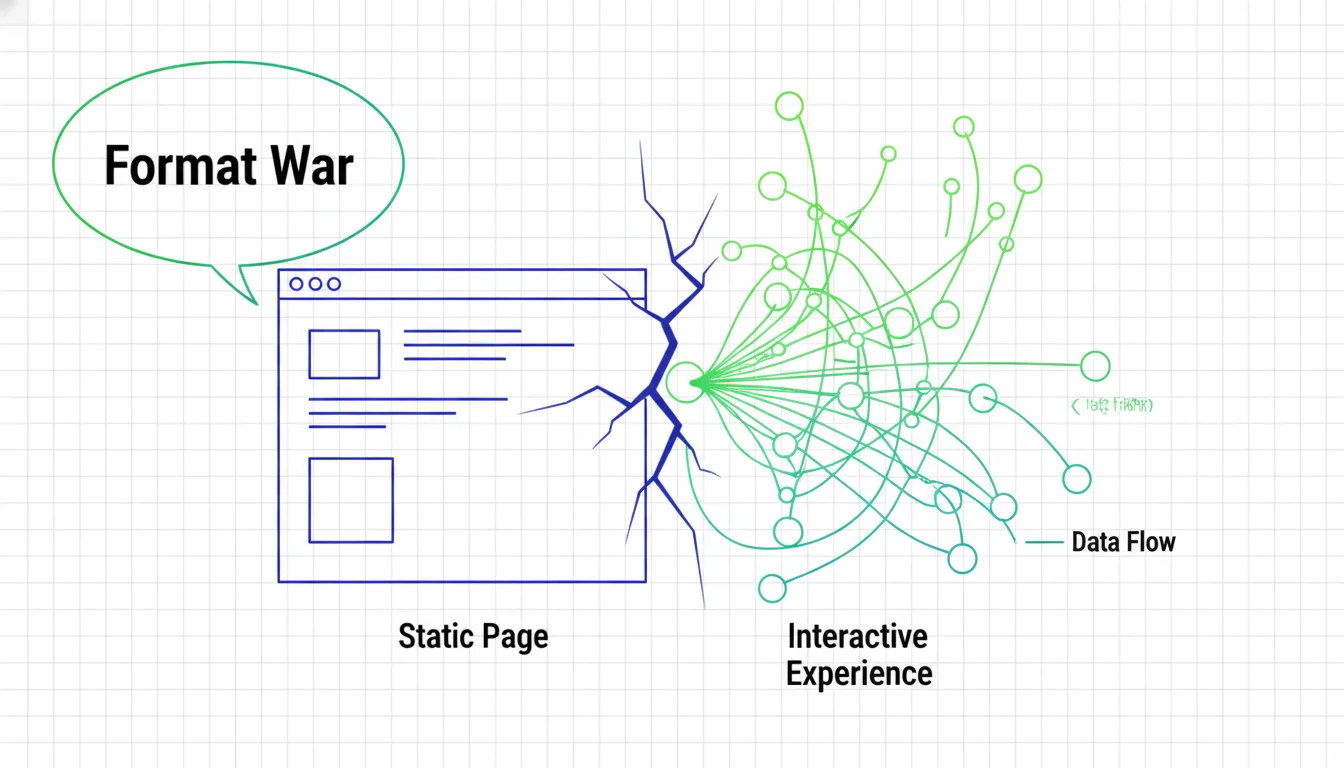
The week before Google I/O, I was debugging an infographic prompt. The pipeline generates two infographics per article — one conceptual, one comparative — and I was trying to get the Gemini image model to stop cramming text into corners where nobody could read it. Pixel-level optimization for a static PNG that would live on a static page that Google would hopefully index and surface in image search results.
Then I watched the keynote. And the thing I was optimizing for suddenly felt like polishing brass on a sinking ship.
Not because the ship is actually sinking — I don’t know that yet. But because Google just showed a version of search where the engine builds its own visuals, its own layouts, its own interactive experiences. On the fly. Personalized to the query. In a format that no static webpage — no matter how well-optimized — can compete with on its own terms.
Here’s what I need to say upfront: I run Best AI Web, an AI content site that we built over the past six months. Four AI personas write the articles, each with a distinct voice. There’s claim verification, editorial review, structured planning. We’re transparent about the AI generation — it’s disclosed in footers, editorial standards, schema markup. We believe honesty about what the content is matters more than pretending a human wrote every word.
The site has been indexed without issues. About a third of the planned content is live. We’re adding slowly because each batch teaches us something we didn’t anticipate.
I’m also a former copywriter who learned SEO by building WordPress sites for years until the patterns started clicking. So when I say the I/O demo rattled something, it’s not theoretical. I was literally mid-sprint on AEO optimization when the rules shifted under my feet.
The shrinking half-life of content strategy
Twenty years of “write good content, get ranked, earn clicks.” That was the deal. It was simple enough that you could build a career around understanding it.
Then featured snippets arrived, and Google started answering questions without requiring a click. The deal changed: structure your content so the machine can extract a clean answer. You still got cited. You adapted. Answer engine optimization became a discipline — learn what the machine wants, give it that, earn your position.
Now Google demonstrated something different in kind: AI Mode doesn’t extract answers from your page. It constructs its own. It generates interactive visualizations, dynamic layouts, complete experiences — all assembled in real time for a specific query. The student in the demo asked about black holes and got a manipulable 3D visualization. Asked a follow-up about gravitational waves and the interface rebuilt itself on the spot.
The exact words from the stage:
Search can build you the ideal format exactly for your question, completely custom, on the fly. We’re talking dynamic layouts, interactive widgets, entire experiences, all created just for you. This is agentic coding at the scale of search.
Each era of search has been shorter than the last. Each one redefined what “being visible” means. And each one caught people who were still optimizing for the previous era.
Why this one feels different
I’ve sat through enough Google announcements to know that stage demos overpromise. NotebookLM can generate podcasts, mindmaps, and presentations from uploaded sources — and the quality is uneven. Building a good infographic from a well-scoped document is a solved problem. Building one from the entire web, on the fly, at demo quality? That’s a claim I’d like to see at scale before I believe it.
But the direction matters more than the first version’s quality. Google isn’t trying to send you better traffic. It’s trying to render the experience itself. Even a mediocre first release signals where the investment is going. And Google doesn’t invest at this scale to produce something mediocre for long.
For our pipeline specifically, this hits the most vulnerable spot. We generate explainers — “how does attention work,” “what are state space models,” “how do RAG pipelines process queries.” These are precisely the kinds of conceptual breakdowns that a generative UI could construct interactively, in 3D, personalized to the user’s level of understanding. Our static Markdown articles can’t do that. No static page can.
The experience I was building for
Let me be specific about what was in my head the week before the keynote.
I was learning query fan-out patterns — the way modern AI search engines decompose a user query into 5-8 sub-queries, fetch answers from different sources, and synthesize them into a unified response. I was structuring articles so each section could be independently cited by these sub-queries. I was optimizing schema markup so the machine understood not just what a page said, but what kind of thing it was — an explainer, a comparison, a how-to.
This is text-based AEO. It has rules you can learn. You structure clearly, lead with the answer, mark up your content, earn citations. It’s demanding but legible.
Visual AEO — the ability to influence what generated visual appears for a query — doesn’t exist. And it might never exist in a form creators can shape. When Google constructs an interactive explainer, it synthesizes information from thousands of sources and renders something none of them created. There’s no markup tag for “generate this visualization from my data.” There might never be one.
The pipeline I built was designed for a world where the machine needed my words to construct its answers. That assumption is now conditional. Maybe it still holds for another year. Maybe two. But the direction is visible.
First-party data as the last asymmetry
There’s a comforting answer to all of this: lean into what AI can’t fabricate. Your specific data. Your actual costs. Your process documentation. Your mistakes and what you learned from them.
It’s true. Google can’t generate the fact that our pipeline averages $1.43 per article on Sonnet, or that we iterated infographic prompts five times to get the right background texture, line weights, and color palette before the output stopped looking like a PowerPoint from 2014. These are things only I can source because only I did the work.
But there’s a catch nobody likes to say out loud: first-party experience only matters if someone searches for it. “How does attention work” has millions of searchers. “What was it like building a Claude Skill for a Hugo content pipeline” has maybe a dozen. Your experience is unique, but uniqueness and demand are different things.
You end up with a defensible position around a small castle. The question — the one I genuinely don’t know the answer to — is whether that castle grows in value as everything around it gets commoditized, or whether it just gets quieter.
A four-quadrant map of what I think is happening
Losing discovery value: Generic concept explainers. “What is RAG?”, “How does a transformer work?” Google will answer these with or without your page. If your entire strategy is ranking for these queries, you’re optimizing for an era that’s ending.
Still defensible for now: Evaluation and comparison content. “RAG vs. fine-tuning for enterprise search” — this requires specific constraints, infrastructure context, cost tradeoffs that Google can approximate but not personalize without your data. AEO still works here. The “for now” is load-bearing.
Growing in relative value: Process documentation and experience-based writing. Not because the writing is getting better, but because everything around it is getting commoditized. When any explanation can be generated, the only scarce explanation is the one that required doing the thing. The process is the proof the machine can’t fabricate.
Genuinely unknown:
- Will Google cite sources for generated visuals, or will attribution disappear entirely?
- Does generative UI handle complex technical topics, or is it limited to accessible, educational demos?
- Is there a way to influence what gets generated — a kind of visual AEO — or is the system closed?
- How does the real product compare to the stage demo?
Summer 2026 will answer these. Anything I write before then is a bet, not an analysis.
What I’m actually doing about it
I don’t have a strategy. I have adjustments.
The pipeline keeps running. We’re still generating articles, still verifying claims, still publishing. But the mix is shifting. More process documentation. More “here’s what we tried and what broke.” More specificity about real costs, real decisions, real tradeoffs. Less “here’s how concept X works” — not zero, but less.
We’re designing new pipelines for specific roles — Java backend developers moving into AI, data scientists evaluating deployment options. These are mid-funnel, context-heavy, harder for a generative UI to construct because they require knowing the reader’s stack, constraints, and career context. That’s the bet: go deeper into specificity, not wider into coverage.
And I’m watching the launch closely. When AI Mode with generative UI rolls out, I’ll test our key queries. What does Google build? Does it cite? Is the quality real? Those answers are worth more than any prediction I could write now.
One pattern has held through every Google shift I’ve lived through — Panda, featured snippets, AI overviews. The content that survived each transition had something Google couldn’t replicate at the time. In 2012, quality. In 2020, structure. In 2026, I think it’s the specific, documented experience of having built the thing.
The web has survived every prediction of its death. It will probably survive this one too — reshaped, serving different functions, maybe smaller in some ways and more valuable in others. The builders who keep building through the uncertainty will be the ones who figure out what shape it takes.
I’d rather be adjusting a live pipeline than theorizing about what to build from scratch. Even if some of what I’m adjusting turns out to be unnecessary. The alternative — waiting until the ground settles — assumes the ground will settle. I’m not counting on that anymore.
First-hand experience from a human editor, written with AI assistance. Part of our Fifth Element series. Editorial Standards · Our Editors