GitLab Duo, GitHub Agentic Workflows, and the Self-Healing Pipeline Race in 2026
TL;DR
- The shift: CI/CD vendors stopped automating test runs and started automating the fix — agents now read failure logs, find the bug, and open a PR.
- Why it matters: Pipeline triage was a human bottleneck. That bottleneck is being designed out, tier by tier.
- What’s next: The fight moves from “who runs your tests fastest” to “who repairs your build without you.”
For a decade, your Continuous Integration pipeline did exactly one thing when it broke: it stopped, turned red, and waited for a human. Someone opened the logs. Someone guessed at the root cause. Someone pushed a fix and prayed.
That model is being dismantled right now — not by a startup, but by the three platforms that already own your build.
The Pipeline Stopped Waiting for You
Thesis: AI in CI/CD Pipelines just crossed from automation that runs your work to automation that repairs it — and the major platforms made that bet simultaneously.
This is not another AI feature bolted onto a dashboard. It is a change in what a pipeline is for.
The old promise of Continuous Deployment was speed: commit, test, ship. The new promise is recovery. When the build fails, an agent reads the logs, isolates the file and line, and proposes the patch — the loop that defines Self Healing Pipelines.
Three vendors converging on the same capability inside a single release window is not a coincidence. It is a market deciding where the next margin lives.
Three Vendors, One Bet
The evidence isn’t a roadmap promise. It’s shipping code.
GitLab put it in the platform. GitLab Duo ships a Fix CI/CD Pipeline flow that analyzes failure logs, pinpoints the offending file and line, and opens a merge request with the fix — triggered straight from the pipeline or MR view. It went generally available in GitLab 18.8, and a free tier backed by GitLab Credits landed in GitLab 18.10, per GitLab Docs.
GitHub went one level deeper — into the orchestration layer itself. GitHub Agentic Workflows entered technical preview on February 13, 2026, letting teams define agents as Markdown files inside .github/workflows/ and run them via a gh aw CLI, according to the GitHub Blog. The same format runs across Copilot CLI, Claude, Gemini, and OpenAI Codex. Alongside it, the GitHub Copilot coding agent edits files, runs terminal commands like npm install and pytest, and iterates autonomously, the GitHub Docs confirm.
CircleCI attacked the test layer. Its Smarter Testing combines test impact analysis, dynamic splitting, and auto-rerun for up to 4x faster test runs (CircleCI Blog) — the only firm vendor performance number in this race. Its newer Chunk capability analyzes test history, flags flaky tests with root cause, and opens fix PRs, though it remains in beta.
Underneath all of it sits Test Prioritization: tools like Launchable use ML to predict and run the most relevant tests first, per CircleCI Docs.
Different entry points. Same destination: the pipeline that fixes itself.
Who Moves Up
The platforms that already hold your repository win first. GitLab, GitHub, and CircleCI don’t need to acquire your trust — they own your build history, and that history is the training signal for every agent they ship.
Teams disciplined about Pipeline As Code win next. Agents reason far better against declarative, version-controlled config than against a pile of hand-clicked UI settings. Your clean pipeline definition just became an AI asset.
Predictive test selection vendors move up too. Once an agent is fixing builds, the value of running the right tests first — and of solving Flaky Test Detection before it poisons the signal — compounds.
You’re either feeding these agents structured, well-instrumented pipelines, or you’re handing them noise and expecting miracles.
Who Gets Left Behind
Manual triage as a workflow is the first casualty. The model where a senior engineer is the designated “build whisperer” doesn’t scale against agents that read every log in seconds.
Teams running undocumented, brittle pipelines lose the most. An agent can’t repair what it can’t parse. Flaky tests, hard-coded UI config, and missing history turn auto-fix into auto-confusion.
There’s a cost trap, too. GitHub Copilot moves all plans to usage-based, token-metered billing on June 1, 2026, per the GitHub Blog — days after this writing. The same Code LLMs that fix your build now meter every fix. Teams that adopt agentic auto-repair without tracking token spend may trade a triage problem for a budget one.
The strategy that just became obsolete: treating CI/CD as a fixed cost you configure once and forget.
What Happens Next
Base case (most likely): Agentic auto-fix becomes a standard pipeline tier across GitLab, GitHub, and CircleCI within the next few release cycles. Human review stays mandatory — the agent proposes, you approve. Signal to watch: GitLab’s Fix Pipeline flow graduating its free tier broadly, and GitHub Agentic Workflows exiting technical preview. Timeline: Within 6–12 months.
Bull case: Deployment Risk Assessment fuses with auto-fix — agents not only repair failures but predict and block risky deploys before they break. Signal: Vendors shipping risk-scoring as a default gate, not an add-on. Timeline: 12–18 months.
Bear case: Security incidents from over-permissioned agents force a retreat to human-in-the-loop everywhere, slowing adoption. GitHub itself flags that Agentic Workflows are in early development and demand careful security review and supervision. Signal: A high-profile breach traced to an agent with write access to production pipelines. Timeline: Possible within 12 months.
Frequently Asked Questions
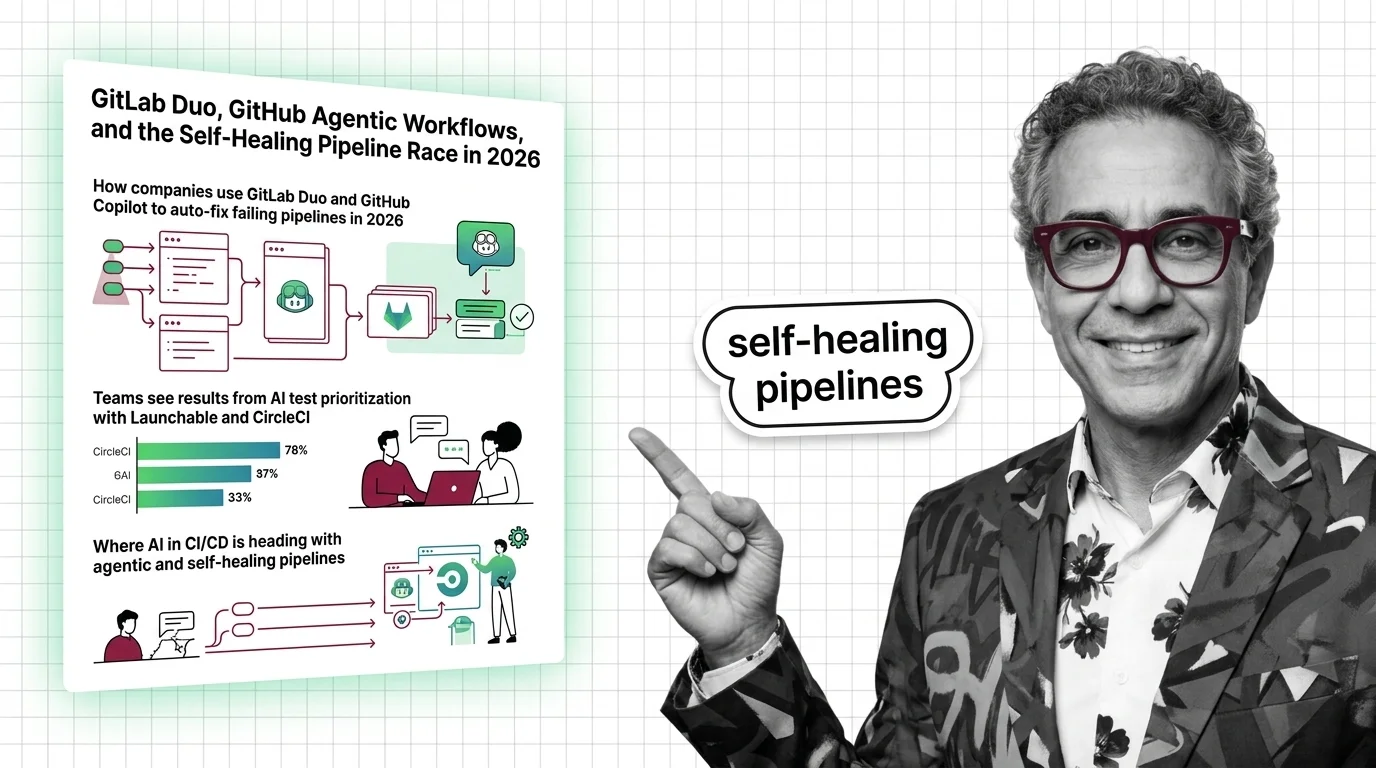
Q: How are companies using GitLab Duo and GitHub Copilot to auto-fix failing pipelines in 2026? A: GitLab Duo’s Fix Pipeline flow reads failure logs, locates the file and line, and opens a merge request with the patch. GitHub’s Copilot coding agent edits files and runs commands like pytest autonomously, iterating until the build passes.
Q: What results have teams seen from AI test prioritization with Launchable and CircleCI? A: CircleCI reports Smarter Testing delivers up to 4x faster test runs through impact analysis and dynamic splitting. Launchable uses ML to run the most relevant tests first. Beyond CircleCI’s 4x figure, vendor-verified ROI percentages remain scarce — treat broader claims cautiously.
Q: Where is AI in CI/CD heading in 2026 with agentic and self-healing pipelines? A: Toward continuous AI layered on top of existing CI/CD, not replacing it. Agents diagnose failures, fix flaky tests, and open PRs while humans approve. Expect risk assessment and auto-fix to merge as the next competitive frontier.
The Bottom Line
The race is no longer about who runs your pipeline fastest — it’s about who repairs it without you. GitLab, GitHub, and CircleCI all placed the same bet inside one release window, which tells you the direction is set. Watch the free-tier rollouts and the billing meter: both decide who can actually afford to let the pipeline heal itself.
AI-assisted content, human-reviewed. Images AI-generated. Editorial Standards · Our Editors