GigaGAN, Real-ESRGAN, and the Diffusion Rivalry: Where GANs Still Compete in 2026
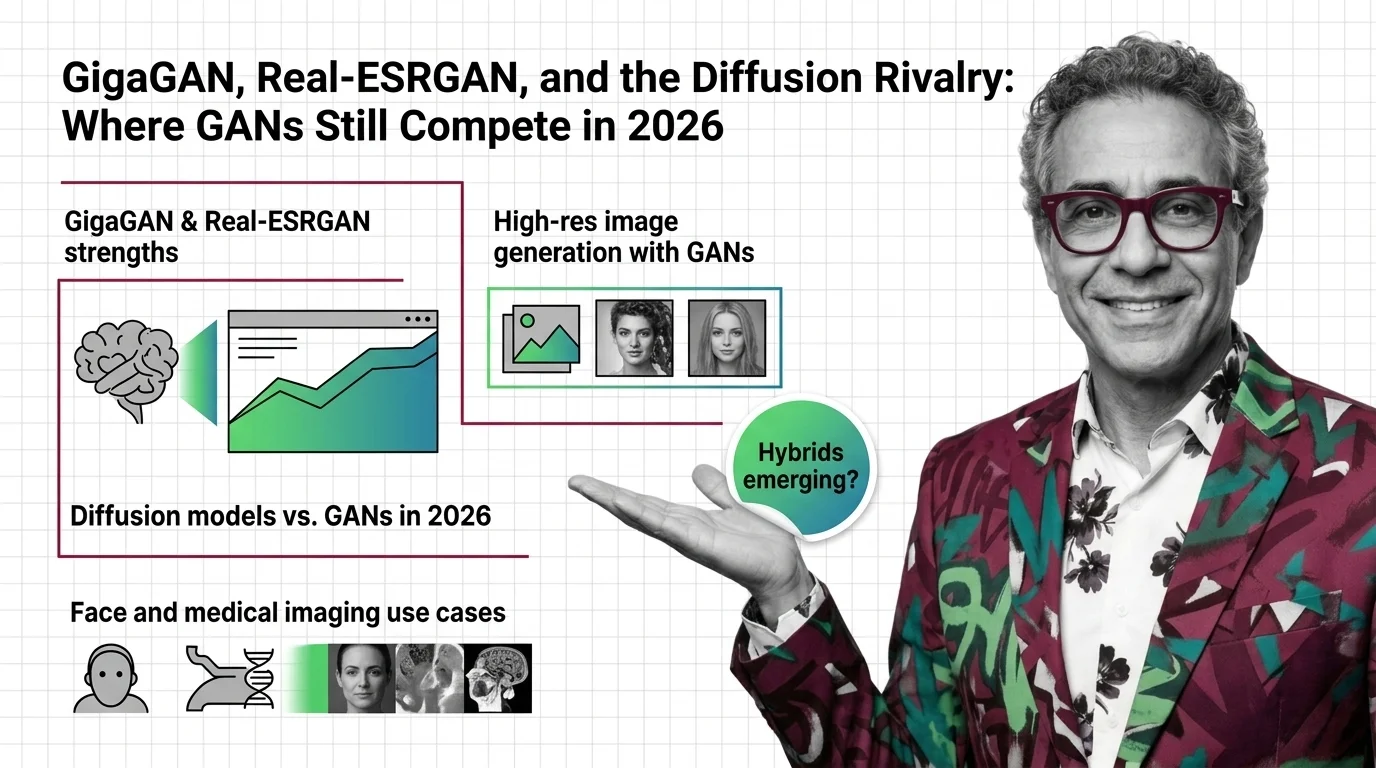
Table of Contents
TL;DR
- The shift: GANs didn’t die — they split from diffusion into speed-first niches that iterative denoising can’t serve.
- Why it matters: Real-time video, medical imaging, and production upscaling still run on adversarial architectures because latency decides.
- What’s next: Hybrid architectures like Diffusion-GAN point toward convergence, not replacement — the winner controls the integration layer.
Everyone wrote the obituary for Generative Adversarial Network models the moment diffusion started winning quality benchmarks. The Neural Network Basics for LLMs behind both architectures haven’t changed. The deployment economics have. GigaGAN generates 512px images in 0.13 seconds. R3GAN matches diffusion on standard metrics. The architecture everyone counted out just repositioned.
The Split Nobody Priced In
Thesis: The GAN-versus-diffusion contest didn’t produce a winner. It produced a market split — and the dividing line is latency.
GigaGAN — a 1B-parameter model from Adobe Research, CMU, and POSTECH — runs a Convolutional Neural Network-based generator that delivers 512px output in 0.13 seconds and 4K in 3.66 seconds (GigaGAN Project Page). Diffusion models doing the same work need dozens of denoising steps. The speed gap is roughly a hundred times, varying by architecture and resolution.
That’s not a quality delta teams can optimize around. It’s a physics problem.
R3GAN confirmed the other half at NeurIPS 2024. This modern GAN baseline surpassed StyleGAN2 on FFHQ, ImageNet, and CIFAR benchmarks (R3GAN Paper). The paper’s title was direct: “The GAN is dead; long live the GAN.”
Quality is no longer the argument against GANs. Speed was always the argument for them.
The split is structural.
Three Fronts Where GANs Still Hold
The evidence doesn’t organize by timeline. It organizes by application — and in each domain, the reason GANs persist is the same.
Super-Resolution
Real-ESRGAN remains the most deployed open-source upscaling model — x4plus, x2plus, anime-optimized variants, tile inference, and video support in one package (Real-ESRGAN GitHub). But its last release shipped over eighteen months ago. Newer architectures with attention-based enhancements like AESRGAN are already posting stronger benchmark numbers.
Real-ESRGAN is dominant by install base. Not by capability. The crown is moving.
Medical Imaging
GANs drive data augmentation for rare disease imaging — generating synthetic MRI scans where real patient data is scarce or privacy-restricted. Pix2Pix, SPADE GAN, and WGAN variants have been evaluated across cardiac, brain, and abdominal datasets (Taylor & Francis, 2026).
This remains research-stage. Clinical deployment requires regulatory clearance. But where patient data can’t be shared, GANs fill the gap.
Real-Time Generation
Gaming engines, robotics pipelines, and live video processing operate under hard latency budgets. Iterative denoising doesn’t fit. GANs do.
VideoGigaGAN demonstrated 8x video super-resolution with temporal consistency last year, addressing resolution challenges that Recurrent Neural Network-based approaches struggle with at scale (VideoGigaGAN Project Page). It’s a research prototype, not production tooling. But the direction is set.
Who Gains Ground
Teams building latency-critical pipelines. If your application runs inside a real-time loop — game rendering, endoscopy analysis, edge video upscaling — GANs are not legacy. They’re the architecture that ships.
Researchers bridging the GAN-diffusion boundary. Diffusion-GAN showed that training GANs with diffusion-based instance noise improves both stability and output quality (Diffusion-GAN Paper). Hybrid architectures are the signal — not one replacing the other, but both merging.
Medical imaging teams using synthetic data to train models they couldn’t build with real patient data alone.
Who Falls Behind
Anyone still dependent on Stylegan without a migration plan. StyleGAN3 hasn’t been updated in nearly five years. The community shifted to derivatives — StyleGAN-XL for ImageNet-scale generation, StyleGAN-T for text conditioning — and increasingly to R3GAN as the modern baseline.
Teams waiting for GigaGAN’s official weights. Adobe never released them publicly. Community reproductions exist but remain unofficial. Building a production pipeline on weights that don’t exist is not a strategy.
Anyone treating GAN-versus-diffusion as binary. The market already answered: both survive. The question is which runs where — and whether your stack handles the handoff.
What Happens Next
Base case (most likely): GANs consolidate into speed-critical niches while diffusion dominates creative generation. Hybrid architectures grow but stay research-heavy through 2026. Signal to watch: A major cloud provider ships a hybrid GAN-diffusion pipeline as a managed service. Timeline: Within 18 months.
Bull case: Modern GAN training and hybrid approaches close the quality gap enough that GANs reclaim text-to-image share in latency-sensitive segments. Signal: An open-weights GAN matches current diffusion benchmarks while holding sub-second inference. Timeline: 18-24 months.
Bear case: Diffusion distillation pushes inference below one second, eliminating GANs’ core advantage. Signal: Diffusion-based models deployed in production gaming engines. Timeline: Within a year.
Frequently Asked Questions
Q: How is StyleGAN used in real-world face generation and creative applications? A: StyleGAN3 powered face generation, style transfer, and creative tools through its alias-free architecture. It hasn’t been updated in nearly five years. Derivatives like StyleGAN-XL and the newer R3GAN baseline now carry that research forward.
Q: How are GANs used in medical imaging and healthcare data augmentation? A: GANs generate synthetic MRI and CT scans for training diagnostic models where real patient data is scarce or privacy-restricted. Adoption remains at research stage — clinical deployment still requires regulatory clearance.
Q: Are diffusion models replacing GANs or are hybrid architectures emerging in 2026? A: Both. Diffusion dominates flexible creative generation. GANs dominate speed-critical pipelines. Hybrid approaches like Diffusion-GAN combine the strengths — training GANs with diffusion noise for better quality without sacrificing inference speed.
The Bottom Line
GANs didn’t lose the war. They ceded territory they never needed and fortified the ground that matters: speed, real-time processing, and synthetic data under constraints.
The dividing line is latency. Pick your side accordingly.
Disclaimer
This article discusses financial topics for educational purposes only. It does not constitute financial advice. Consult a qualified financial advisor before making investment decisions.
AI-assisted content, human-reviewed. Images AI-generated. Editorial Standards · Our Editors