Generative Media APIs in 2026: fal.ai's $400M ARR Surge and the Multi-Provider Shift
TL;DR
- The shift: Image and video generation APIs are consolidating around usage-based pricing and provider-agnostic routing, not single-model loyalty.
- Why it matters: A revenue surge on one side and a major provider’s API cuts on the other are the same signal — single-vendor lock-in just became a liability.
- What’s next: Generative Media APIs keep fragmenting across more aggregators, more routing layers, and falling per-output prices.
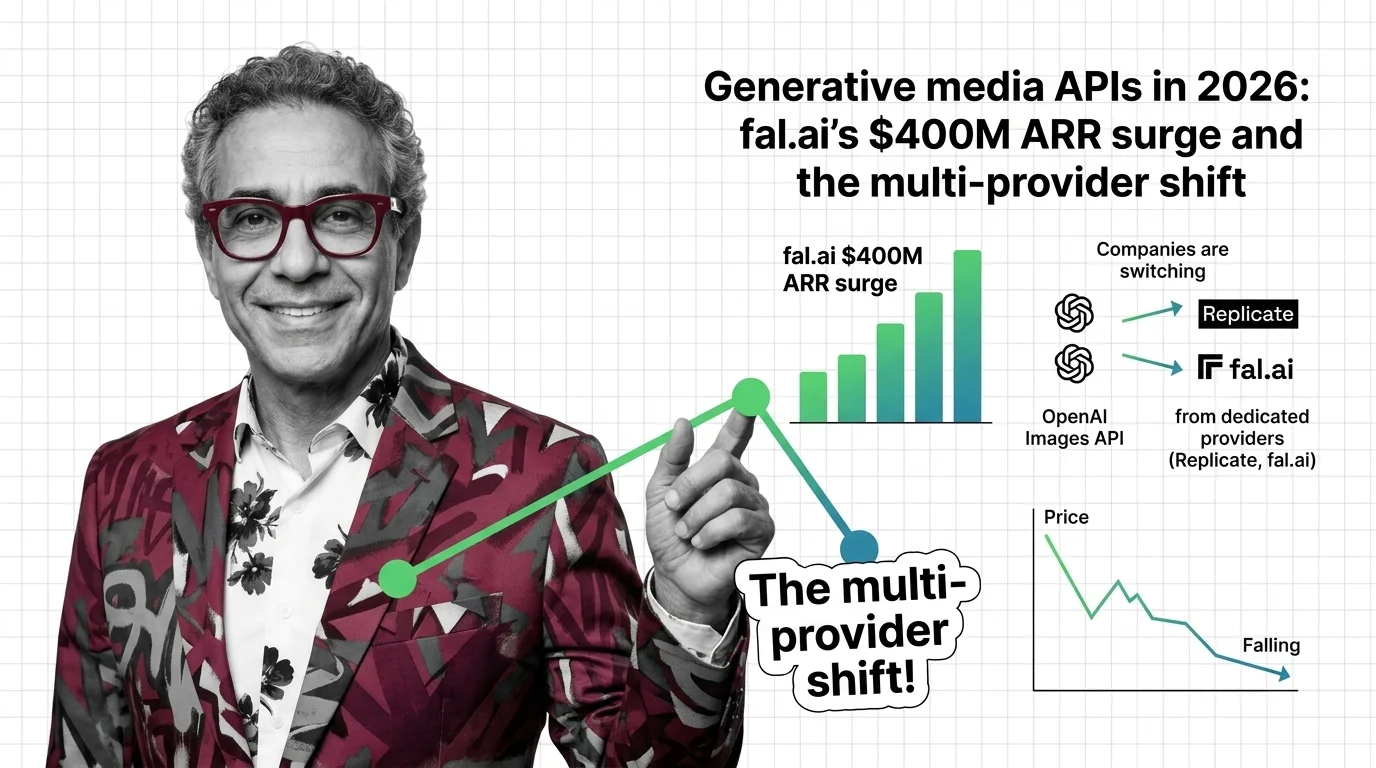
In just over a year, Fal AI went from a $25M-a-year API most developers had never heard of to a reported $400M run rate by February 2026, backed by Sequoia at a $4.5B valuation.
In the same window, OpenAI quietly removed the DALL-E endpoints that countless integrations were still calling. Those two facts are the same story.
fal.ai’s Revenue Curve Is the Whole Market’s Story
Thesis: The generative media API market stopped being a contest between models and turned into a contest between infrastructure layers — and fal.ai’s revenue curve is the clearest proof of it.
fal.ai doesn’t train its own image or video models. It runs everyone else’s, charging by the GPU-second and by the output — a thin-margin business on paper.
The infrastructure layer is now the product, not the model underneath it. The revenue says the bet worked.
That pattern holds everywhere a model provider tries to lock developers into one stack: build the routing layer, and the model underneath becomes interchangeable. That’s Multi Provider Abstraction in practice, not theory.
You’re either building on a routing layer, or you’re betting the whole stack on one vendor’s roadmap.
This isn’t a one-quarter spike. It’s a market redrawing how it buys compute for image and video generation — and the evidence backs it up.
GPU-Seconds Are Funding This, Not Model Loyalty
fal.ai’s growth didn’t happen on hype.
According to TechCrunch, annualized revenue moved from roughly $25M at the end of 2024 to about $285M by the end of 2025, then to a reported $400M by February 2026. That figure comes from press and analyst reporting, not fal.ai’s own disclosure — treat it as reported, not confirmed.
The funding followed the revenue.
fal.ai’s own blog confirms a $140M Series D led by Sequoia, with Kleiner Perkins and NVIDIA participating, on a team of 70 people. That round tripled the company’s valuation to $4.5B last December, up from $1.5B mid-year.
The plumbing is mundane, and that’s the point: submit a job, poll or wait on a Webhook callback, retrieve a hosted output URL. Most providers run some version of that loop.
The differentiation isn’t the API shape — price, breadth, and reliability decide who wins.
Together AI runs the same playbook from a different angle: its docs list FLUX, Google’s image models, GPT Image 1.5, and Ideogram, all on one bill, none of them its own model. That’s an aggregator’s economics, not a model lab’s.
fal.ai, Replicate, and the Multi-Provider Premium
The winners share one trait: none of them are betting the business on a single model staying competitive forever.
Replicate joined Cloudflare last fall. Its blog is explicit that the API and pricing stayed the same — what changed is the infrastructure underneath it, now backed by a much larger network.
That’s a company trading independence for staying power, and it kept its brand intact while doing it.
Together AI wins by never picking a side. One bill, several vendors’ models, and a hedge against any single provider’s roadmap going sideways.
And fal.ai wins by being the default answer to “which provider do I call first.” A reported $400M run-rate doesn’t happen by being a backup option.
Portability has become the premium feature, not an afterthought bolted onto a pricing page.
OpenAI’s API Cuts Are Forcing a Reckoning
OpenAI’s own Images API tells the other half of the story.
GPT Image 2 is the current flagship, priced from a few tenths of a cent per image up past twenty cents depending on quality and resolution, per OpenAI’s documentation. But the legacy line underneath it is being shut down.
Teams that built deep on DALL-E don’t get to keep ignoring that. Single-vendor lock-in just became measurably more expensive than the alternative.
Single-vendor integrations are either getting rebuilt for portability now, or they’re next in line for a deprecation notice.
Stability AI sits in a tougher spot, running its own model family through Stability API with credit-based pricing while squeezed between aggregators undercutting it on breadth and frontier labs outspending it on quality. Being a single-model provider is no longer a neutral choice — it’s a structural disadvantage.
One correction worth making: Fireworks AI gets lumped into “new generative-media entrant” headlines alongside Together AI, but that framing doesn’t hold up. Its image generation is minimal and it ships no video at all, per WaveSpeed Blog’s review — an LLM-inference company that bolted on image support, not a media-API competitor.
API & compatibility notes:
- OpenAI Images API: DALL-E 2 and DALL-E 3 were fully removed from the API on May 12, 2026. GPT Image 1 is deprecating on October 23, 2026. Any integration still calling DALL-E, or planning around GPT Image 1 long-term, needs to migrate to GPT Image 2 now.
- fal.ai runner-state API: The platform added a new IDLE state to its job-status responses. Integrations polling runner status programmatically should confirm they handle it correctly.
What Happens Next
Base case (most likely): Multi-provider routing keeps spreading. More platforms add generative media as a line item rather than a standalone product, and GPU-second pricing keeps compressing costs as competition widens. Signal to watch: Whether more single-model providers fold into aggregator platforms instead of competing head-on. Timeline: Over the next two to three quarters.
Bull case: fal.ai closes a much larger follow-on round — Dealroom reports talks near an $8B valuation, unconfirmed as of writing — and the GPU-second, multi-model playbook becomes the default infrastructure layer industry-wide. Signal: An official close announcement from fal.ai itself, not just press reporting. Timeline: Within the year.
Bear case: A frontier lab tightens its ecosystem enough on price or exclusive features to pull developers back toward single-vendor stacks. Or compute costs rise and squeeze the margins under per-second pricing. Signal: A major aggregator raising prices instead of cutting them. Timeline: Within two to three quarters, if it’s happening.
Frequently Asked Questions
Q: How did fal.ai reach $400M in ARR powering image and video generation apps in 2026? A: fal.ai’s revenue grew from about $25M in late 2024 to a reported $400M by February 2026 (TechCrunch), driven by GPU-second and per-output pricing that scales directly with the image and video traffic developers route through it.
Q: Which companies are switching from OpenAI’s Images API to dedicated providers like Replicate or fal.ai? A: No public list exists, but the forcing function is clear: OpenAI fully removed DALL-E 2 and DALL-E 3 from its API in May 2026, pushing any team still calling those endpoints toward migration. fal.ai and Replicate are the two providers picking up that traffic.
Q: Will generative media API prices keep falling as Together AI and Fireworks AI enter the market in 2026? A: Together AI fits this trend — it now bundles FLUX, Google’s image models, GPT Image 1.5, and Ideogram on one bill, which pressures prices. Fireworks AI doesn’t: its image generation is minimal and it offers no video at all, so it isn’t a true competitor here yet.
The Bottom Line
fal.ai’s climb from $25M to a reported $400M in ARR is the clearest data point yet that GPU-second pricing and provider-agnostic routing have become the default architecture for generative media. The providers building for portability are absorbing the migration traffic; the ones still selling a single model are explaining deprecation timelines instead. That split is the market now.
AI-assisted content, human-reviewed. Images AI-generated. Editorial Standards · Our Editors