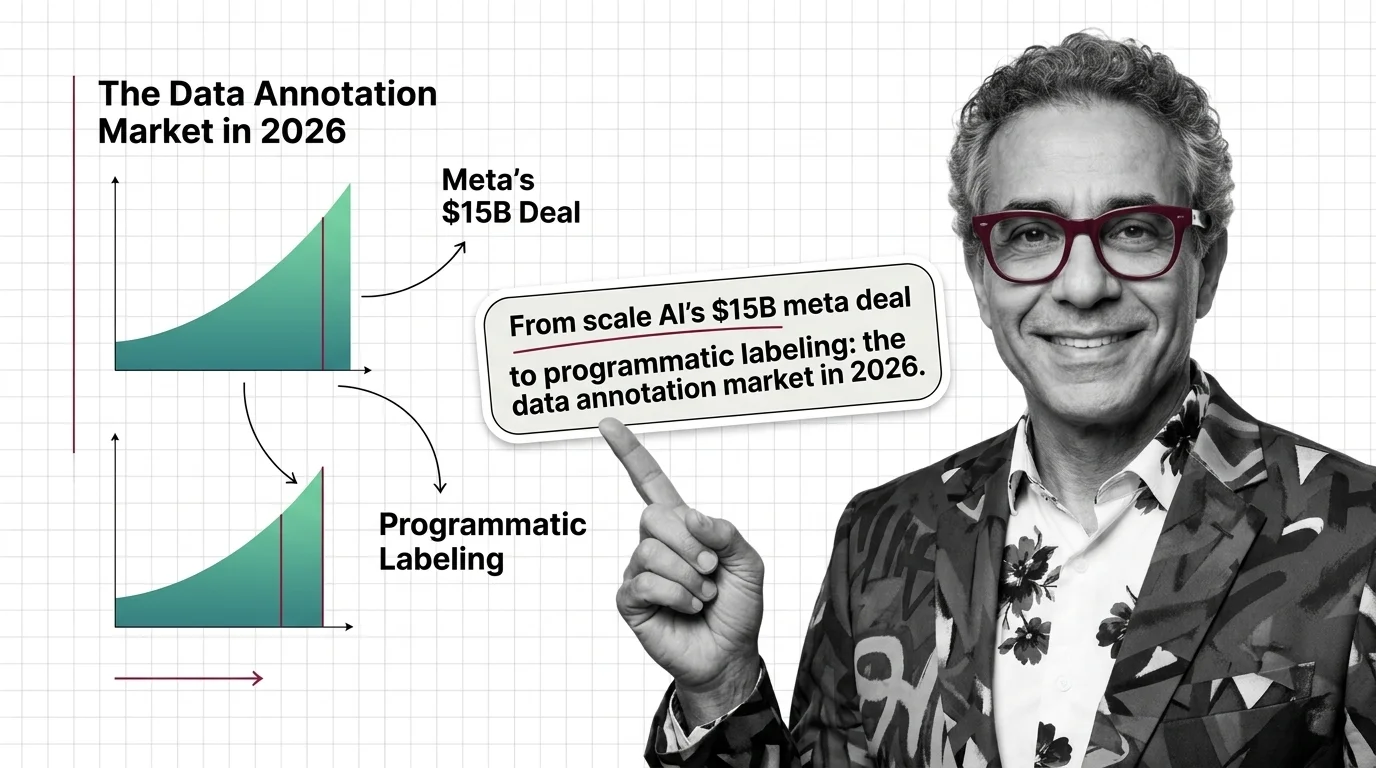
From Scale AI's $15B Meta Deal to Programmatic Labeling: The Data Annotation Market in 2026
TL;DR
- The shift: One investment turned the data-labeling market’s biggest incumbent into a conflict of interest, and the customers walked.
- Why it matters: Training data is the supply chain for every frontier model, and that supply chain just fragmented across rivals and automation.
- What’s next: The labor-heavy labeling model is giving way to programmatic, AI-assisted pipelines that need fewer hands and more engineering.
A single check rearranged an entire market. When Meta took a near-half stake in the company that labeled the data for half the industry’s models, the other half of the industry stopped being customers and started being competitors-in-waiting. What looked like an acquisition headline was actually a supply-chain rupture. The companies that move Data Labeling And Annotation from a service you buy to a system you build are the ones who win the next eighteen months.
The Annotation Market Just Got Repriced Overnight
Thesis: Meta’s deal did not buy Scale AI a future — it broke the neutrality that made Scale the market’s default vendor, and the market is restructuring around the gap.
In June 2025, Meta took a roughly 49% stake in Scale AI for about $14.3 billion — reported widely as “nearly $15 billion,” according to Axios. The deal pushed Scale’s valuation past $29 billion, per the Washington Post.
That is not a product update. That is a market restructuring.
Here is the problem the headline buried. Scale’s value was its position as the Switzerland of training data — every lab could send it work without fear. The moment Meta owned half of it, that neutrality evaporated. Scale’s founder Alexandr Wang left to run Meta’s superintelligence lab, with Jason Droege stepping in as CEO, according to TechCrunch.
When your data vendor reports to your fiercest competitor, you don’t renegotiate. You leave.
Follow the Customers, Not the Headline
The evidence is in the exits, not the announcement.
TechCrunch reported that OpenAI, Google, and xAI pulled back from Scale over access and neutrality concerns — claims sourced to insiders, not confirmed by the companies themselves. CNBC reported separately that Google, described as Scale’s largest customer, planned to split after the deal.
Then came the contraction. In July 2025, one month after the investment landed, Scale laid off about 200 employees — roughly 14% of staff — plus an estimated 500 contractors, and collapsed 16 internal pods into five focus areas, according to Tom’s Hardware. The company began pivoting toward public-sector work.
Read those moves together. A market leader does not shed 14% of its workforce a month after a record raise unless its demand base is walking out the door. The layoffs were not a cost tweak. They were the first visible crack from the customer exodus.
Quality is the quiet casualty here. When labs scramble to re-source labeling, the consistency that Inter Annotator Agreement measures and the reliability of every Ground Truth dataset is what wobbles first. Disruption at the vendor layer is disruption to Training Data Quality downstream.
Who Caught the Overflow
The displaced demand had to land somewhere. It landed on the rivals who were ready.
Surge AI, a premium-talent specialist that took no venture money, reported ARR climbing to about $1.4 billion by August 2025, up from roughly $1.2 billion at the end of 2024, according to Sacra. It is reportedly in talks to raise at a valuation between $15 billion and $25 billion — talks, not a closed round.
Mercor moved faster still. Computerworld reported its valuation jumped from $2 billion in early 2025 to around $10 billion by a late-2025 Series C, winning work that once flowed to Scale.
The windfall spread wider. Computerworld noted Labelbox booked “hundreds of millions” in new revenue and Handshake said demand “tripled overnight” as labs redistributed contracts and pulled labeling in-house.
If you sell trustworthy, neutral labeling at scale, the past year was the best demand environment of your life. You’re either capturing that overflow now or watching a competitor lock in the contracts you’ll spend two years trying to win back.
Who’s Running Last Year’s Playbook
The losers share a pattern: they bet the business on human headcount as the moat.
Pure labor-arbitrage labeling — rooms of annotators billing by the task — is the model under pressure. It scales linearly with cost, and the market just learned how fragile a single-vendor, manual supply chain can be.
That is exactly the gap programmatic labeling fills. Snorkel AI, spun out of the Stanford AI Lab in 2019, built its platform on Weak Supervision — generating training labels from rules and heuristics instead of hand-tagging every example. It raised a $100 million Series D at a $1.3 billion valuation in 2025, bringing total funding to $237 million, according to the Snorkel AI Blog.
The mechanics matter for why this is structural. Weak supervision plus Active Learning — where the model flags the examples most worth a human’s attention — and Data Deduplication to strip redundant samples means teams label smarter, not harder. Mordor Intelligence pegs the AI data-labeling market near $2.3–2.8 billion in 2026 inside a broader annotation market around $4.59 billion, with human-in-the-loop and semi-supervised approaches growing at a roughly 33% CAGR and about 64% of enterprises adopting automated labeling.
Anyone treating annotation as a pure staffing problem is optimizing for a game that is already ending.
Compatibility note — Snorkel SDK v25.5: A breaking change moves imports from
snorkelflow.*tosnorkelai.sdk.*. Predictive ML use cases are not transferable across the boundary and require a fresh install. Pin and migrate deliberately before upgrading.
What Happens Next
Base case (most likely): The market settles into a multi-vendor norm — labs split labeling across Surge, Mercor, Labelbox, and in-house teams while programmatic tooling absorbs the high-volume, low-ambiguity work. Signal to watch: A second major lab publicly confirming a multi-vendor labeling strategy. Timeline: Through 2026.
Bull case: Programmatic and AI-assisted labeling compress costs fast enough that mid-size teams build frontier-grade datasets without armies of annotators. Signal: Enterprise automated-labeling adoption climbing well past the current ~64%. Timeline: 12–24 months.
Bear case: Rushed re-sourcing degrades label quality, and a wave of models ships on noisier ground-truth data before anyone notices. Signal: Public benchmark regressions traced back to annotation pipelines. Timeline: Within a year.
Frequently Asked Questions
Q: How did Meta’s $15B Scale AI deal reshape the data labeling market? A: Meta’s roughly $14.3 billion stake cost Scale AI its neutrality. Rival labs including OpenAI, Google, and xAI pulled back, per TechCrunch, and demand flowed to Surge, Mercor, Labelbox, and Handshake — fragmenting a once-concentrated market.
Q: How are companies using Snorkel programmatic labeling and weak supervision in real projects? A: Teams use Snorkel’s weak supervision to generate labels from rules and heuristics instead of hand-tagging, then apply active learning to route only ambiguous cases to humans. It cuts manual effort on high-volume, repetitive labeling work.
Q: What is the future of data labeling and annotation in 2026 as AI-assisted labeling grows? A: The labor-heavy model is giving way to programmatic, human-in-the-loop pipelines. Mordor Intelligence reports semi-supervised approaches growing near 33% CAGR with about 64% of enterprises adopting automated labeling — fewer annotators, more engineering.
The Bottom Line
The Meta-Scale deal didn’t just move one company — it taught the market that a single-vendor training-data supply chain is a liability. The advantage now belongs to whoever pairs neutral, quality labeling with programmatic automation. Watch which labs lock in multi-vendor strategies first.
AI-assisted content, human-reviewed. Images AI-generated. Editorial Standards · Our Editors