From ResNet Skip Connections to AblationMage: How Component Analysis Evolved into Automated Methodology by 2026
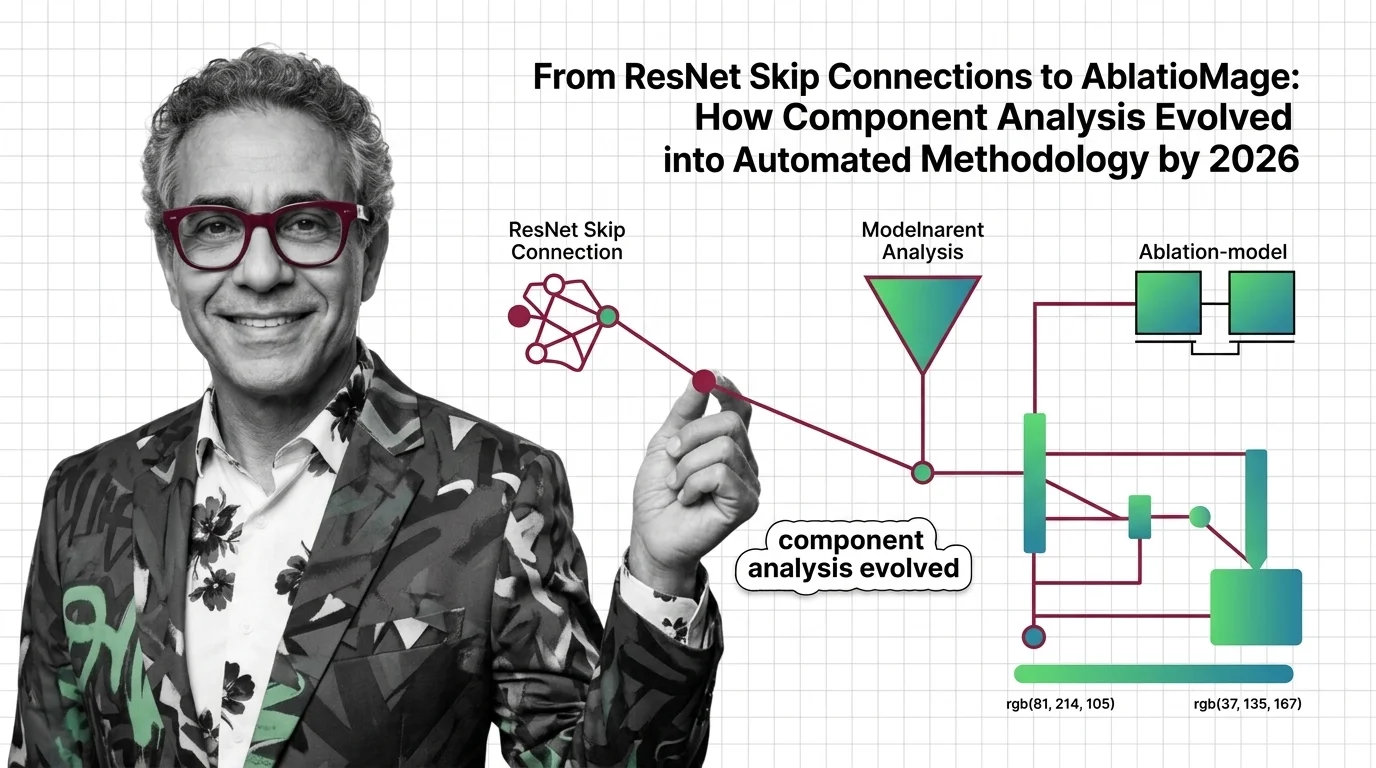
Table of Contents
TL;DR
- The shift: The dissection method behind every major AI architecture is being automated by the same LLMs it helped build
- Why it matters: LLM-assisted tools now run ablation experiments autonomously, but catch only about 38% of what human researchers design
- What’s next: The gap between automated and human ablation planning defines who scales ML research — and who stalls
The method that proved skip connections work, that multi-head attention matters, and that dropout earns its keep — the Ablation Study — is no longer a researcher’s manual craft. It’s becoming an automated pipeline. And the tools doing the automating were built on findings that manual ablation produced.
That loop just closed. Most of the field hasn’t noticed.
The Proof-by-Subtraction Method That Built Every Architecture You Use
Thesis: Ablation studies created the evidence base for modern AI, and LLM-driven automation is turning the method into a scalable service — with a gap that reveals where machine intelligence still falls short.
The concept predates deep learning by decades. Allen Newell introduced ablation to AI in the 1970s, borrowing from neuroscience: remove a component, measure the damage, the delta tells you what that component was doing.
For most of AI’s history, this stayed manual. A researcher would strip a layer, a Regularization technique, or a training parameter — run experiments against a Baseline Model, verify Statistical Significance, and publish. The entire process depended on the researcher knowing which components to test.
That constraint shaped what got studied. And what got ignored.
Two Papers That Proved Subtraction Beats Intuition
ResNet rewrote the rules in 2015. He et al. ran ablations showing a 56-layer plain network performed worse than a 20-layer one — the degradation problem. Skip connections fixed it. The 152-layer ensemble hit 3.57% top-5 error on ImageNet, winning ILSVRC 2015 (He et al.).
Without ablation, the degradation problem stays invisible. The fix never gets built.
Two years later, Vaswani et al. set the standard with “Attention Is All You Need.” Table 3 is a masterclass in Model Evaluation through removal. Reducing eight attention heads to one dropped BLEU from 25.8 to 24.9. Removing dropout cost more than a full BLEU point. Swapping sinusoidal for learned positional encoding barely moved the score — 25.7 versus 25.8 (Vaswani et al.).
Ablation decided what became standard. Multi-head attention survived because subtraction proved it mattered. Learned positional encoding didn’t become default because subtraction showed it was expendable.
The pattern across both papers: the biggest architectural decisions in AI aren’t made by adding features. They’re made by removing them.
Automation Arrives — And Hits a Ceiling
The manual bottleneck was obvious. Running ablation experiments is expensive, and choosing what to ablate requires domain expertise that doesn’t scale.
Two waves of automation attacked the problem.
First wave: rule-based parallelism. AutoAblation, published at EuroMLSys ‘21, introduced parallel ablation on the Hopsworks/Maggy platform. It sped up the compute. It didn’t solve the harder problem — deciding what to ablate.
Second wave: LLMs enter the loop. AblationMage, presented at EuroMLSys ‘25, uses explicit code markers and natural-language hints to let an LLM generate executable ablation code plus trial instructions (Sheikholeslami et al.). It’s a research prototype, not a production system. But it proves LLMs can read a codebase and propose ablation plans.
Then Karpathy shipped AutoResearch in March 2026 — 630 lines of Python, autonomous ML experiments on a single GPU. Primary use case: ablation. Roughly 12 experiments per hour. One published result: 700 experiments in two days, yielding 20 optimizations and an 11% training speedup (MarkTechPost). Within a month — 66.8K GitHub stars.
You can automate the execution. You can’t yet automate the judgment.
The benchmarks confirm it. AbGen tested LLMs against 2,000 expert-annotated ablation examples from 677 NLP papers — LLMs significantly underperformed humans on importance, faithfulness, and soundness (Yale NLP). AblationBench found the best language model recovers only about 38% of the ablations human researchers designed (AblationBench authors).
A 62% gap between machine and human ablation planning. That’s a capability boundary — not a tuning problem.
Who Moves Up
Small teams with limited compute. AutoResearch runs on a single GPU — a solo researcher can now execute hundreds of ablation experiments that once required a lab. If your workflow still relies on manual Hyperparameter Tuning, automated ablation cuts the iteration cycle from weeks to days.
Framework builders who integrate ablation into reproducible pipelines. Automated Reproducibility — experiments any team can rerun and verify — is the prize. The way unit testing changed software development, automated ablation is starting to change ML research.
Teams that build evaluation infrastructure around Precision, Recall, and F1 Score tracking and Confusion Matrix analysis across ablation variants. When you run hundreds of experiments, extracting actionable signal from the results is where the edge lives.
Who Gets Left Behind
Anyone trusting automation without verification. The 38% recovery rate means LLMs miss the majority of ablation designs that human experts consider important. Delegate ablation planning entirely to a tool, and you’re optimizing with blind spots.
Researchers who dismiss automation entirely. The field is developing evaluation approaches that account for Benchmark Contamination and demand large-scale systematic experimentation. Manual-only ablation cannot keep pace with the component count in modern architectures.
You’re either augmenting your ablation workflow or falling behind it.
What Happens Next
Base case (most likely): Automated ablation becomes standard for preliminary experiments. Humans design the critical ablation plans; tools handle exhaustive sweeps. Think automated testing versus test design. Signal to watch: A top ML conference accepts papers using LLM-generated ablation plans without human revision. Timeline: Late 2026 to mid-2027.
Bull case: Ablation tools close the gap to 60%+ recovery. AblationMage-style annotation integrates directly into experiment tracking platforms. Ablation becomes as routine as linting. Signal: AblationBench evaluations show recovery rates above 55%. Timeline: Mid-2027.
Bear case: The 38% ceiling holds. LLMs remain weak at identifying which components carry the most weight. Automated ablation stalls as convenience, not acceleration. Signal: Next-generation benchmarks show no meaningful improvement in recovery rates. Timeline: Visible by early 2027.
Frequently Asked Questions
Q: What are famous examples of ablation studies that changed AI research? A: ResNet’s 2015 ablation revealed the degradation problem and validated skip connections — shaping all subsequent deep network design. The transformer paper’s Table 3 proved multi-head attention’s value and showed learned positional encoding was expendable, decisions that defined the architecture era.
Q: How did the original transformer paper use ablation studies to validate design choices? A: Vaswani et al. systematically removed or modified components — attention heads, dropout, positional encoding — and measured BLEU score changes. Results proved multi-head attention was essential while learned positional encoding offered no advantage over the sinusoidal baseline.
Q: How is LLM-assisted ablation automation changing ML research workflows in 2026? A: Tools like AblationMage propose ablation plans from code annotations, and Karpathy’s AutoResearch runs roughly 12 experiments per hour on a single GPU. Automation handles exhaustive sweeps, but benchmarks show LLMs recover only about 38% of human-designed ablations — a wide planning gap.
The Bottom Line
The method that built modern AI is being automated by the AI it built. The tools are fast, accessible, and scaling. But the 62% gap between what machines ablate and what humans design is the clearest signal of where research still demands human judgment. Close that gap, and you’ve automated research design itself. Miss it, and you’ve built a fast machine for asking the wrong questions.
Disclaimer
This article is for educational purposes only and does not constitute professional advice. Consult qualified professionals for decisions in your specific situation.
AI-assisted content, human-reviewed. Images AI-generated. Editorial Standards · Our Editors