From Nightshade to Constant-Sample Attacks: Real Data Poisoning Cases and the 2026 Threat Shift
TL;DR
- The shift: data poisoning threats expanded in two directions simultaneously — the volume assumption for LLMs collapsed, and entirely new attack surfaces opened in RAG pipelines and MCP servers.
- Why it matters: teams fine-tuning models or deploying RAG without provenance controls are operating on a threat model that no longer reflects reality.
- What’s next: expect poisoning defenses to move from research libraries into production infrastructure requirements.
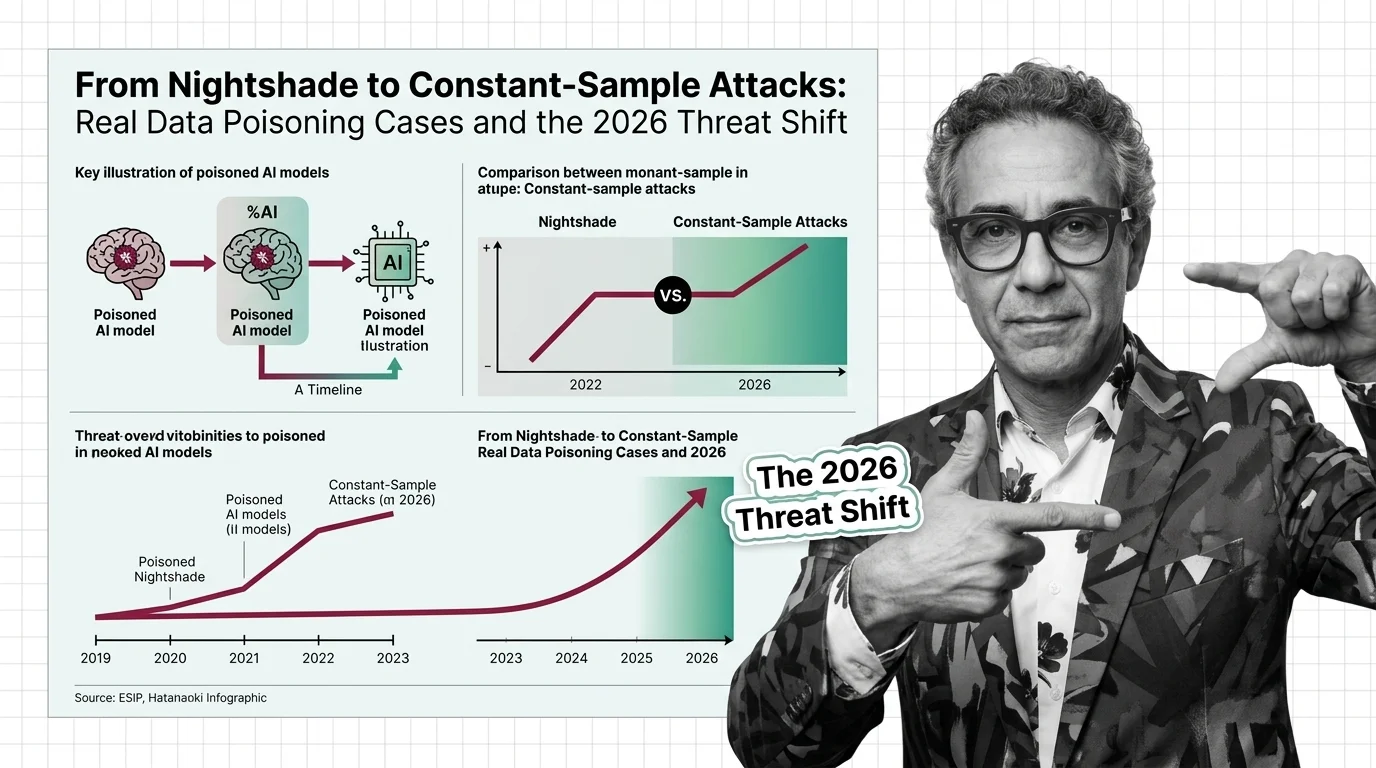
The assumption was that Data Poisoning required scale. Flood training data with enough corrupted examples and eventually the model breaks. That assumption is gone.
A paper published in October 2025 showed that 250 poisoned documents are enough to compromise an LLM — across every model size and dataset size tested. At the same time, artists shipped a tool that corrupts image diffusion models with fewer than 100 examples. And a new class of attack emerged that doesn’t touch training data at all.
Three fronts. One conclusion: the threat model changed.
The Scale Assumption Is Gone
A team led by Alexandra Souly, Javier Rando, and Nicholas Carlini published “Poisoning Attacks on LLMs Require a Near-constant Number of Poison Samples” (Arxiv 2510.07192) in October 2025. The result: 250 poisoned documents is enough, regardless of model or dataset size.
They tested models from 600M to 13B parameters. They tested datasets from 6B to 260B training tokens — chinchilla-optimal ranges. The number of poisoned samples required to compromise the model stayed constant across all of it.
That’s the structural shift. Teams building on large datasets assumed volume was protection. It isn’t.
This applies specifically to LLMs — text models. Image diffusion models are a different attack surface with different mechanics, described below.
Three Attack Patterns, All Active
The evidence isn’t theoretical. Three distinct poisoning patterns are operating in 2025-2026.
Pattern one: artist-deployed poisoning. Nightshade reached 2.5 million downloads since January 2024, per MIT Technology Review. Companion tool Glaze crossed 8.5 million downloads since March 2023. Both tools come from the SAND Lab at the University of Chicago, led by Professor Ben Zhao.
Nightshade modifies images at the pixel level — invisible to humans, destructive to training. Fewer than 100 poisoned images can corrupt a target prompt in Stable Diffusion SDXL, per the Nightshade Paper. Poisoning one concept spreads to semantically related concepts: “fantasy art” corruption bleeds to “dragon” and “Michael Whelan.” The pixel modifications survive cropping, compression, screenshotting, and editing, per TechCrunch.
Compatibility note:
- Nightshade v1.1 (April 2026): Fixes a Windows Nvidia “TRUE” driver bug and Apple Silicon GPU issues present in earlier versions. Artists on older versions should update via nightshade.cs.uchicago.edu.
Pattern two: fine-tuning pipeline attacks. In early 2026, a reported incident involved hidden prompts embedded in GitHub code comments that poisoned DeepSeek DeepThink-R1 fine-tuning, per Lakera AI Blog. The attack, called Basilisk Venom, didn’t require access to model weights — only the fine-tuning dataset.
This class of attack exploits a gap most ML teams haven’t closed: provenance. Where did the training data come from? Who touched it? Was any of it sourced from adversarially controlled repositories?
A Nature Medicine study found that replacing 0.001% of medical LLM training tokens with misinformation produced 7–11% more harmful completions, as cited in Lakera AI Blog. That’s a trace contamination level. Most teams have no visibility into whether their data has been touched at that concentration.
Pattern three: inference-time surface attacks. RAG Poisoning extended the poisoning threat beyond training entirely. Separately, MCP server tooling became an attack vector: Lakera AI Blog reported a case where a “joke_teller” MCP tool contained invisible instructions in its description that redirected agent behavior. MCPTox benchmark testing across 1,300+ malicious cases on 45 real MCP servers found a 72% success rate on some agents, per Lakera AI Blog. These incidents are sourced from Lakera and have not been independently corroborated — treat them as reported signals, not confirmed incidents.
The Backdoor Attack pattern that once required weight-level access now has viable surface-level analogues.
The Defenders Who Gained Ground
Security teams that built data provenance as infrastructure — not aspiration — are ahead.
Adversarial Robustness Toolbox reached version 1.20.1 in July 2025, now under the Linux Foundation AI & Data umbrella after originating at IBM Research. ART covers 55+ attack methods and 30+ defense mechanisms across evasion, poisoning, extraction, and inference attacks. Teams running ART-based detection pipelines have the tooling to surface the patterns described above — the organizations that haven’t deployed it yet are running blind.
Artists using Nightshade and Glaze represent a different kind of adaptation: the first non-technical cohort to deploy offensive poisoning as a rights defense. They’re not trying to stop scraping — they’re making scraped data costly to use.
Organizations treating data provenance as a production requirement — cryptographic dataset hashing, signed data lineage, automated Data Leakage detection — are building the infrastructure that will matter at scale. Early movers here are building institutional muscle memory that a competitor can’t acquire in a single hiring sprint.
Where the Exposure Sits
Teams fine-tuning foundation models without auditing their Clean Label Attack and Label Flipping exposure are operating blind. The constant-sample finding means a targeted campaign can undermine a model regardless of total dataset size. Volume is no longer protection.
Dataset Bias and Class Imbalance create natural leverage points. A small manipulation of underrepresented class labels can reshape model behavior with minimal intervention.
RAG deployments without input validation are an open attack surface. Every document that enters a retrieval pipeline is a potential poisoning vector. Organizations that built RAG for internal knowledge without auditing who controls the upstream documents have exactly this exposure.
Developers building on MCP servers need to treat tool descriptions as adversarially controlled inputs — not trusted metadata. That isn’t how most MCP implementations were built. It needs to change.
What Happens Next
Base case (most likely): Provenance tooling moves into production ML pipelines as a standard requirement, not a security add-on. Fine-tuning workflows without cryptographic data lineage become a recognized liability.
Signal to watch: Enterprise ML platforms (Databricks, AWS SageMaker, Azure ML) ship provenance controls as default features, not optional integrations.
Timeline: 12–18 months.
Bull case: The constant-sample finding accelerates formal data auditing standards. ART becomes a required component of regulated AI deployments.
Signal: A major regulator — EU AI Act enforcement or US NIST — issues specific guidance requiring poisoning-resistance controls for high-risk AI systems.
Timeline: 18–24 months for formal standards; faster if a documented production incident occurs involving a widely used model.
Bear case: The attack surface expands faster than defensive tooling can track. MCP ecosystems and RAG pipelines become preferred vectors with no centralized detection infrastructure.
Signal: A supply chain poisoning incident affecting a widely used public fine-tune is confirmed by independent researchers, not just a vendor blog post.
Timeline: A credible incident at this scale is possible within 12 months given current attack sophistication.
Frequently Asked Questions
Q: What real-world data poisoning attacks have actually happened?
A: Confirmed: Nightshade artist defense poisoning at scale, the constant-sample LLM finding, and medical LLM token contamination (Nature Medicine, via Lakera). Reported by Lakera AI Blog but not independently corroborated: Basilisk Venom (DeepSeek fine-tuning, early 2026) and MCP server tool poisoning. Treat the Lakera-only items as unverified signals.
Q: Where is data poisoning research and defense heading in 2026?
A: Two tracks simultaneously. Offensive: minimum effective poisoning dose (constant-sample result) and inference-time surfaces like RAG and MCP servers. Defensive: provenance tooling, ART-based detection, and cryptographic dataset lineage moving into production ML workflows as baseline requirements, not optional security additions.
Q: How are artists using Nightshade to poison AI image training data?
A: Nightshade modifies image pixels invisibly to humans but destructively to training. Fewer than 100 modified images can corrupt a target prompt in image diffusion models. Poisoning spreads to semantically related concepts. It is free to download from SAND Lab. Version 1.1 (April 2026) is the current stable release fixing earlier driver compatibility issues.
The Bottom Line
The scale assumption that large training datasets were inherently hard to poison is gone. 250 documents is enough for LLMs. Fewer than 100 images is enough for diffusion models. And the attack surface now extends to inference pipelines that never touched training data at all.
You’re either building provenance into your ML stack now, or you’re discovering the gap after it matters.
AI-assisted content, human-reviewed. Images AI-generated. Editorial Standards · Our Editors