From Manual Prompts to Braintrust Loop: Prompt Engineering in Production and Where It Is Heading in 2026
TL;DR
- The shift: Artisanal prompt tweaking has been replaced by evaluation pipelines — automated scoring, version control, and CI quality gates are now the baseline.
- Why it matters: Teams without eval infrastructure are flying blind as model behavior shifts under their feet without warning.
- What’s next: Context engineering is absorbing prompt engineering, and the tooling gap between teams with formal pipelines and those without it is widening fast.
The question isn’t whether Prompt Engineering matters anymore. The question is whether your team is still doing it the way people did in 2023.
The companies setting the pace in production AI aren’t. They built infrastructure. They run evaluations continuously. They deploy new frontier models within hours of release because they can verify the output before it ships.
The teams still editing prompts by hand are optimizing a practice that the leading players already industrialized.
Prompt Engineering Didn’t Die. It Got Professionalized.
The craft became quality engineering, not creative writing.
The framing crystallized in June 2025. Andrej Karpathy coined the term Context Engineering — “the delicate art and science of filling the Context Window with just the right information for the next step” (X, Karpathy). Prompt engineering optimizes the question. Context engineering optimizes the full information ecosystem: System Prompts, retrieved knowledge, tool outputs, memory summaries — the entire configuration that determines what a model sees at inference time (LangChain Blog).
The distinction matters in production. Single-turn prompts were stateless. Agentic workflows are dynamic. They require reliable Instruction Following across dozens of tool calls, under load, with context that changes every step.
The skills that worked in 2023 don’t transfer cleanly to systems that behave differently with every model update. You need to measure what changes — which means you need an evaluation pipeline, not a better prompt.
Three Production Teams, One Convergent Pattern
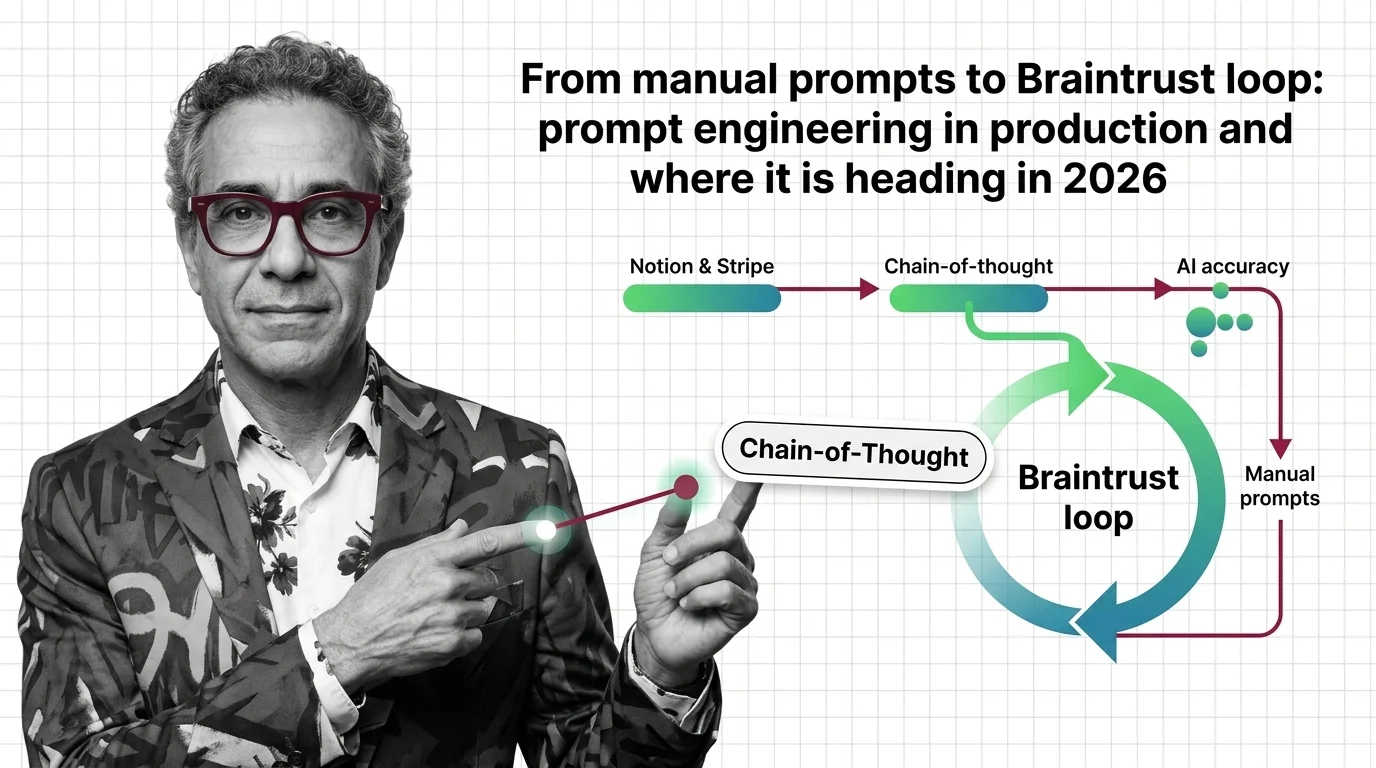
Notion runs 70+ engineers on a shared evaluation framework (Braintrust). Not one team. Not a dedicated QA function. Seventy engineers, shared infrastructure, running evaluations as a continuous process. They created a hybrid role — “AI Data Specialists” — combining QA engineering, prompt expertise, and product judgment. New frontier models deploy within hours of release (Notion Blog). That’s only possible with automated scoring, not manual review.
Stripe took a different approach to the same problem. They built a benchmark against 11 real integration tasks across three categories: backend-only, full-stack, and gym problem sets covering Checkout and subscriptions. At the time of the benchmark’s publication, Claude Opus 4.5 scored 92% across four full-stack API integration tasks (Stripe Blog). The harness uses a consistent toolset and MCP server to isolate model capability from tooling variance. That’s not a product demo. That’s an engineering evaluation discipline.
The convergence is the signal. Notion and Stripe didn’t coordinate. They hit the same wall independently and built the same type of infrastructure to solve it.
The chain-of-thought data adds nuance. CoT still delivers real gains for non-reasoning models — Gemini Flash 2.0 gained 13.5% and Sonnet 3.5 gained 11.7% on PhD-level benchmark questions in a 2025 study (Wharton GAIL). But applying CoT to reasoning models yields minimal to negative returns, adding 20-80% latency for near-zero benefit. The rule used to be “add CoT, get better results.” The rule is now “it depends — which means you need to test it.”
Zero-shot prompting still works for simple, well-defined tasks. The moment you move into complex multi-step workflows, you need evaluation data to know what’s actually happening.
The Platforms That Moved First
Braintrust closed an $80 million Series B in February 2026, led by ICONIQ Growth, at an $800 million post-money valuation (Braintrust Blog). Their production customer list includes Notion, Vercel, Replit, Cloudflare, Ramp, and Dropbox. The Loop agent — available on Pro+ plans — runs evaluations autonomously, generates test cases, and iterates on prompts without manual intervention. That’s Meta Prompting at production scale.
Coursera, another Braintrust customer, generated 45x more feedback using AI-assisted grading through the platform (Braintrust). That’s a different category of operation, not a marginal improvement.
Security & compatibility notes:
- Braintrust AWS breach (May 2026): Unauthorized access to Braintrust’s AWS account exposed org-level AI provider API keys across all customers. If your team uses Braintrust, rotate stored API keys immediately (TechCrunch).
- Braintrust SDK migration: Raw OTel attributes (
gen_ai.input.messages) moved to structured fields (input,output,metrics). SQL queries, automations, or dashboards reading raw attributes will break (Braintrust Docs).
LangChain shipped its first stable 1.0 release in late 2025. The production response has been migration, not celebration. Teams are actively rewriting from LangChain to raw SDKs — the monolithic package deprecated in favor of modular packages (Ravoid). They left because their requirements outgrew the abstraction. That’s a structural verdict, not a complaint about documentation.
The Manual-Prompt Playbook Is a Liability
Teams still relying on Role Prompting patterns and hand-crafted Structured Output templates as their primary AI strategy are running last year’s playbook against this year’s problems.
The failure mode is invisible until it isn’t. Model updates change behavior silently. Without evaluation infrastructure, you discover the regression in production — not in a CI gate. By then, it’s user reports, not pipeline warnings.
Security exposure compounds this. Prompt Leakage risks scale with system complexity. Production systems with elaborate prompt chains and no systematic testing are attack surface without armor. The Braintrust breach showed that evaluation infrastructure itself can become a vector.
You’re either running evaluations before you ship, or you’re finding out what’s wrong after.
What Happens Next
Base case (most likely): Evaluation-driven prompt management becomes a procurement baseline for enterprise AI systems within 12-18 months. Teams without eval infrastructure scramble to catch up as model update frequency increases. Signal to watch: Enterprise AI vendors start requiring evaluation attestation for procurement sign-off. Timeline: 12-18 months.
Bull case: Context engineering gets standardized tooling and formal training paths. The “AI Data Specialist” role gains a recognized certification track. Early movers build institutional muscle competitors can’t replicate with a single hiring sprint. Signal: Major cloud providers ship native evaluation frameworks integrated into their LLM APIs. Timeline: 18-24 months.
Bear case: Evaluation becomes a checkbox, not a discipline. Teams generate vanity eval metrics — high benchmark scores that don’t reflect production conditions. The gap between benchmark performance and real-world instruction following widens. Signal: Public incidents where AI systems that “passed evaluation” fail at scale in production. Timeline: Already starting.
Frequently Asked Questions
Q: How are companies like Notion and Stripe using prompt engineering in production AI systems? A: Notion runs 70+ engineers on a shared evaluation framework, deploying new frontier models within hours of release using automated scoring and LLM-as-a-judge pipelines. Stripe built a benchmark against 11 real integration tasks to measure model capability against actual production conditions, not synthetic tests.
Q: What are real-world examples of chain-of-thought prompting improving AI accuracy on complex tasks? A: A 2025 Wharton study found CoT lifted Gemini Flash 2.0 by 13.5% and Sonnet 3.5 by 11.7% on PhD-level GPQA Diamond questions (Wharton GAIL). Foundational Google Research showed CoT taking PaLM 540B from 17.7% to 58.1% on GSM8K math problems. Gains are real — but only for non-reasoning models on genuinely complex tasks.
Q: Is prompt engineering a dying skill in 2026 or is it becoming more critical as models scale? A: The standalone “write better prompts” skill is contracting. The broader discipline — evaluation-driven configuration, context architecture, and systematic testing — is growing. The standalone job title is fading; the underlying practice is being absorbed into engineering roles that didn’t exist two years ago.
The Bottom Line
The companies setting the pace aren’t writing better prompts. They’re running evaluation pipelines that catch regressions before they ship, version configurations like code, and deploy new models with confidence because they’ve measured what changed.
Teams treating prompting as a craft skill are fighting the right problem with the wrong tools.
The new baseline is an evaluation loop.
AI-assisted content, human-reviewed. Images AI-generated. Editorial Standards · Our Editors