From GPT-4 Pre-Launch to Frontier Model Audits: How AI Red Teaming Became Industry Standard by 2026
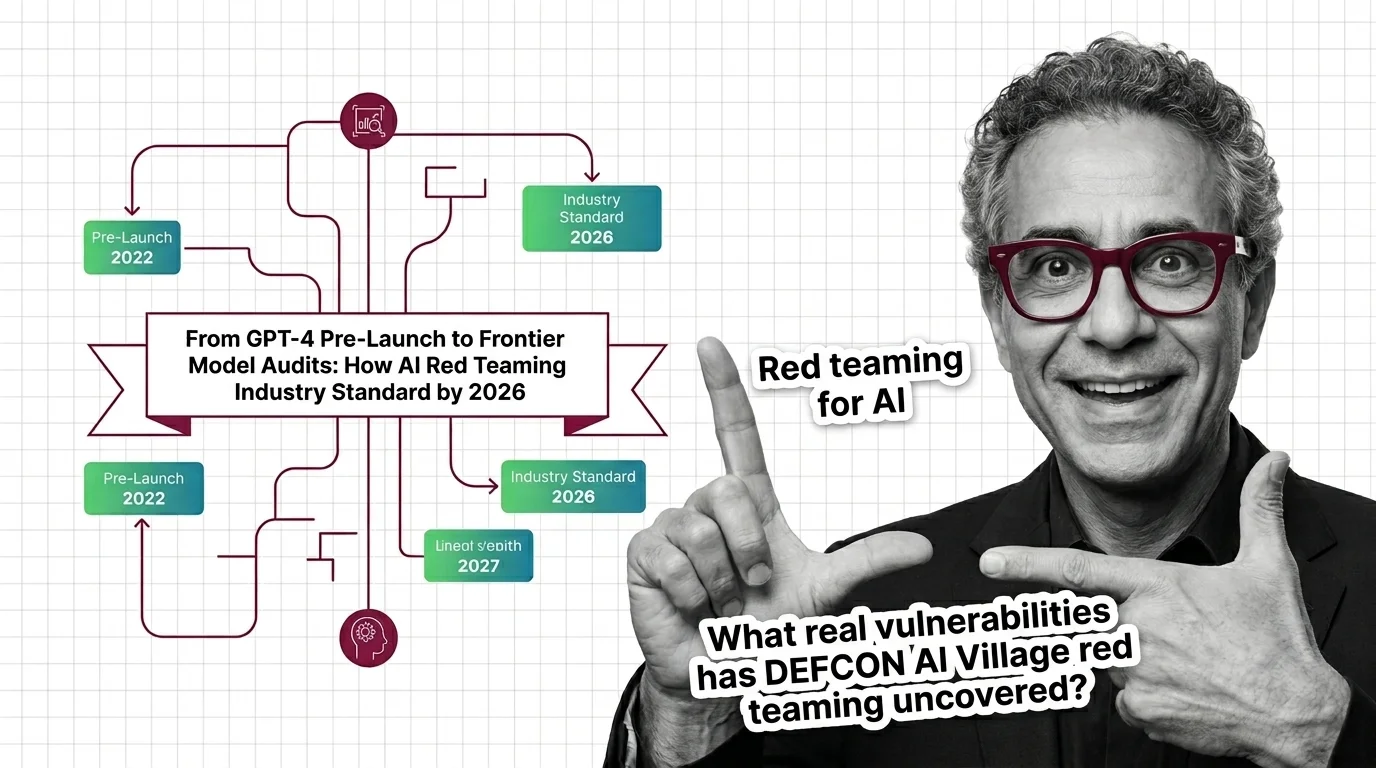
Table of Contents
TL;DR
- The shift: AI red teaming went from voluntary pre-launch experiment to federal procurement requirement in under three years
- Why it matters: The March 2026 deadline forces every AI vendor selling to government to produce red-team documentation — no results, no contract
- What’s next: Autonomous red-teaming tools are replacing manual expert audits, turning security testing from a one-time gate into a continuous process
Three years ago, OpenAI invited fifty security researchers to stress-test GPT-4 before launch. Voluntary. Experimental. No regulation required it. Today, federal agencies have until March 11, 2026 to demand red-team results from every AI vendor they buy from. The experiment became a compliance checkpoint.
The Fastest Compliance Arc in Tech History
Thesis: AI red teaming became a regulatory requirement faster than any comparable security discipline — and the companies that treated it as optional are now facing a procurement wall.
OpenAI’s pre-launch Red Teaming For AI effort for GPT-4 set the template. Over fifty domain experts — cybersecurity, biorisk, international security — each spent 10 to 40 hours probing the model over months (OpenAI Red Teaming Paper). That was early 2023. Pioneering. Voluntary.
It was also the last time “voluntary” applied.
Biden’s Executive Order 14110 in October 2023 required frontier model developers to share red-team results with the government before release. That order was rescinded in early 2025, but its replacement didn’t soften the requirement — it crystallized it. EO 14319 now requires federal agencies to request model cards, evaluation artifacts, and red-team results by March 11, 2026 (Promptfoo Blog).
California moved in parallel. SB 53 became the first state statute requiring transparency documentation for frontier AI, effective at the start of 2026.
Three forces converged: offensive AI capabilities accelerated, public incidents multiplied, and the government’s own AI procurement expanded. When the tools you’re buying can generate their own attack vectors, pre-deployment testing stops being optional.
The rules are still shifting. But the direction is locked.
The Attack Surface That Proved the Regulators Right
The threat frameworks tell the same story from the engineering side.
The Owasp LLM Top 10 released its 2025 edition with new entries for Vector and Embedding Weaknesses and System Prompt Leakage. Prompt Injection held the number one vulnerability slot — three years running (OWASP).
Mitre Atlas expanded to 15 tactics and 66 techniques. Its 2026 update added five agentic-specific entries: AI Service API abuse, Tool Credential Harvesting, Tool Data Poisoning, Agent Clickbait, and Data Destruction (Zenity Blog). The threat model shifted from “can you Jailbreak a chatbot” to “can you compromise an autonomous agent’s entire execution chain.”
DEF CON’s AI Village was the public proof of concept. Over 2,200 hacking sessions at DEF CON 31 targeted models from Anthropic, Google, OpenAI, and others. A year later, DEF CON 32 shifted from hunting isolated exploits to probing systemic flaws in open-weight models — structural weaknesses in safety alignment, not party tricks.
On the offensive side, AI-generated phishing outperformed human-crafted campaigns by 24% as of early 2025, with one model doubling its success rate in six months (Menlo Ventures).
The attacks scaled faster than the defenses.
Who’s Already Positioned
Companies that built red-teaming infrastructure before the deadline are now selling to everyone who didn’t.
Promptfoo — the open-source LLM red-teaming CLI covering 50+ vulnerability types — was acquired by OpenAI on March 16, 2026. It remains MIT-licensed, though long-term governance is uncertain. That acquisition tells you where the market values red-teaming capability.
The next wave is autonomous. Novee runs autonomous LLM pentesting built from its own vulnerability research. Votal AI deploys CART with RLHF-trained attackers. Zscaler expanded multi-modal testing across text, image, voice, and documents (Security Boulevard).
The difference matters. Annual penetration tests check a static snapshot. Continuous red-teaming catches the vulnerability that surfaces when you update a model, swap a tool, or change a system prompt. In agentic deployments, the attack surface shifts every time the toolchain changes.
Teams running continuous pipelines — not annual audits — are the ones positioned to meet rolling compliance.
Who’s Running Out of Time
Anyone treating Adversarial Attack testing as a one-time checkbox.
Static Guardrails without ongoing stress testing are a false sense of security. The agentic techniques in MITRE ATLAS target tool use, credential chains, and data integrity — layers most deployed systems have never tested. If your last security evaluation was a pre-launch check six months ago, your deployment has drifted past the boundary of what you verified.
Organizations without red-team documentation face a binary outcome: produce results before the deadline, or lose access to federal procurement.
That’s not a theoretical risk. That’s a calendar event.
What Happens Next
Base case (most likely): Autonomous red-teaming tools become standard CI/CD integrations by late 2026. Manual expert audits shift to frontier-only models. Mid-tier deployments rely on automated scanning. Signal to watch: A major cloud provider bundles red-teaming as a default service tier. Timeline: Q3-Q4 2026.
Bull case: EU conformity assessments adopt U.S.-style red-team requirements, creating a global compliance floor. Security vendors consolidate around a handful of dominant platforms. Signal: Cross-jurisdictional mutual recognition of red-team artifacts. Timeline: Mid-2027.
Bear case: The March 2026 deadline passes with weak enforcement. Companies produce minimal documentation. Hallucination risks and data poisoning incidents mount without systematic testing. Signal: A major government AI deployment fails publicly due to untested vulnerabilities. Timeline: Late 2026.
Frequently Asked Questions
Q: How did OpenAI red team GPT-4 before public release? A: OpenAI assembled over fifty domain experts across cybersecurity, biorisk, and international security. Each spent 10 to 40 hours probing the model over months, testing for harmful outputs, safety failures, and adversarial exploits before the public launch.
Q: What real vulnerabilities has DEFCON AI Village red teaming uncovered? A: DEF CON 31 ran over 2,200 hacking sessions across models from major AI labs. DEF CON 32 shifted from hunting isolated jailbreaks to probing systemic flaws in open-weight models, revealing structural weaknesses in safety alignment and output reliability.
Q: How is AI red teaming evolving in 2026 with multi-modal and autonomous testing? A: Autonomous tools now run continuous pentesting without human operators. Multi-modal testing covers text, image, voice, and document inputs simultaneously. Manual expert audits are shifting to frontier models only, while automated scanning handles production deployments.
The Bottom Line
Red teaming went from experiment to industry checkpoint in three years. The March 2026 deadline is the first enforcement moment — not the last.
You’re either building continuous testing infrastructure now, or you’re explaining to procurement why you don’t have results.
Disclaimer
This article discusses financial topics for educational purposes only. It does not constitute financial advice. Consult a qualified financial advisor before making investment decisions.
AI-assisted content, human-reviewed. Images AI-generated. Editorial Standards · Our Editors