From COMPAS to the EU AI Act: Fairness Metrics Reshaping AI Accountability in 2026
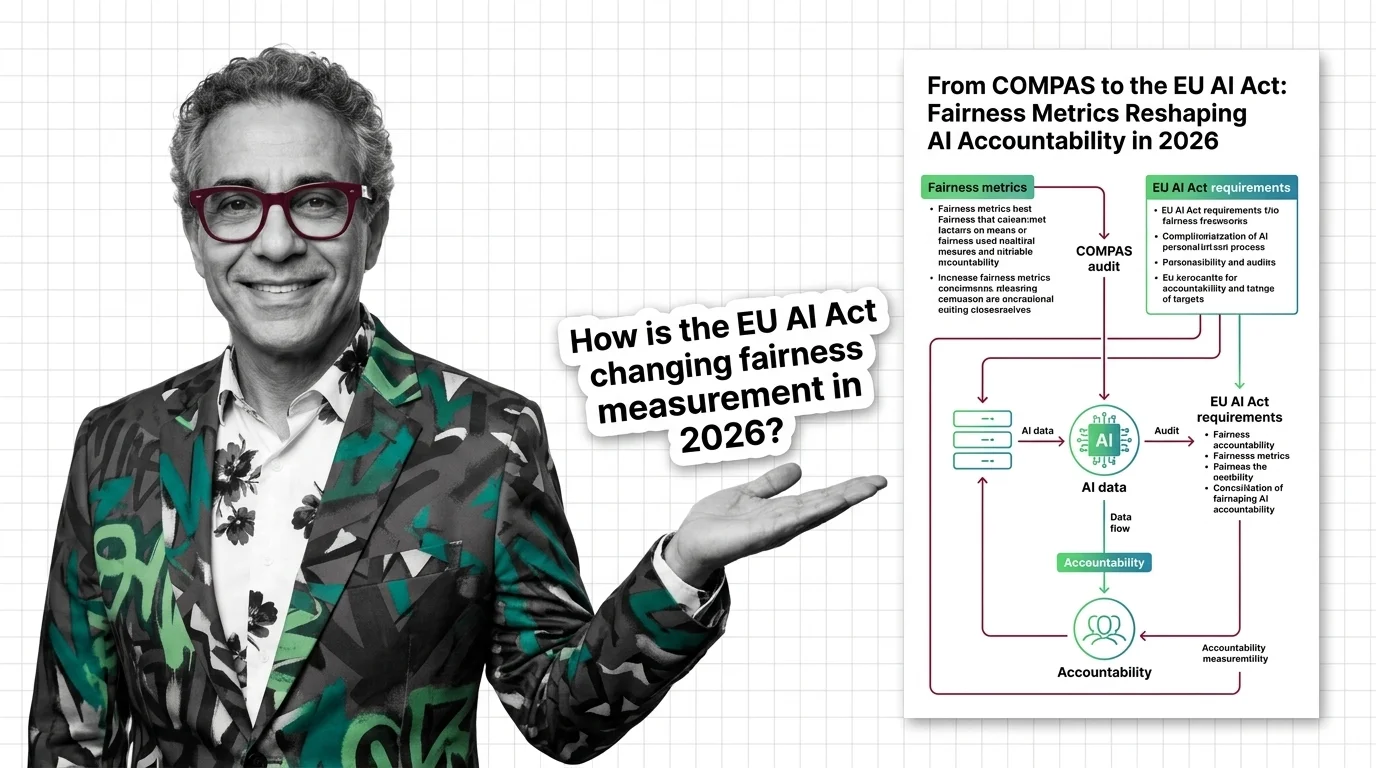
Table of Contents
TL;DR
- The shift: Fairness metrics have crossed from academic research into courtrooms and regulatory mandates — they now carry legal force.
- Why it matters: The EU AI Act’s high-risk rules take effect August 2026, and US bias lawsuits are already using metric failures as evidence.
- What’s next: Organizations deploying high-risk AI have a compliance deadline measured in months, not years.
Hallucination gets the headlines. Bias is what gets you sued. For a decade, Bias And Fairness Metrics lived in research papers — cited, discussed, safely ignored by anyone shipping production AI. That changed. Courtrooms and regulators picked up the same metrics and gave them teeth.
The Accountability Shift Nobody Priced In
Thesis: Fairness metrics are no longer diagnostic tools — they are legal evidence and regulatory requirements, and most organizations building AI are unprepared for either.
Three independent pressure vectors — litigation, regulation, and open-source tooling — converged in the same eighteen-month window. Each alone would change how companies build AI. Together, they redraw the accountability map.
The COMPAS recidivism algorithm was the warning shot. ProPublica’s 2016 analysis of over 7,000 defendants in Broward County, Florida, exposed a Confusion Matrix that told two different stories depending on race. A 44.9% false positive rate for Black defendants. A 23.5% false positive rate for White defendants (ProPublica). Overall accuracy: 61% for general recidivism — dropping to just 20% for violent crime predictions (ProPublica).
That study did more than expose a broken algorithm. It surfaced the Impossibility Theorem in practice: calibration and equal error rates cannot coexist across groups unless base rates are identical. The math makes a single universal “fair” metric impossible. Every deployment forces a trade-off — and most teams deploying AI in 2026 still haven’t made that choice explicitly.
The lesson took a decade to land. It’s landing now — in court.
Three Lawsuits, One Pattern
The US litigation wave confirms fairness metrics aren’t academic anymore.
Workday faces a class action certified last year alleging age discrimination in its AI screening tools (Quinn Emanuel). SafeRent settled for over $2 million after its tenant screening algorithm used race-proxy variables to filter applicants. The ACLU filed against HireVue early last year, arguing its AI video interview tool systematically disadvantaged deaf and non-white candidates.
Each case turns on the same question: did the system produce Disparate Impact across Protected Attribute groups?
The EEOC has already signaled where the standard is headed. Its guidance notes the traditional four-fifths rule is “merely a rule of thumb” for AI screening — smaller statistical differences may still indicate adverse impact (EEOC).
The legal bar for AI fairness is dropping, not rising.
That’s not a policy memo. That’s a liability clock.
Who Gains Ground
Organizations that built audit infrastructure before the mandate have a structural advantage — and the tooling is mature enough to act on.
Fairlearn reached v0.13.0 late last year, offering assessment and mitigation under an MIT license. AI Fairness 360 provides over 70 metrics and 13 mitigation algorithms.
Compatibility note:
- AI Fairness 360: Last release was v0.6.1 in April 2024 — no updates in over twelve months. Verify compatibility with your stack before adopting.
The EU AI Act gives these tools regulatory weight. Article 10 mandates that training data for high-risk systems must be examined for biases, with special-category data processing explicitly allowed for bias detection (EU AI Act). High-risk enforcement begins 2 August 2026. Penalties for non-compliance run up to EUR 15 million or 3% of global turnover (Holistic AI).
Teams already running Demographic Parity and Equalized Odds audits aren’t scrambling. They’re documenting.
The EU Council’s Omnibus agreement this quarter to streamline AI Act rules (EU Council) may adjust some requirements before final adoption — but the direction is locked. Audit infrastructure built now won’t become obsolete.
Who Gets Exposed
Anyone deploying AI in hiring, lending, housing, or criminal justice without bias audits is holding an unlit fuse.
The pattern from the US lawsuits is clear: companies didn’t know their systems were discriminating until someone measured. The metrics existed. The tests existed. Nobody ran them.
Article 10 does not prescribe specific fairness metrics — it mandates bias examination without naming demographic parity or equalized odds by name. That ambiguity cuts both ways. Organizations can’t point to a single compliance checkbox. Regulators have discretion to evaluate whether the examination was genuine.
You’re either auditing or you’re hoping nobody checks. Hope is not a compliance strategy.
What Happens Next
Base case (most likely): The August 2026 deadline drives a compliance rush for high-risk systems across the EU. US litigation continues expanding the scope of AI bias claims. Organizations without audit infrastructure face legal exposure and procurement disqualification. Signal to watch: First enforcement action under EU AI Act high-risk provisions. Timeline: Late 2026 to early 2027.
Bull case: The Omnibus streamlining creates clearer, more actionable requirements that accelerate adoption. Standardized fairness benchmarks emerge from industry coalitions. Signal: Major cloud providers embed fairness auditing as a default feature in ML platforms. Timeline: Mid-2027.
Bear case: Regulatory fragmentation between EU and US approaches creates compliance chaos. Companies route high-risk deployments through jurisdictions with weaker enforcement. The impossibility theorem becomes a legal defense — “mathematically, we can’t satisfy every metric simultaneously.” Signal: Court ruling accepting metric impossibility as a valid defense against bias claims. Timeline: 2027-2028.
Frequently Asked Questions
Q: What are real-world cases where bias metrics exposed discriminatory AI systems? A: ProPublica’s COMPAS analysis exposed racially disparate false positive rates using confusion matrix metrics. The Workday, SafeRent, and HireVue lawsuits followed the same pattern — disparate impact analysis surfaced discrimination that standard accuracy measures missed entirely.
Q: How did the COMPAS recidivism algorithm fail fairness metric tests? A: COMPAS produced a 44.9% false positive rate for Black defendants versus 23.5% for White defendants across over 7,000 cases. Overall accuracy was 61% for general recidivism, dropping to 20% for violent crime. The system’s calibration masked racially unequal error rates — a textbook impossibility theorem conflict.
Q: How is the EU AI Act changing fairness measurement and bias reporting requirements in 2026? A: Article 10 mandates bias examination of training data for high-risk AI systems, enforceable from August 2026. Non-compliance risks fines up to EUR 15 million or 3% of global turnover. The Act requires audit processes but does not prescribe specific fairness metrics.
The Bottom Line
Fairness metrics went from academic footnote to legal weapon in under two years. The EU’s August 2026 deadline and the US litigation wave are converging on the same demand: prove your AI isn’t discriminating, or pay the price. The tools exist. The math is settled. The only variable left is whether you measure before someone else measures for you.
Disclaimer
This article discusses financial topics for educational purposes only. It does not constitute financial advice. Consult a qualified financial advisor before making investment decisions.
AI-assisted content, human-reviewed. Images AI-generated. Editorial Standards · Our Editors