From Biased Hiring Models to Governance-Grade Tooling: The State of Bias Mitigation in 2026
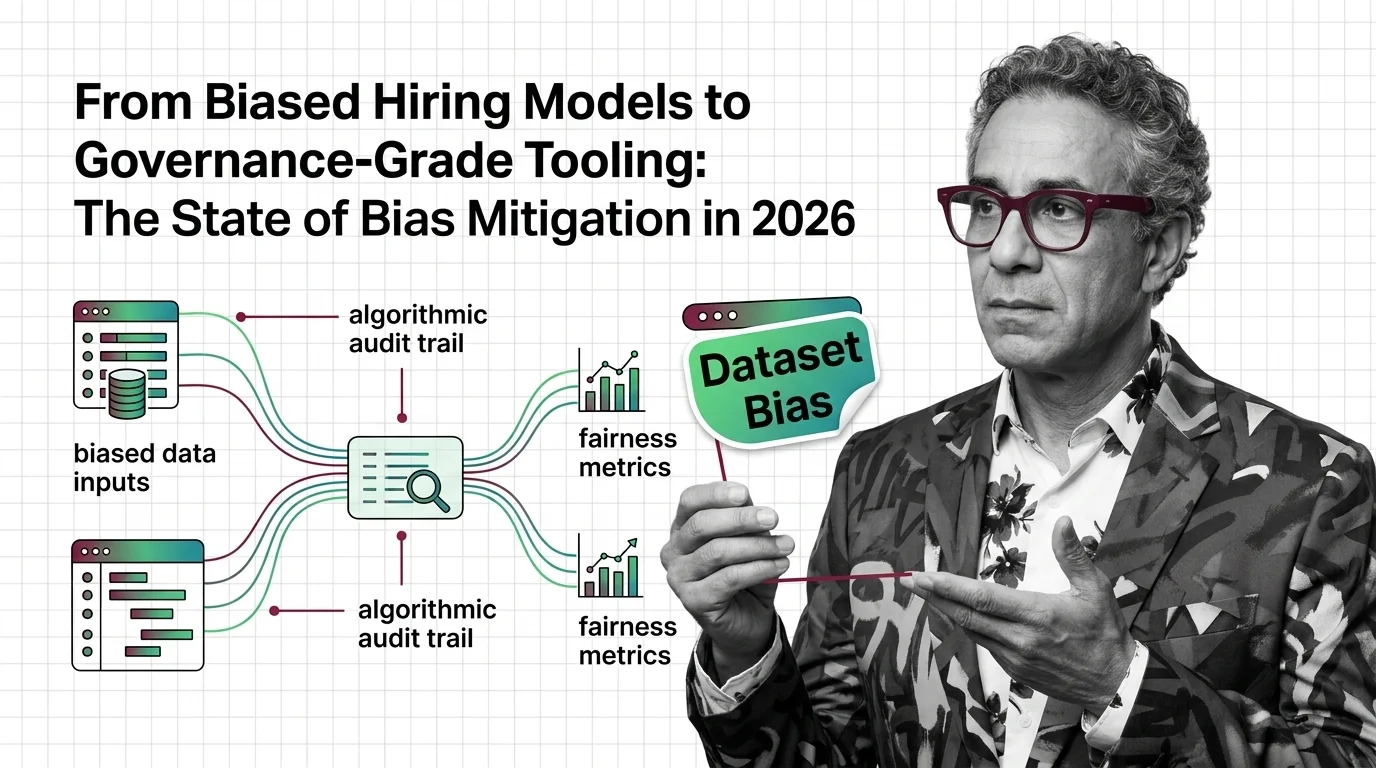
TL;DR
- The shift: Fairness checking is moving from one-off audit scripts to continuous, audit-ready governance monitoring.
- Why it matters: New laws turn bias detection from a research nicety into mandatory, repeatable conformity reporting.
- What’s next: Open-source fairness libraries are absorbing mitigation, and a commercial governance layer is forming on top of them.
For most of the last decade, checking a model for bias was a science project. You ran a toolkit once, exported a chart, and filed it somewhere nobody looked again. That arrangement is ending. In 2026, fairness stopped being a number you measure once and became a state you have to keep proving.
Fairness Just Became a Compliance Function
Thesis: Bias mitigation has crossed from one-off academic auditing into continuous, governance-grade compliance — and regulation, not research, is what moved it.
The technical problem hasn’t changed since 2018. Dataset Bias still enters models the same three ways: who got sampled ( Selection Bias), who got represented ( Representation Bias), and how the labels were defined ( Measurement Bias).
What changed is the cost of ignoring it.
When Reuters reported Amazon’s scrapped recruiting tool in 2018, the model had taught itself to penalize résumés containing the word “women’s” and graduates of all-women colleges. The same year, the Gender Shades study exposed commercial facial analysis systems misreading darker-skinned women far more often than lighter-skinned men (MIT Media Lab). At the time, both were cautionary tales. Blog-post villains.
Now they’re a liability category.
Laws like New York City’s Local Law 144 and Colorado’s SB 205 require employers to audit automated hiring tools and document the results. Bias detection moved from “good practice” to “show us the report.” That is the entire shift, compressed into one demand.
Three Toolkits, One Direction
The clearest signal isn’t a law. It’s what the open-source fairness libraries are quietly doing to themselves.
For years, these tools only diagnosed. They measured Disparate Impact, flagged a failing Four Fifths Rule ratio across a Protected Attribute, and stopped there. Diagnosis without treatment.
That boundary is dissolving.
Aequitas — built by Rayid Ghani’s DSSG group as a bias-audit toolkit off a 2018 paper — shipped version 1.0.0 as “Aequitas Flow,” adding actual mitigation across pre-, in-, and post-processing plus fairness experimentation, per Aequitas’ GitHub repository. The auditor learned to fix.
Fairlearn reached 0.14.0 this year on a steady release cadence, according to Fairlearn’s release notes. AI Fairness 360, IBM’s contribution, sits at 0.6.1 — maintained but slower-moving, its last release dating to 2024, per AIF360’s GitHub repository. Still alive. Just not where the momentum is.
Three independent libraries, the same trajectory: from measuring bias to managing it.
A commercial tier is forming on top. Governance platforms — Arthur, ModelOp, Monitaur, Weights & Biases, IBM watsonx.governance — now generate conformity reports aimed directly at NYC Local Law 144 and Colorado SB 205, according to Trustible. The open-source libraries tell you what’s broken. The governance layer proves to a regulator that you watched it.
That’s not a feature race. That’s a new product category being born.
Who Moves Up
The winners are the teams that already treat models like regulated assets.
Banks and insurers have run model risk management for years. For them, continuous fairness monitoring is a new column in an existing process, not a new discipline.
Governance-platform vendors win twice — once selling the monitoring, once selling the audit trail that survives a regulator’s questions.
And engineers who can wire fairness metrics into an MLOps pipeline just became more valuable than engineers who can only run a notebook once. The skill didn’t change. The shelf life of the output did.
Who Gets Left Behind
The losers share one habit: they treat fairness as a one-time audit.
A bias check that’s true the day you ship means little three months later, after the data drifted and the model retrained. A static audit in a continuous-monitoring world is a screenshot of a river.
Teams waiting for a hard deadline to act are exposed too. Class Imbalance and skewed sampling don’t announce themselves. By the time a regulator or a lawsuit surfaces them, the model has been making decisions for months.
You’re either building fairness into the pipeline now or you’re retrofitting it under audit later. One of those costs far more.
What Happens Next
Base case (most likely): Fairness monitoring gets absorbed into MLOps the way security scanning got absorbed into CI/CD — an expected stage, not a special project. Signal to watch: Governance vendors and observability platforms shipping fairness monitoring as a default feature, not an add-on. Timeline: Through 2026 and into 2027.
Bull case: Audit-ready tooling standardizes around shared metric definitions, making cross-vendor conformity reports comparable and cheap to produce. Signal: Convergence on common fairness-metric definitions across the open-source libraries and the commercial layer. Timeline: 2027.
Bear case: Regulatory uncertainty gives teams an excuse to stall. The EU AI Act high-risk obligations are scheduled for August 2026, but a proposed Digital Omnibus deferral toward late 2027 was under negotiation and not enacted as of mid-2026, per the EU AI Act implementation timeline. A moving deadline is an invitation to wait. Signal: The final EU decision on the deferral, and whether NYC and Colorado enforcement produces visible penalties. Timeline: Resolution likely by late 2026.
Frequently Asked Questions
Q: What are real-world examples of dataset bias in AI systems? A: The canonical cases are Amazon’s scrapped recruiting tool, which penalized résumés tied to women, and the Gender Shades study, which exposed large accuracy gaps in commercial facial analysis. Both trace back to skewed training data, not faulty code.
Q: How did biased training data affect hiring algorithms and facial recognition systems? A: Amazon’s tool learned from a decade of male-dominated résumés and downgraded female candidates. Gender Shades found commercial gender classifiers misread darker-skinned women up to 34.7% of the time versus 0.8% for lighter-skinned men, per MIT Media Lab.
Q: How are AI bias detection and fairness tools evolving in 2026? A: They’re shifting from one-time auditing to continuous mitigation and governance reporting. Open-source libraries like Aequitas and Fairlearn now bundle bias-fixing, while commercial platforms generate audit-ready conformity reports for laws like NYC Local Law 144.
The Bottom Line
Bias mitigation stopped being a research checkbox and became infrastructure. You can build continuous fairness monitoring into the pipeline now, or explain to an auditor later why you didn’t. The tooling that wins won’t have the prettiest metric — it’ll be the one that proves, on demand, that you never stopped watching.
AI-assisted content, human-reviewed. Images AI-generated. Editorial Standards · Our Editors