From Back-Translation to LLM Synthetic Data: Where Data Augmentation Is Heading in 2026
TL;DR
- The shift: Data augmentation is forking into two tracks — label-preserving transforms hold the vision and audio stack, while text moves to LLM-generated synthetic data.
- Why it matters: Pick the wrong track for your modality and you either leave accuracy on the table or train a model that quietly degrades.
- What’s next: Synthetic-plus-real mixing becomes the default discipline, because going fully synthetic triggers model collapse.
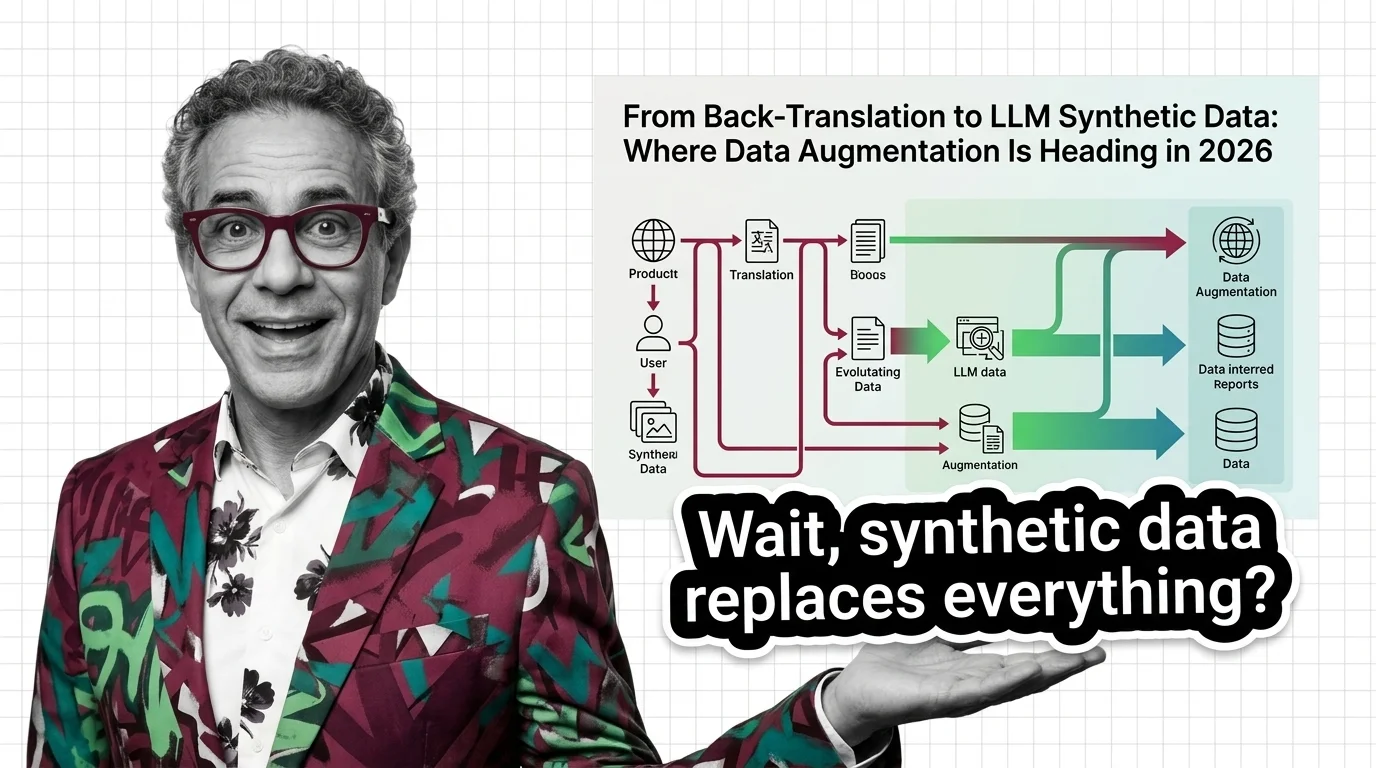
The headlines keep declaring traditional augmentation obsolete. Synthetic data is here, the story goes, so crops and flips and paraphrases are last decade’s tooling. That story is wrong about the verb. Nothing is being replaced. The field is splitting down the middle, and the line runs straight between modalities.
Augmentation Didn’t Die. It Forked.
Thesis: Data Augmentation is bifurcating by modality, not being retired — vision and audio keep transforming real examples, while text migrates to generating new ones.
Two tracks now exist, and they answer different questions.
The first track transforms data you already have. Crop an image, flip it, mix two together — the label stays intact. This is still the default for vision and audio, and it isn’t going anywhere.
The second track manufactures data you never had. A teacher model writes new examples from a seed prompt, with no anchor example to transform. That distinction — transforming versus generating — is the whole story, and a 2024 survey of data synthesis for LLMs draws the line exactly there (A Survey on Data Synthesis and Augmentation for LLMs).
Treating these as competitors is the mistake. They’re solving different problems in different parts of your stack. You either match the track to your modality, or you leave accuracy on the table.
The Evidence Is in the Stack Teams Actually Ship
Start with vision, because that’s where the receipts are oldest.
AlexNet in 2012 didn’t win on architecture alone. It leaned hard on augmentation — random 224×224 crops plus horizontal flips expanded the training set by a reported 2048×, with PCA color shifts and 10-crop test-time averaging on top (LearnOpenCV). The accuracy didn’t come from more data. It came from more views of the same data.
That logic never left. Mixup, introduced at ICLR, blends two images and their labels into one training example. CutMix followed at ICCV, pasting a patch of one image onto another — with reported clean-accuracy gains in the range of a point and a half in robustness studies (Clova AI Blog). Treat that as a reported figure, not a guarantee; the gain depends on dataset and architecture.
Audio tells the same story. SpecAugment, out of Google Brain, masks blocks of the spectrogram and helped drive a 6.8% word error rate on LibriSpeech test-other without a language model (Google Research). Still the canonical method for speech recognition.
And the augmentation tooling is alive, not legacy. Albumentations now ships as the dual-licensed AlbumentationsX 2.1.3 (April 2026), with 100-plus transforms and benchmarks as the fastest option in its class (AlbumentationsX GitHub). Nobody ships a major release for a dead technique.
Now text. This is where the fork actually bends.
Back Translation — translate a sentence to another language and back to manufacture a paraphrase — was the workhorse for years. In 2026 workflows it’s being superseded. Teams now reach for LLM-generated synthetic data: Self-Instruct, Evol-Instruct, Constitutional AI, and DPO preference pairs are the standard for instruction tuning and alignment (A Survey on Data Synthesis and Augmentation for LLMs).
Same goal — more training signal. Completely different machine.
The Constraint Nobody Gets to Skip
Here’s the wall the synthetic track keeps hitting: model collapse.
Train a model recursively on its own generated output and quality decays — distributions narrow, tails vanish, the model forgets the rare cases that mattered. Shumailov and colleagues documented this in Nature in 2024, and they found that keeping roughly a tenth of the training data real meaningfully slows the collapse (Nature).
That single finding rewrites the playbook.
Synthetic-only is a trap. Synthetic-plus-real is the discipline. And once real data is back in the mix, Training Data Quality and Data Deduplication stop being hygiene and become the thing that keeps the whole pipeline from rotting.
Who Moves Up
The maintained vision libraries win first. AlbumentationsX is actively developed, fast, and broad — teams that standardize on it inherit a moving target their competitors have to chase.
Alignment teams win next. The labs that built repeatable synthetic-data pipelines — Self-Instruct-style generation, preference-pair construction, Constitutional methods — can produce instruction data at a scale that hand-labeling never matched.
And the data-quality crowd wins quietly. The moment real data has to anchor synthetic data, the people who own deduplication, provenance, and curation own the leverage. They were a cost center. Now they’re the safety rail.
Who Gets Left Behind
The unmaintained text libraries are the clearest casualty. Nlpaug and AugLy both stalled years ago — usable, but not where the momentum is. Building a 2026 text pipeline on either means betting on tooling nobody is patching.
Back-translation as a primary text strategy is the other one. It still works, but as a default it’s running last year’s playbook while the field moved to direct generation.
And anyone planning a fully synthetic training run is optimizing for a result that collapses on contact with the math. You’re either mixing in real data or you’re watching your model forget the edges of its own distribution.
Maintenance & licensing notes:
- nlpaug: Last release v1.1.11 (July 2022), effectively unmaintained. Usable, but not actively developed — avoid as the backbone of a new text pipeline.
- AugLy (Meta): Last release v1.0.0 (March 2022), development stalled. Same caveat.
- AlbumentationsX: Active development moved to the dual-licensed X line; commercial use requires a license. Factor that in before standardizing.
What Happens Next
Base case (most likely): The two tracks formalize. Vision and audio keep label-preserving transforms as the default; text settles on synthetic-plus-real mixing with quality gates. Signal to watch: mainstream training recipes that publish their synthetic-to-real ratio as a tuned hyperparameter. Timeline: through 2026.
Bull case: Curation tooling matures fast enough that synthetic data scales cleanly with a thin real-data anchor, unlocking domains where labeled data was the bottleneck. Signal: open benchmarks showing synthetic-heavy training matching real-data baselines. Timeline: 12 to 18 months.
Bear case: Teams ignore the collapse finding, ship synthetic-only models, and a wave of quietly degraded systems erodes trust in the whole approach. Signal: public post-mortems blaming “data quality” for accuracy regressions. Timeline: any time teams cut the real-data anchor to save cost.
Frequently Asked Questions
Q: What are real-world examples where data augmentation improved model accuracy? A: AlexNet used crops and flips to expand its training set by a reported 2048×. SpecAugment helped reach a 6.8% word error rate on LibriSpeech test-other. CutMix reported clean-accuracy gains in robustness studies — dataset-dependent, not guaranteed.
Q: How did AlexNet and modern vision models use data augmentation? A: AlexNet (2012) applied random 224×224 crops, horizontal flips, PCA color shifts, and 10-crop test-time averaging. Modern models extend this with mixup, which blends images and labels, and CutMix, which pastes patches between images.
Q: Is LLM-generated synthetic data replacing traditional augmentation in 2026? A: No — it’s splitting the field by modality. Vision and audio keep label-preserving transforms. Text shifts toward LLM synthetic data. But model collapse forces a synthetic-plus-real mix, so neither track fully wins.
The Bottom Line
Stop asking whether synthetic data kills augmentation — it doesn’t, it forks it. Match your method to your modality: transforms for vision and audio, generation for text, and real data anchoring anything synthetic. Watch for training recipes that publish their synthetic-to-real ratio; that’s the tell that the discipline has gone mainstream.
AI-assisted content, human-reviewed. Images AI-generated. Editorial Standards · Our Editors