Evidently, Arize, and Fiddler: How ML Monitoring Converged on Unified Drift Detection in 2026
TL;DR
- The shift: ML monitoring’s two camps — tabular drift tools and LLM observability platforms — collapsed into one product category.
- Why it matters: Teams running both predictive models and GenAI apps no longer have to buy and operate two separate monitoring stacks.
- What’s next: Consolidation continues through 2026, with open instrumentation standards and acquisitions deciding who owns the unified console.
For years, you picked your stack by what you were running. Predictive model on tabular data? You reached for a dedicated drift tool. Shipping an LLM app? Different vendor, different dashboard, different vocabulary. That split just collapsed.
Two Camps Just Met in the Middle
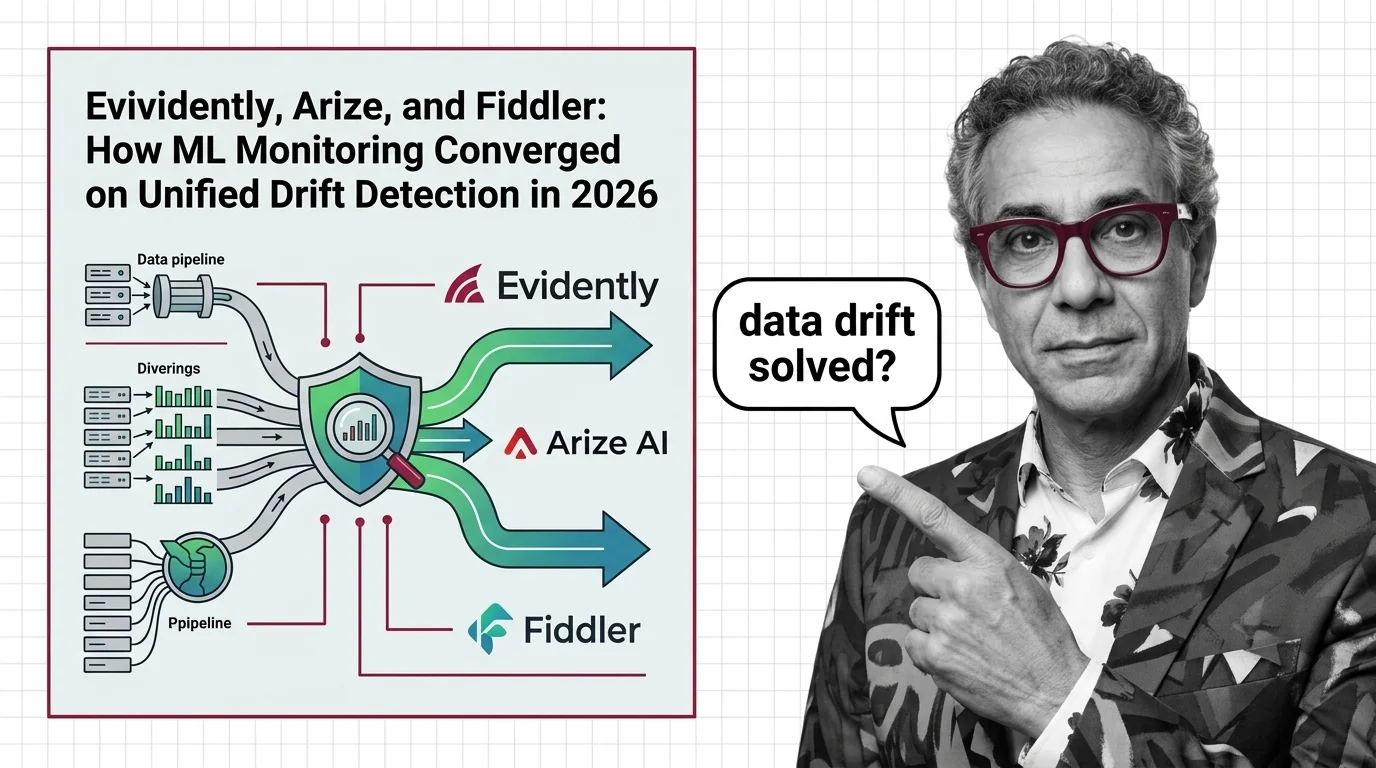
The dedicated drift tool and the LLM observability platform stopped being different products. They converged into one category: Model Monitoring that watches a tabular fraud model for Data Drift and a RAG chatbot for hallucinations from the same console.
This happened from both directions. The drift-native tools — Evidently AI, NannyML, Alibi Detect, WhyLabs — bolted LLM evaluation onto their statistical cores. The broad observability platforms — Arize, Fiddler — kept their drift metrics and added tracing and LLM guardrails.
No vendor declared a merger. The convergence is a pattern you read off the products, not a press release.
The driver is structural: the same teams now run predictive models and LLM apps, and they want one pane of glass, not two.
Two camps. Same destination.
The Same Bet, Made From Both Directions
Start with Evidently, the open-source leader. Released under Apache-2.0, it ships “100+ built-in metrics” and “20+ statistical tests and distance metrics” for drift, per Evidently’s GitHub repository — the classic Kolmogorov-Smirnov Test, Population Stability Index, and Wasserstein Distance.
Then it reused that exact framework for GenAI. Open-source LLM tracing landed in version 0.7.17, and the same engine now scores chatbots, RAG, and agents. Covariate Shift and Label Drift detection sit beside LLM-judge metrics in one toolkit. Even the profiling side moved: Whylogs relicensed to Apache-2.0.
Fiddler came from the other side. Its platform still monitors five metric types — data drift, performance, data integrity, traffic, and statistical properties — and measures drift with Jensen-Shannon distance and the Population Stability Index, per Fiddler Docs. On that statistical core it stacked LLM guardrails for hallucination, prompt-injection, and jailbreak detection.
Arize split its product in two. Phoenix is the open-source, dev-time layer, built on OpenInference and OpenTelemetry; Arize AX is the production-scale monitor — and embedding drift detection runs across both, per Arize Docs.
Then the money confirmed the same bet from opposite ends. Arize raised a $70M Series C in early 2025, led by Adams Street Partners, which it called the largest-ever investment in AI observability, per the Arize Blog. Weeks later it bought Velvet, an AI gateway, to pull LLM evaluation in-house, per SiliconANGLE.
Fiddler raised too. Its $18.6M Series B Prime extension in late 2024 brought that round to $50M and total funding to $68.6M, per the Fiddler Blog.
Three independent companies, one direction.
Who Owns the Single Pane of Glass
The winners are the platforms that built both halves before the market asked for one console.
Evidently owns open-source distribution and a free tier, the default for teams that start monitoring before they start paying. Arize bought its way to LLM depth with Velvet. Fiddler leaned enterprise: explainability, fairness, and compliance wrapped around the same drift core.
The bigger winner is the team running both predictive ML and GenAI in production. One tool. One on-call rotation. One definition of “something changed.”
There’s no benchmark here — no leaderboard for drift tools. Comparison guides put Evidently, Arize, and Fiddler at the front, but that’s editorial market position, not a measured score.
You’re either consolidating onto one monitoring layer, or you’re paying two vendors to watch half your stack each.
Who Gets Squeezed
A monitoring tool in 2026 either covers both model types or it covers half the job.
A tool that only does tabular drift now looks like half a product. A pure-play drift library with no GenAI story can’t serve a team shipping a RAG app. The LLM-eval startup with no statistical drift monitoring can’t serve the team still running fraud and forecasting models.
The other loser: anyone still treating drift as a dashboard they glance at quarterly.
Zillow is the warning. Zillow Offers wrote down roughly $500M and shut its home-flipping unit in November 2021 after its pricing model kept assuming a hot housing market as the market cooled — concept drift that monitoring caught too late, per the NannyML case study.
Drift isn’t a tabular-only problem, and it isn’t a quarterly check. It’s a production signal that should trigger Model Retraining, or it’s a write-down waiting to happen.
What Happens Next
Base case (most likely): Consolidation continues and the category standardizes on open instrumentation, so one agent feeds both worlds. Signal to watch: More drift-native tools shipping LLM evals, more observability platforms keeping drift, and more tuck-in acquisitions like Velvet. Timeline: Through 2026.
Bull case: A shared standard for drift and LLM telemetry takes hold, and teams run one instrumented stack instead of two. Signal: Convergence on OpenTelemetry-style instrumentation across vendors, not proprietary SDKs. Timeline: The next 12 to 18 months.
Bear case: “Unified” stays a marketing label: the tabular and LLM sides remain bolted-together modules with separate workflows under one login. Signal: Products that show two disconnected UIs and two data models behind a single account. Timeline: Persists through 2026.
Frequently Asked Questions
Q: How is the ML monitoring market evolving in 2026? A: Toward consolidation. Drift-native tools added LLM evaluation, while observability platforms kept statistical drift and added tracing and guardrails. The two camps now ship one product that watches predictive models and GenAI apps from a single console.
Q: What real-world failures were caused by undetected data drift? A: Zillow Offers is the canonical case. Its pricing model kept assuming a hot housing market as conditions cooled — concept drift, a sibling of data drift — contributing to a roughly $500M write-down and the unit’s shutdown in November 2021.
Q: Are drift detection tools merging with LLM observability in 2026? A: Yes. Evidently reuses one test framework for tabular drift and LLM evals. Fiddler pairs Jensen-Shannon and PSI drift with LLM guardrails. Arize runs embedding drift alongside Phoenix tracing. The merge spans the category, not one vendor.
The Bottom Line
The dedicated drift tool is becoming a feature, not a category. If your team runs both predictive models and LLM apps, you no longer have to pick two vendors. Watch the acquisitions — they are the clearest signal of who is consolidating.
Stay ahead, Dan.
AI-assisted content, human-reviewed. Images AI-generated. Editorial Standards · Our Editors