Evaluation Metrics, Test Datasets, and LLM Judges: The Parts of a Prompt Evaluation System
ELI5
A prompt evaluation system has three parts: metrics that define what “good” means, test datasets that expose failure modes, and judges that score outputs humans can’t check manually. Each layer can fail independently.
Most teams discover they need evaluation infrastructure the same way you discover your apartment has a gas leak: something went obviously wrong, and you can no longer pretend the warning signs were ambiguous. A prompt that worked last month now produces outputs that look correct but aren’t. A model upgrade shifted the output distribution in ways your informal spot-checks never caught. The question that follows is always the same: how do you know when your prompts are working?
The answer isn’t intuition — and it isn’t just running a few manual examples. A properly constructed Prompt Testing And Evaluation system has three distinct components, each with its own failure modes, and understanding them separately is what separates ad hoc vibe-checking from genuine engineering.
The Three Layers That Must All Work Together
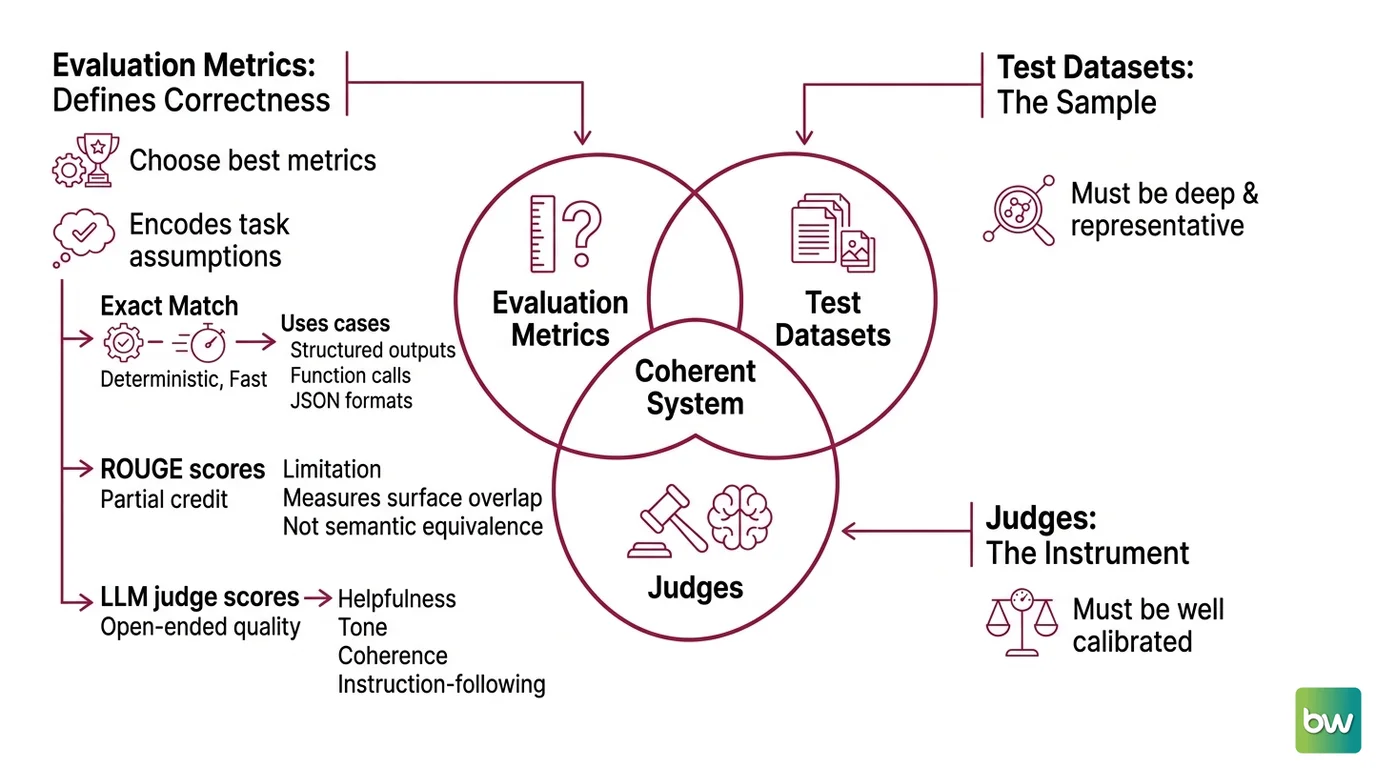
Before building anything, it helps to see the system as a whole. The three components aren’t sequential steps — they’re interdependent layers. A precise metric applied to a shallow test dataset gives you a precise answer to the wrong question. A deep test dataset evaluated by a poorly calibrated LLM judge produces confident-sounding noise. The architecture only works when all three layers are coherent with each other.
Think of it like a measurement instrument. The metric is your unit of measurement. The dataset is your sample. The judge is your instrument. A miscalibrated instrument measuring an unrepresentative sample with arbitrary units tells you nothing about the phenomenon you care about.
What are the main components of a prompt evaluation system?
The three components are evaluation metrics, test datasets, and judges.
Evaluation metrics define what “correct” means in machine-readable form. The choice of metric encodes assumptions about your task — assumptions that are usually hidden until they’re wrong. Exact match metrics work when outputs have a single correct answer: structured data extraction, function calls, JSON-formatted responses. They’re binary, deterministic, and fast. If your Structured Output Prompting pipeline needs a date in ISO 8601 format, exact match will tell you immediately whether the format is right.
ROUGE scores occupy a middle tier, useful for extractive tasks where the ground truth is a reference text and partial credit matters. For summarization or extractive question-answering, ROUGE-L measures longest common subsequence overlap between generated and reference output. The limitation is that ROUGE measures surface overlap, not semantic equivalence — a paraphrase that captures the same meaning will score poorly.
LLM judge scores handle open-ended quality: helpfulness, tone, coherence, instruction-following on tasks where no single answer is correct. This is where evaluation becomes expensive and calibration becomes essential.
Test datasets are the inputs you evaluate against. The structure of your dataset determines what failure modes your metrics can detect. A dataset made of average-case examples tells you how your prompt performs on average cases — which is rarely the thing that breaks in production. The standard architecture separates two types: a golden dataset of curated expected input/output pairs covering known good behaviors, and a red-team dataset of edge cases, adversarial inputs, and known failure modes (Galtea Blog, Context QA Blog). The golden set confirms the system does what it should. The red-team set confirms it doesn’t do what it shouldn’t.
Judges score the outputs. For deterministic metrics, the judge is the metric itself. For open-ended quality, the judge is either a human rater or another language model. This is where the most interesting engineering problems live.
Why Judgment Is the Hardest Part to Get Right
What do you need to understand before building automated prompt evaluation?
The prerequisite that most teams skip: judge calibration determines whether automated evaluation is informative or decorative. A judge that systematically disagrees with human raters in a consistent direction — preferring longer answers, preferring its own outputs, preferring the first option presented — is not a neutral measuring instrument. It’s a bias amplifier.
LLM judges have measurable failure modes that the research community has named and studied (DeepEval Guides). Position bias: the judge rates the first response higher when presented with two options in a fixed order. Verbosity bias: longer answers score higher even when they contain more hedging and less substance. Self-preference bias: a model rates outputs from models with similar training higher. Rubric drift: a judge applies the same rubric inconsistently across sessions, rating the same output differently on different runs.
These biases don’t cancel each other out. They compound. A judge with position bias and verbosity bias will reliably prefer the long response that appears first — regardless of quality.
The minimum defensible approach before choosing a judge model: 100–300 human-labeled examples from your specific task domain (Future AGI Blog). Run each candidate judge against this calibration set and measure agreement with human raters. Agreement isn’t a single number — you want to measure where the judge disagrees with humans, not just how often it agrees, because the disagreement patterns reveal which biases are active.
The current judge model rankings, as of 2026, reflect the tradeoffs between calibration quality, context window size, and cost. Claude Sonnet 4.5 and Opus 4.x hold the top calibration position for subjective rubrics and long-context tasks (Future AGI Blog). GPT-5 and GPT-5-mini work well as a cascade: the mini model screens at scale, GPT-5 rescores flagged outputs, with roughly a ten-fold cost difference between them. Gemini 2.5 Pro handles tasks that require multimodal evaluation or very long context windows — over a million tokens. For teams operating in regulated environments where data cannot leave the organization, Llama 3.3 70B is the standard self-hosted option. For open-weight at scale with favorable cost economics, DeepSeek-V3 at 671 billion total parameters runs only 37 billion active parameters per forward pass.
There’s also a class of fine-tuned judge models worth knowing. Prometheus 2 is trained on over 100,000 feedback examples specifically for evaluation tasks and supports both pairwise comparison and absolute scoring, under Apache 2.0 licensing. It’s a reasonable choice when you want a dedicated judge without the inference cost of a frontier model — but the quality claims come primarily from the model’s developers, so validate against your own calibration set before treating it as ground truth.
A practical detail: when you’re using a Braintrust platform for managed evaluation, the built-in scoring through Braintrust Loop gives you access to over 25 scorer types generated from plain English descriptions (Braintrust Docs). The platform includes 25+ built-in scorers. That’s useful for initial setup; it doesn’t substitute for calibrating which scorers are appropriate for your specific task.
What are the technical limitations of automated prompt evaluation in 2026?
The deepest limitation is the one that can’t be engineered away: a judge model cannot evaluate correctness on knowledge it doesn’t have. If your application requires domain expertise that isn’t well-represented in the judge’s training data — medical diagnosis reasoning, jurisdiction-specific legal analysis, niche security vulnerability assessment — the judge’s confidence in its scores is not a reliable signal. It will produce confident-sounding scores based on surface plausibility, not correctness.
The second structural limitation: evaluating Structured Output Prompting quality is harder than it appears. JSON Schema compliance is deterministic, but schema compliance doesn’t guarantee semantic correctness. A response can be valid JSON, pass every schema check, and still extract the wrong entity from a document. The metric catches syntax errors; it doesn’t catch semantic errors.
This is where the choice of structured output library becomes relevant to evaluation architecture. Instructor (v1.15.3, with over 3 million monthly downloads and 11k GitHub stars as of PyPI data) patches the retry loop at the API level — when output fails Pydantic validation, it retries with the validation error included as context. That’s a useful guarantee for schema compliance. XGrammar operates at the inference level: it’s the default Constrained Decoding backend for vLLM, SGLang, and TensorRT-LLM, guaranteeing schema-valid output with under 40 microseconds per token overhead (XGrammar site). BAML takes the DSL approach — you define expected output structure in a domain-specific language, and its Schema-Aligned Parsing recovers valid structure even from broken JSON or chain-of-thought responses that end with the answer (Boundary Docs). Outlines pioneered the space but currently shows the lowest compliance scores on complex schemas in independent benchmarks, with compilation times ranging from 40 seconds to over ten minutes on complicated schema definitions (TECHSY ranking). For evaluation infrastructure, this matters: if your output-generation pipeline can produce malformed outputs that your schema library doesn’t catch, your evaluation dataset needs to include examples that test those edge cases explicitly.
The third limitation is dataset staleness. A test dataset is a snapshot of known failure modes at a point in time. As you update your prompts, your production data distribution shifts, or you update the base model, your dataset ages. The failure modes that matter in production six months from now are different from the failure modes that mattered when you built the dataset. Scheduled red-teaming — deliberate adversarial testing against current behavior — is not optional maintenance; it’s the mechanism that keeps the test dataset from becoming a false-positive machine that confirms your prompts work against problems they no longer face.
One security consideration that belongs in any discussion of evaluation infrastructure: when building evaluation pipelines that route LLM outputs through proxies or aggregators, supply chain hygiene matters. A supply chain attack against a popular LLM proxy tool (LiteLLM versions 1.82.7–1.82.8, March 2026) embedded malicious code in the PyPI package (Trend Micro). Instructor, BAML, and XGrammar were not directly affected — but the incident is a reminder that the evaluation stack often pulls in dependencies that aren’t directly yours to audit. Pin exact versions, verify checksums, and treat your eval infrastructure with the same security posture as your application code.
What the Architecture Predicts
If you understand the three-layer structure, several consequences follow mechanically.
Adding a new evaluation metric without updating your test dataset produces a number — not a measurement. The metric operates on your existing sample, which was designed to reveal the failure modes the old metrics were sensitive to. New metrics need new test cases that can actually distinguish good from bad on the new dimension.
Switching judge models without re-running your calibration set is a silent baseline change. A new judge may agree with your old judge 90% of the time and disagree systematically on exactly the cases that matter most — longer, more nuanced responses where verbosity bias kicks in, or adversarial inputs where the new model’s training makes it more or less sensitive to specific patterns.
The failure mode that’s hardest to detect: when all three layers look coherent but are measuring the wrong thing together. Your metrics, dataset, and judge were all designed in response to the problems you saw during initial development. If your production distribution shifts toward a use case you didn’t anticipate, the entire evaluation system can give you green signals on a failing system. This is why periodic audits of evaluation output against human raters on current production samples — not the original calibration set — are a necessary check on whether the system is still measuring what you think it’s measuring.
Rule of thumb: build your evaluation system to catch the failure modes you’ve already seen, then assume it will miss the ones you haven’t.
When it breaks: automated evaluation fails silently when judge model biases align with your prompt optimization direction — making the prompt look better according to the judge while making it worse for actual users. Human spot-checks on production samples remain the only reliable catch for this class of failure.
The Data Says
A prompt evaluation system is not a quality gate — it’s a measurement instrument. Its accuracy depends on the coherence between what your metrics define as quality, what your test dataset exposes as failure, and what your judge can reliably score. Each layer has independent failure modes; a system that looks complete can still be telling you what you want to hear.
AI-assisted content, human-reviewed. Images AI-generated. Editorial Standards · Our Editors