Early Fusion, Late Fusion, and What You Must Understand Before Writing Multimodal Prompts
ELI5
Multimodal prompting means sending images, text, and sometimes audio or video to an AI model in one request. Whether that model processes them together from the start or fuses them only at the output stage changes everything about how your prompt structure should work.
Most people discover multimodal models the same way: they paste an image into a chat interface, type “describe this,” and are delighted. The image was described. It worked. Then they try something harder — extract a table from a blurry invoice, compare two charts, ask why the error in the screenshot contradicts the documentation — and they get vague, evasive, or just wrong answers.
The failure isn’t random. It’s architectural.
Understanding why requires looking at what happens inside the model when image and text tokens arrive together — because not all multimodal models handle that moment the same way.
What Breaks When You Skip the Architecture
A widely-held assumption about multimodal models goes something like this: you add images to a prompt the same way you add context text. More context, better answers. The model “sees” the image and reasons about it.
Not quite. The model doesn’t see anything. It processes tokens — sequences of numbers derived from visual patches, the same way it processes sequences of numbers derived from subwords. The question is when those two token streams interact, and how deeply the attention layers connect them.
How Models Actually Merge Modalities
The choice of when to merge image and text representations is one of the most consequential architectural decisions in multimodal model design. Three patterns dominate the field — and each one has distinct implications for how you should structure your prompts.
What background knowledge do you need before learning multimodal prompting
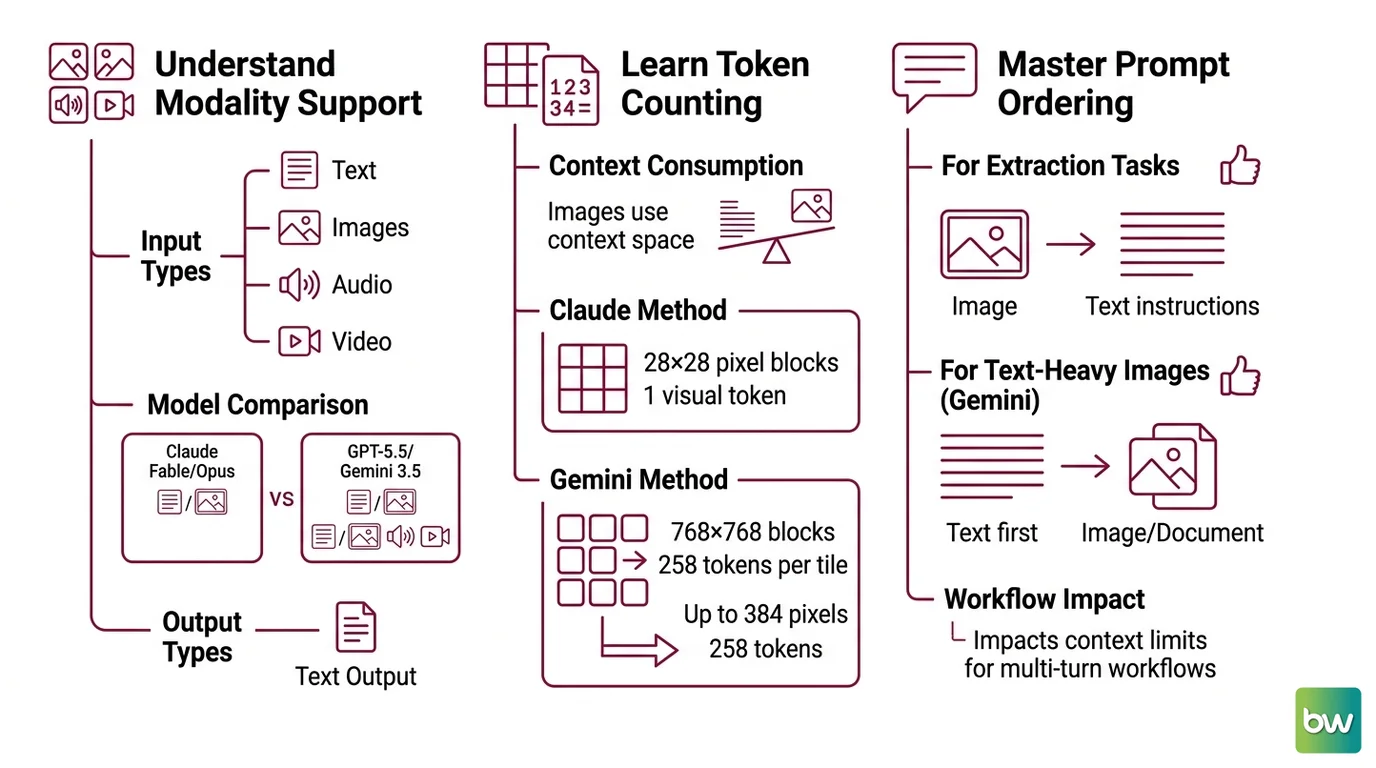
Before writing a single Multimodal Prompting request, you need to understand three things: what the model’s modality support actually is, how its architecture fuses different inputs, and how it counts tokens.
Modality support is the first filter. Claude Fable 5 and Claude Opus 4.8 accept text and images, producing text output — no audio, no video (Anthropic Vision Docs). GPT-5.5 and Gemini 3.5-Flash process text, images, audio, and video natively. The prompting strategies appropriate for an image-only model are a subset of what’s required for a video-capable one. Starting with the wrong assumption about what a model accepts wastes every subsequent minute.
Token counting matters because every image consumes Context Window space before you’ve written a single word of instruction. Claude counts visual tokens in 28×28 pixel blocks — one block equals one visual token (Anthropic Vision Docs). Gemini prices at 258 tokens for images up to 384 pixels, then tiles larger images into 768×768 blocks at 258 tokens per tile (Google AI Docs). A high-resolution product image might consume more context than several paragraphs of detailed instruction. If you’re building multi-turn workflows — say, iteratively refining an analysis across several images — you may hit context limits faster than expected.
Prompt ordering is the third practical prerequisite. Anthropic recommends placing the image before the text instruction for extraction tasks (Anthropic Vision Docs). Google AI Docs recommend the reverse: text first, especially for text-heavy images like documents. This isn’t a contradiction — it reflects differences in how the respective models handle positional attention. The architecture shapes the optimal prompt structure.
What are the main components of an effective multimodal prompt
An effective multimodal prompt has four components: a task specification, the visual input in the correct position, a System Prompts defining the output format, and explicit scope constraints.
Task specification means stating what reasoning operation you want the model to perform, not just what you want it to find. “Describe this chart” asks for narration. “Identify the trend between 2021 and 2023 and state whether it is consistent with the caption” asks for comparison and verification. The second structure forces the model to anchor its response to a specific aspect of the image rather than generating plausible-sounding description.
Visual input positioning follows the model-specific rules above. One consistent principle across providers: when comparing multiple images, number them explicitly in your instruction. “Image 1 shows the baseline, Image 2 shows the result — identify what changed” gives the model a reference frame it can use when forming its response.
Output format via a system prompt matters more in multimodal tasks than in pure text tasks because visual content has no inherent structure the model can mirror. For extraction tasks, specify the output schema in the system prompt: field names, data types, how to handle missing values, and what to return when the image quality is too low to extract a value reliably.
Scope constraints prevent a pattern common in multimodal outputs: the model hedges toward what the image usually contains rather than what this particular image contains. Adding “answer only from what is visible in this image, not from prior knowledge about this type of chart” tightens the probability distribution toward grounded responses.
The two-stage framework from multimodal chain-of-thought research — rationale generation from the visual input, then answer inference from that rationale — works well when the extraction task has multiple steps (Prompting Guide). Applied directly: first prompt the model to describe the relevant visual features in detail, then in the same request (or a follow-up turn) prompt it to reason from that description toward the final answer.
The Architecture Underneath: Early vs Late Fusion
The difference between fusion strategies is not academic — it determines what the model is capable of and, consequently, what it’s worth asking.
Early fusion vs late fusion multimodal AI models explained
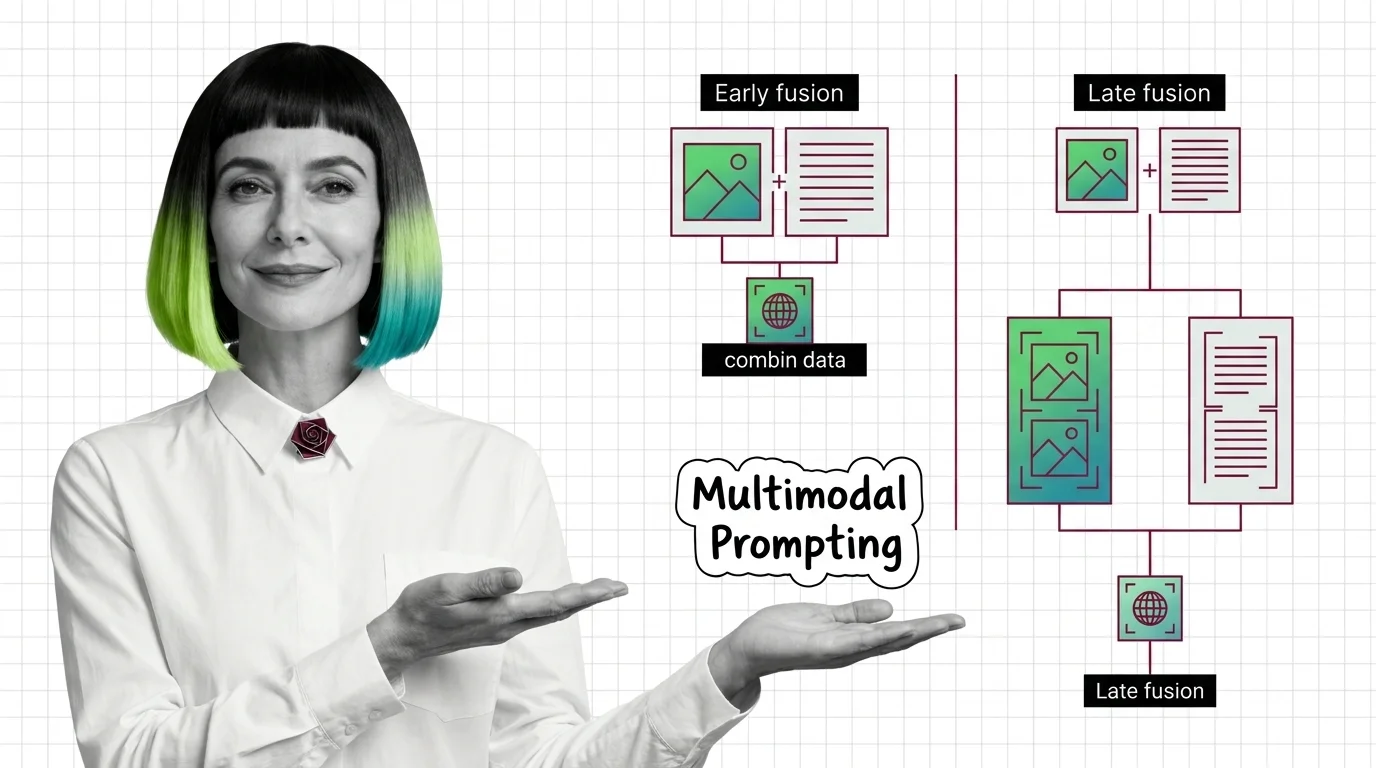
Late fusion keeps image and text on separate tracks. A dedicated vision encoder — often a Vision Transformer — processes the image independently into a representation vector. A language model processes the text. The two representations are combined only at the decision or output stage, typically through a weighted average, cross-attention aggregation, or learned projection. The visual representation is fixed before the language model ever touches it.
The practical consequence: the vision encoder forms a relatively fixed representation before the language model ever touches it. The image representation is shaped by what the encoder was trained to compress, not by the specific question you’re asking. When the question requires noticing something the encoder was not optimized to preserve — fine-grained texture differences, subtle positional relationships between elements, reasoning about what’s absent from the image — the answer quality drops.
Early fusion takes a different approach. All modality tokens — image patches encoded as discrete tokens, alongside text tokens — are merged into a unified transformer from the first layer. Cross-modal interactions happen throughout the entire network, not just at a late aggregation point. Chameleon (Meta FAIR, arXiv:2405.09818) is the canonical academic example: it represents text and images as discrete tokens and trains a unified transformer end-to-end on approximately 10 trillion tokens. Llama 4, released April 2025, uses what Meta describes as early fusion to “seamlessly integrate text and vision tokens into a unified model backbone” — with Scout offering 10 million token context and Maverick running 17 billion active parameters across a 400 billion parameter total (Meta AI Blog).
The implication is that early-fusion models can form different representations of the same image depending on the question — because the text tokens and image tokens interact at every layer. This makes them better candidates for tasks requiring tight visual-linguistic reasoning: grounding a specific phrase to a region, understanding spatial relationships in diagrams, answering questions that require synthesizing information from multiple visual areas simultaneously.
Hybrid approaches occupy the middle ground. Modalities are encoded separately, then merged at an intermediate representation layer via cross-attention rather than at the decision stage. LLaVA-style architectures are the canonical example: a dedicated vision encoder feeds into a language model backbone via a cross-attention bridge, merging at an intermediate representation layer rather than at the final output. This is the dominant pattern in production models as of mid-2026.
One caution on labeling: the Qwen-VL technical report (arXiv:2511.21631) uses the language of “unified multimodal context” and interleaved tokens rather than “early fusion” directly. It’s architecturally adjacent but not identical (Qwen3-VL GitHub). Similarly, GPT-5.5 and Gemini 3.5-Flash are described by their developers as end-to-end multimodal, which resembles early fusion at the token level — but neither architecture is publicly documented in enough detail to confirm the classification (OpenAI Docs; Google AI Docs).
What the Fusion Architecture Predicts for Your Prompts
Understanding fusion architecture turns passive knowledge into active prediction. Certain Prompt Engineering decisions work differently depending on the model’s architecture.
If you’re working with a late-fusion model, adding exhaustive text description of what you want the model to notice in the image can partly compensate for the encoder’s fixed representation. Explicitly directing attention — “focus on the legend in the lower right corner” — helps the cross-attention bridge weight that region more heavily. It’s a workaround, not a solution, but it works.
If you’re working with an early-fusion model, your Context Engineering effort is better spent on the task structure itself rather than describing what to look at. The model can reason about visual context alongside your instruction simultaneously — which means a well-specified task (the second component above) carries more weight than elaborate visual direction.
Role Prompting interacts with multimodal content in a specific way: assigning a role doesn’t improve the model’s visual perception, but it does shift the reasoning style applied after visual tokens are processed. A role like “you are a medical imaging analyst reviewing this scan for abnormalities” doesn’t give the model better visual acuity — it biases the subsequent token generation toward patterns consistent with that domain. For tasks where the visual extraction is straightforward but the interpretation is domain-specific, role prompting adds measurable signal. For tasks where the failure is perceptual rather than interpretive, it adds noise.
Multi-Turn Prompt Design for multimodal sessions requires understanding how images are re-processed across turns. Most current APIs re-encode the image on every turn it appears in the conversation. For long analyses across many images, this has cost implications — and it affects whether you should pass all images upfront or introduce them progressively. Claude supports up to 100 images per request on 200K-context models and up to 600 on 1M-context models, with 20 images per turn on claude.ai (Anthropic Vision Docs). Gemini allows up to 3,600 image files in a single request (Google AI Docs). OpenAI’s low detail mode processes images at a fixed 512×512 pixels; high mode uses 2,048-pixel tiling; original mode (up to 6,000 pixels) is available on GPT-5.5 and GPT-5.4 only (OpenAI Docs).
Rule of thumb: match your prompt’s task specification to the model’s fusion architecture. If the model can reason across modalities from layer one, structure the task. If the model fuses late, guide the perception.
When it breaks: early fusion models require substantially more compute and data to train, which means they remain rarer in open-source and cost-efficient tiers. When an early-fusion model is unavailable and a late-fusion model can’t bridge the perceptual gap on a complex visual reasoning task, neither prompt engineering nor Instruction Following improvements will close that gap — the ceiling is architectural, not instructional.
Freshness note:
- Vertex AI Vision APIs: Google deprecated the Imagen 1/2 image captioning and VQA APIs from Vertex AI on June 24, 2025. If your workflow used these endpoints, migrate to the Gemini API equivalents.
- vLLM VLM serving: Version 0.5.1 removed all vision language CLI arguments. If you self-host multimodal models with vLLM, code migration is required before that version.
- Claude 3.5 Sonnet: Deprecated August 2025. For multimodal workloads, migrate to Claude Opus 4.8 or Claude Fable 5 (Anthropic Models Docs).
The Data Says
The architecture determines the ceiling. Early fusion models can reason across image and text at every layer; late fusion models fix the visual representation before language reasoning begins. Understanding which architecture you’re prompting — and what its token economics look like — is the prerequisite everything else builds on. Qwen3-VL-235B-A22B-Instruct held the top position on the Visual Question Answering DocVQAtest benchmark at 97.1% as of May 2026 (DocVQAtest Leaderboard), reflecting the current state of unified multimodal context at scale. The gap between knowing a model accepts images and knowing how to prompt it effectively is precisely this architectural distance.
AI-assisted content, human-reviewed. Images AI-generated. Editorial Standards · Our Editors