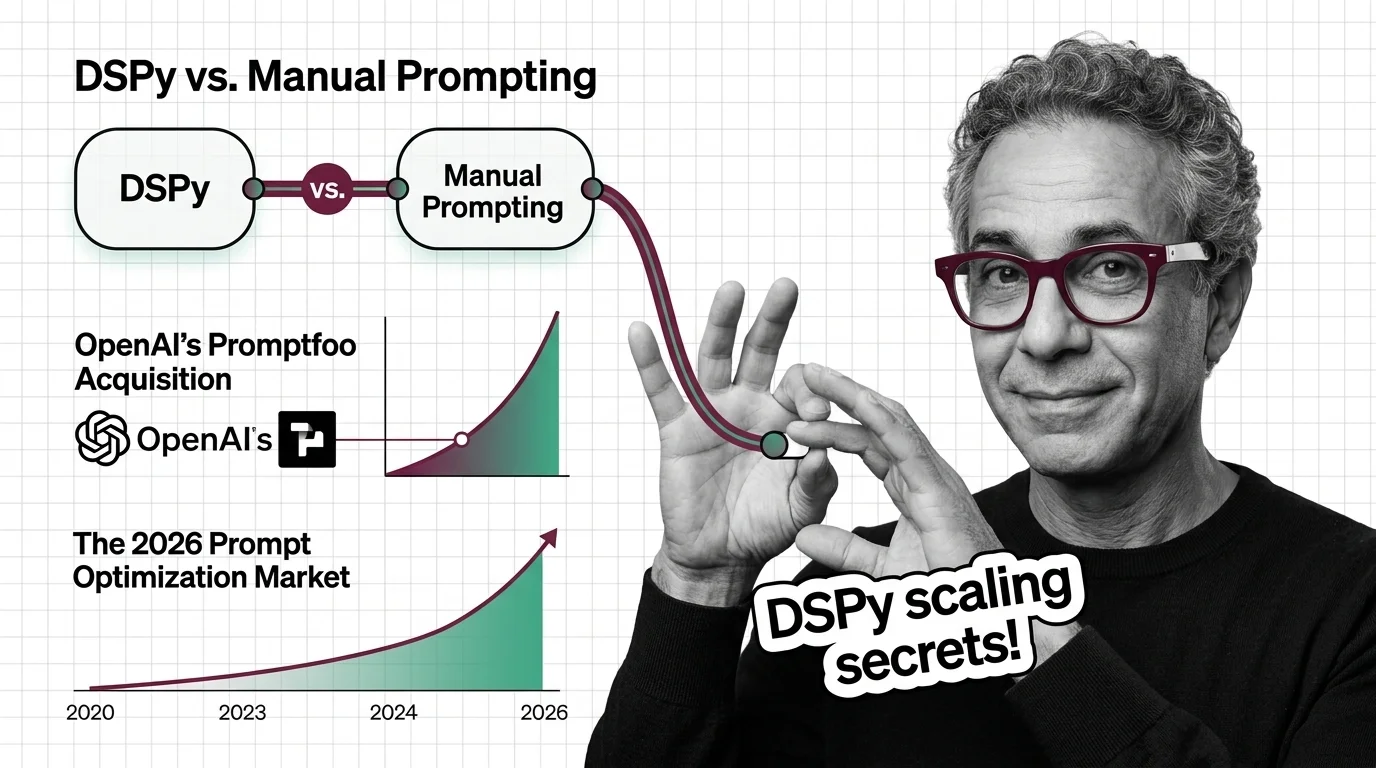
DSPy vs. Manual Prompting, OpenAI's Promptfoo Acquisition, and the 2026 Prompt Optimization Market
TL;DR
- The shift: The Prompt Optimization market is splitting into two tracks — programmatic optimization frameworks that replace manual iteration, and platform-native eval infrastructure that wraps deployment in security compliance.
- Why it matters: OpenAI’s March 2026 acquisition of Promptfoo pulls the leading eval CLI into the model provider layer, where eval independence matters most.
- What’s next: Teams without evaluation discipline are building toward a vendor-controlled finish line they didn’t choose.
OpenAI didn’t buy a testing tool. It bought the layer that sits between your prompts and your production risk.
The market is not evolving. It’s splitting. Programmatic frameworks that replace manual iteration with automated search on one side. Security-and-eval harnesses becoming platform-native features on the other.
One side just became dramatically harder to disrupt.
The Market Just Picked a Direction
Thesis: Enterprise Prompt Engineering is bifurcating — automated optimization for structured tasks on one track, platform-controlled eval for deployment compliance on the other — and OpenAI’s acquisition of Promptfoo is the clearest proof point yet.
Two parallel movements have been accelerating since mid-2024. The research side built tools that treat prompts like code — systems that search for better prompts the way gradient descent searches for better weights. The operations side built tools that catch failure modes before they reach users.
OpenAI just acquired the leading operations tool. Databricks, Shopify, Dropbox, and AWS are already running the research tools in production (DSPy Docs).
The market chose both. And it’s compounding early movers on each track.
Two Bets, One Trend
Google DeepMind’s Opro paper (ICLR 2024) showed LLM-as-optimizer loops beating hand-crafted prompts — +8% on GSM8K and +50% on BIG-Bench Hard, compared to human-written prompts (OPRO Paper). Those numbers held under peer review.
DSPy translated the same insight into production infrastructure. Its MIPROv2 optimizer uses Bayesian optimization over instructions and few-shot demos simultaneously. The newer GEPA optimizer (July 2025) extends to reflective prompt evolution. DSPy claims 10–40% quality lift over hand-written prompts on Structured Output Prompting tasks — self-reported, and worth benchmarking against your actual workload before treating it as a given (DSPy Docs). Textgrad extended the framework further, treating text feedback as gradients and producing measurable gains on QA benchmarks and code generation (TextGrad Paper, arXiv:2406.07496).
The pattern holds across methods — automation beats hand-craft at every published benchmark to date.
Promptfoo’s Prompt Testing And Evaluation CLI reached 350,000+ developers and was active inside more than a quarter of Fortune 500 companies before the acquisition (Promptfoo Blog). It scanned across 50+ vulnerability types — Prompt Injection, jailbreaks, PII leaks, and more (Promptfoo Docs). That’s production-grade security infrastructure — not a dev tool.
OpenAI acquired it on March 9, 2026. Last known private valuation: $86 million from a July 2025 funding round. Acquisition price was not disclosed (TechCrunch). The integration target: OpenAI Frontier, where AI coworkers will need systematic testing against real attack surfaces before deployment.
Compatibility note:
- DSPy GEPA (2026 releases): Breaking API change —
DspyGEPAResult.candidatesis now a list of compiled DSPy modules, not instruction dicts. Teams using GEPA in Prompt Versioning workflows should review the changelog before upgrading (DSPy Releases).
metaTextGrad (May 2025, arXiv:2505.18524) auto-optimizes the LLM optimizer itself. The tools that improve prompts now have tools that improve the optimizers. Manual iteration is not keeping pace with that trajectory.
Who Reads the Signal First
Databricks, Shopify, Dropbox, and AWS have compound advantage: better prompts today, plus a repeatable process for finding better prompts as models change. When you automate the search, you automate the update cycle.
Organizations running Promptfoo before the acquisition have clean audit trails and tested Prompt Compression workflows. They also have time to decide how much of their eval logic stays with the open-source fork versus migrates with the platform.
The open-source path is still viable. Promptfoo remains MIT licensed (Promptfoo Blog). Teams that self-host keep control of their eval data — and that window is open right now.
Who Gets Left Behind
Manual prompt engineering works for single-task applications with a handful of prompts. At hundreds of variants across changing models, you’re sampling from a space too large to cover by hand. The gap between automated and manual is compounding, not closing.
Teams that skipped evaluation discipline are about to discover that gap through compliance costs and production failures, not their own QA cycle. The acquisition accelerates that reckoning.
Standalone eval products competing with model providers face a harder position today than six months ago. You’re not competing with a startup anymore. You’re competing with OpenAI’s distribution, bundling, and default integration surface.
What Happens Next
Base case (most likely): DSPy adoption grows among structured-task pipelines. Promptfoo’s open-source roadmap gradually converges with OpenAI’s product priorities. Enterprise security teams standardize on model-agnostic alternatives to preserve audit independence. Signal to watch: Promptfoo enterprise pricing bundled with OpenAI API tiers. Timeline: 12–18 months for visible feature divergence between the open-source fork and the platform version.
Bull case: Frontier becomes the default eval standard for OpenAI-based deployments. Programmatic optimization frameworks integrate eval hooks directly, closing the loop between optimization and compliance. Signal: First regulatory filing citing Promptfoo-based red-teaming as part of a formal AI governance audit. Timeline: 18–24 months.
Bear case: Enterprise CISOs reject vendor-controlled eval on data sovereignty grounds. The open-source fork fragments. Manual red-teaming resurges as the only trusted independent option. Signal: Procurement mandates requiring model-agnostic eval pipelines at large enterprises. Timeline: 12 months, if security teams move fast.
Frequently Asked Questions
Q: How does automated prompt optimization with DSPy outperform manual iteration at scale? A: DSPy’s MIPROv2 searches instruction space and few-shot demos simultaneously using Bayesian optimization. Manual iteration samples this space one guess at a time. At hundreds of prompt variants across models, automation covers the space faster — and re-optimizes automatically when the base model changes.
Q: Why do experienced ML engineers still choose manual prompt engineering over automated tools? A: Control and interpretability. Optimized prompts can work without being legible — you don’t know why they work or whether they’ll hold under distribution shift. For safety-critical systems, engineers often need to trace a specific output back to a specific prompt decision. Automated search doesn’t guarantee that.
Q: How did the prompt optimization market shift after OpenAI acquired Promptfoo in March 2026? A: The acquisition merged the leading eval CLI into the model provider layer. Teams relying on Promptfoo for independent red-teaming now face a vendor dependency question. Independent alternatives gained renewed enterprise interest from security and compliance teams immediately after the announcement.
Q: Where is automated prompt optimization heading in 2026 after OPRO and TextGrad? A: The meta-optimization layer. metaTextGrad showed the optimizer itself can be improved via text gradients. The logical next step: optimization pipelines that adapt continuously from production feedback — not just pre-deployment tuning, but live self-adjustment as model behavior drifts. DSPy’s GEPA is an early step in that direction.
The Bottom Line
The split is done. Automated frameworks are winning on structured tasks. Platform-native eval is becoming a compliance feature, not a dev tool. Early movers on both tracks are compounding that advantage every quarter they stay ahead.
You’re either building with the tools that automate this, or you’ll be explaining to your future self why you didn’t.
AI-assisted content, human-reviewed. Images AI-generated. Editorial Standards · Our Editors