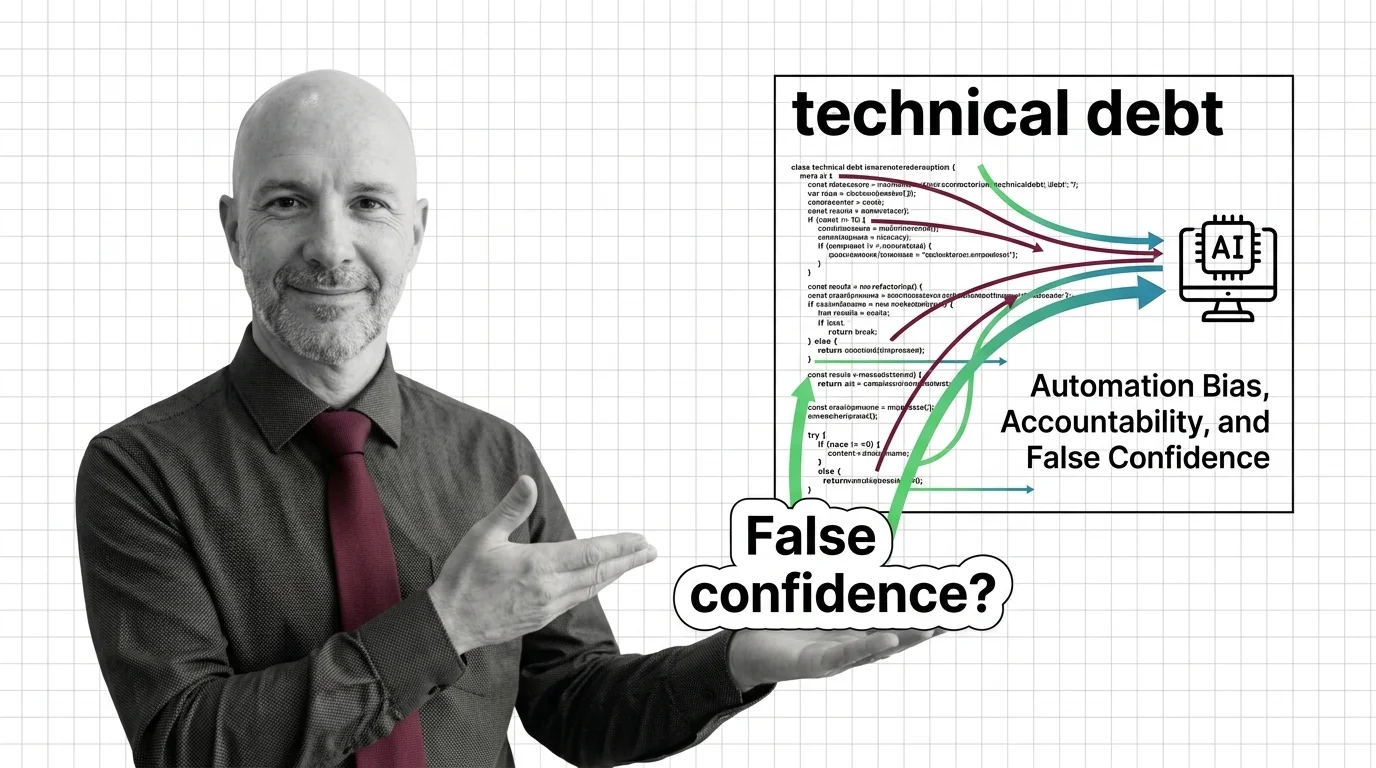
Does AI Really Pay Down Technical Debt? Automation Bias, Accountability, and False Confidence
The Hard Truth
A tool scans your repository, flags a thousand problems, and quietly fixes half of them while you sleep. The dashboard turns green. But green compared to what — and decided by whom? When the machine declares your code healthy, who is left to disagree?
There is a particular comfort in watching a number go down. Technical debt has always been hard to see, harder to measure, and almost impossible to argue about without someone reaching for a metaphor. Now a class of tools promises to make it legible — to scan, score, and even repair the accumulated compromises in a codebase. The promise is seductive precisely because the problem is so old and so exhausting. But comfort and correctness are not the same thing, and the gap between them is exactly where this story lives.
The Debt We Stopped Being Able to See
Every engineer knows the feeling of inheriting a system nobody fully understands. AI For Technical Debt tooling steps into that anxiety with a reassuring offer: let the model read what you no longer have time to read. It will find the Code Smell, measure the Cyclomatic Complexity, and tell you where the rot is concentrated.
The trouble is not that these tools are wrong. It is that they are persuasive. A survey of 800 professionals found that 59% of developers merge code they do not fully understand, per Clutch. Sit with that number for a moment. Not code they wrote and forgot — code they never understood in the first place, accepted on the authority of a system that sounded confident. The question we are not asking is simple and uncomfortable: when comprehension becomes optional, what exactly is the human still doing?
The Case These Tools Make for Themselves
It would be unfair to treat this as snake oil. The strongest version of the argument is genuinely strong. Manual Static Code Analysis has real limits — it drowns teams in findings without telling them which findings matter. The better tools answer that complaint directly. Codescene reads commit history to find Hotspot Analysis targets, the files that are both complex and changed constantly, because those are where pain actually concentrates. SonarQube added an AI Code Assurance feature in 2026 that does something quietly wise: instead of trusting AI-generated code, it labels it and forces it through stricter security scans and a tighter Quality Gate, per Sonar.
That is the thoughtful posture. It treats machine output as a suspect, not a colleague. Vendors will tell you these systems can cut technical debt dramatically — Sonar markets reductions of up to 50% — though that figure is a vendor claim, not independent research, and the distance between a marketing slide and a maintained codebase is considerable. Still, the underlying idea is defensible. The tools are at their best when they assume they might be wrong.
The Assumption Hiding Inside the Dashboard
Here is the fault line. Every one of these systems rests on a quiet assumption: that a human will remain in the loop, skeptical and engaged, ready to overrule the machine. That assumption is exactly the thing the tools erode.
A 2025 randomized controlled trial from METR studied 16 experienced open-source developers across 246 real issues. When allowed to use AI tools, they were 19% slower — and this is the part that should unsettle us — they had forecast being 24% faster, and even after finishing, still believed they had been 20% faster. The work slowed down. The feeling of acceleration did not. This was a narrow context — seasoned developers in codebases they knew intimately — so the slowdown itself may not generalize. But the perception gap travels everywhere: we are poor judges of when the machine is helping us and when it is quietly slowing us down.
That gap has a name in the research literature. Higher confidence in AI correlated with less critical thinking, not more — a finding Microsoft Research presented at CHI 2025. Trust alone accounted for up to 24.1% of the variance in how much people relied on a system, per Springer’s review of automation bias. The more we believe, the less we check. And a tool that fixes your debt while you sleep is engineered, however unintentionally, to maximize exactly that belief. So does AI technical debt tooling create false confidence and erode developer accountability? The evidence does not suggest it might. It suggests it already does, and that we are structurally bad at noticing.
What the Algorithm Borrowed From the Bureaucrat
This is not the first time a society handed judgment to a system and called it progress. The modern bureaucracy was, in its day, a kind of artificial intelligence — a machine made of forms, rules, and clerks, designed to make decisions impersonal, consistent, and fast. It worked. It also produced a distinctive moral hazard: the clerk who could say, truthfully, that they were only following the procedure. Responsibility dissolved into the process. Nobody decided; the system decided.
A green dashboard is a procedure wearing the costume of a measurement. When a quality gate passes, the human who merges the code can say they followed the gate. When the Code Health score improves, the team can report improvement without anyone having read the diff. The danger is not that the machine is malicious. It is that it offers everyone a place to stand where no one has to own the outcome.
The Quiet Transfer of Judgment
Thesis: delegating code-quality decisions to AI is not unethical, but doing so without preserving accountability is — because it launders human judgment into machine output and leaves no one answerable when the judgment is wrong.
Is it ethical to rely on AI to make Refactoring and code-quality decisions? The honest answer is that the question is poorly framed. Reliance is not the problem; unexamined reliance is. A model that proposes a refactor is offering an opinion about what your code should be — what counts as clean, what counts as debt, which compromises are tolerable. Those are value judgments dressed as technical ones. When a human makes them, we can ask why. When they are encoded into a scoring engine, the reasoning disappears into the weights, and the disagreement that used to happen in code review simply stops happening.
Only 28% of organizations said their CEO was responsible for AI governance, per McKinsey’s 2025 survey. The accountability is not being transferred to someone more senior. It is evaporating. And evaporated accountability is the most expensive debt of all, because it never appears on any dashboard.
The Questions We Owe Our Codebases
What would it mean to use these tools without surrendering to them? Not a checklist — this is not a problem a checklist solves — but a set of questions worth sitting with.
When the tool proposes a fix, can someone on the team explain why it is right, not merely that the gate approved it? Frameworks like the NIST AI Risk Management Framework’s “Govern” function point in a useful direction: they insist on named roles, audit trails, and human oversight for high-impact systems, per NIST AI RMF — not because a document says so, but because someone must remain answerable. Does your team treat a passing score as the end of the conversation or the start of one? And when the model is confident and wrong — which it will be — have you built the friction that lets a human notice before the code reaches production?
The goal is not distrust. It is the preservation of judgment as a living practice rather than a delegated formality.
Where This Argument Could Break
I could be wrong, and it is worth naming how. If the next generation of tools makes their reasoning genuinely transparent — surfacing not just what they flag but why, in terms a developer can interrogate and contest — then the accountability gap could narrow rather than widen. And the METR slowdown was measured on experts in familiar code; for a junior developer drowning in an unfamiliar legacy system, the same tools might restore comprehension rather than erode it. If that is where this goes, much of my worry dissolves.
The Question That Remains
These tools can genuinely improve a codebase, and the best of them are built by people who clearly understand the risk of false confidence. The danger was never the technology. It is the human temptation to stop looking once the number turns green. So the question we owe ourselves is not whether AI can pay down technical debt — but whether, in letting it, we are quietly accumulating a debt of judgment that no tool will ever flag.
AI-assisted content, human-reviewed. Images AI-generated. Editorial Standards · Our Editors