Deepfakes, Biometric Consent, and Identity Exploitation: The Ethics of AI Avatar Generation
The Hard Truth
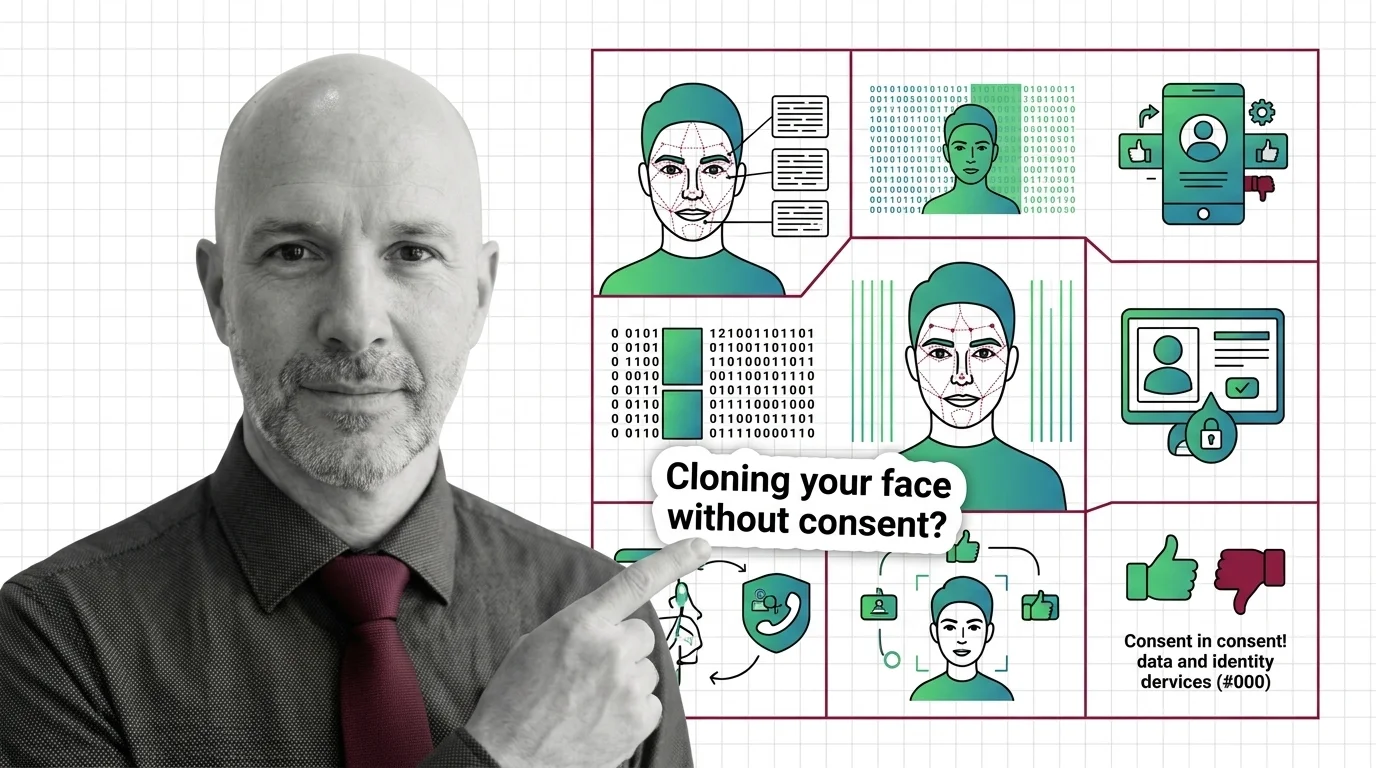
What happens to the box you checked once your face keeps working long after you’ve forgotten you checked it? A platform can now build a working clone of your face and voice from a few seconds of footage and ask for consent in the same breath the clone is being assembled. The clone doesn’t expire. The consent rarely gets revisited.
Consent, through most of human history, was bound to a single moment: a handshake, a signature, a spoken yes trusted to hold. Biometric consent for an AI avatar works the same way — one recorded statement before a face becomes data — even though what gets built from it can be redeployed in contexts nobody discussed, for as long as nobody objects. The platforms call this consent. It behaves more like a one-time waiver wearing consent’s name.
The Click That Outlives the Face
Ask anyone building or buying AI Avatar Generation tools what consent means, and the answer arrives fast: the subject agreed, there’s a recording, the policy covers the rest. That answer closes a conversation rather than opening one. What are the ethical risks of cloning someone’s likeness without an ongoing consent record — not the risk of cloning with consent, but the distance between a single recorded yes and everything the clone goes on to do afterward? That distance is where most of the real damage lives, and almost no platform is required to measure it.
Follow it far enough, and the people most confident consent has been handled turn out to be the ones who built the consent box — not the ones whose face now lives inside it.
The Honest Case for Synthetic Presenters
The strongest version of the pro-avatar argument doesn’t deny any of this — it argues the safeguards already exist and are improving. Avatars depicting a real person should only be created or shared with their expressed permission, per HeyGen’s own ethics page, with violations triggering removal. Synthesia built its market position on the opposite end: enterprise buyers who need audit trails proving every Digital Human in their training videos was built with permission, not assumed.
The machinery deserves credit too. Talking Head Synthesis models handle Lip Sync and micro-expression timing well enough to pass a casual glance; more ambitious systems lean on NeRF and Gaussian Splatting feeding Text-to-3D pipelines, building a navigable presence from a handful of reference images. A training team producing videos in dozens of languages without flying anyone, or a patient seeing their own face deliver a diagnosis — these are real benefits, not marketing hypotheticals.
That honest version is more persuasive than the one usually attacked — which is why the failure mode is worth finding precisely.
What “I Consent” Quietly Leaves Out
Look closely at how that consent is captured, and the hidden assumption becomes obvious: it assumes a face, once authorized, stays put. HeyGen’s newest avatar system can build a usable clone from a single fifteen-second webcam clip — a steep drop from the minutes earlier versions required — and asks for a recorded, on-camera consent statement before processing (HeyGen Help Center). That is a real safeguard, and also a single checkpoint guarding an asset that doesn’t stay still: once the clone exists, it can be redeployed in contexts the original recording never mentioned, with no mechanism for consent to follow it there.
The custody problem compounds when data is mishandled, not just misused: a HeyGen account was compromised earlier this year not through a flaw in the code, but through a support process an attacker talked past its own multi-factor authentication — the biometric data handed over by exploiting a human trying to be helpful, not by breaking the system’s cleverness (Keepnet Labs).
A consent statement that can be social-engineered away from its owner was never consent in the durable sense the word implies. It was permission, captured once, inside a system that treats “once” as good enough forever.
Borrowing a Standard Biometric Law Already Half-Built
There is a different way to structure this, and pieces of it already exist — just not consolidated into one standard. The EU’s AI Act takes a labeling approach: starting 2 August 2026, anyone deploying an AI-generated Deepfake realistic enough to pass as authentic will have to disclose that fact (EU AI Act Service Desk). The TAKE IT DOWN Act, in force in the US since May 2026, requires platforms to remove non-consensual intimate imagery — AI-generated included — within forty-eight hours of notice, backed by FTC fines reaching $53,088 per violation (FTC).
Should governments require explicit biometric consent before AI systems can replicate someone’s appearance? The more interesting answer is being tested piecemeal, through entertainment contracts rather than one sweeping law. SAG-AFTRA’s 2026 agreement requires informed consent for digital replicas and pays performers per line whenever their cloned voice is reused — not once at signing (SAG-AFTRA). Each is a fragment of the same idea: a cloned likeness is not a transaction to authorize once, but an ongoing condition needing continuous accountability.
Likeness Was Never a Signature; It Was a Standing Relationship
Thesis: Biometric consent for an AI-cloned likeness cannot be a single signature collected at onboarding — it has to function as a standing, revocable right, because every safeguard examined here, from HeyGen’s recorded statement to the EU’s disclosure mandate, treats consent as a transaction completed once, while the harm a clone can cause compounds for as long as the clone exists.
Put the fragments side by side and the pattern holds: the labeling rule fires only after a fake is already circulating; the takedown clock starts only once a victim complains; SAG-AFTRA’s protections cover union performers under that specific agreement and say nothing about a private individual whose face is pulled from a public video and cloned outside any studio. The asset is durable; the protections around it are episodic. A face, cloned well, does not expire when the project that justified cloning it ends — the apparatus governing it should match that durability, not treat each use as a fresh, isolated event.
Living Inside a Face That Keeps Working Without You
Sit with what continuous consent would cost an industry that depends on its absence, and a less comfortable question appears: who loses jobs and income when AI avatars replace human presenters and performers? A 2026 press-wire summary of a National Association of Voice Actors survey put the share who’ve lost work directly to AI at roughly one in five, up from one in seven the year before — with a smaller group finding a synthetic clone of their own voice circulating without ever being asked (GlobeNewswire, via NAVA). The underlying report isn’t public, so treat the figures as directional, not exact; the direction is still the point. For a meaningful slice of working performers, this is displacement with no severance attached.
SAG-AFTRA’s response — paying performers per line whenever their cloned voice is reused — treats ongoing use as ongoing pay, not a one-time fee, but only for people with a union already negotiating for them. Everyone outside that protection negotiates alone. None of this resolves into a clean villain — it resolves into a question of who gets continuous protection and who gets a one-time checkbox, tracking bargaining power more than actual harm.
Where This Argument Could Be Wrong
This argument is most vulnerable where consent is already structurally continuous rather than one-time — closer to existing than it appears from the consumer side of the industry. SAG-AFTRA’s per-use compensation model is a working example of ongoing consent enforced through a contract with real teeth, not a hypothetical. If that pattern extends — more jurisdictions holding tool-makers liable for likeness misuse they knowingly enable, or provenance standards becoming widespread enough that a cloned frame carries a traceable record back to its consent statement — the gap between transactional and continuous consent narrows on its own. It isn’t yet clear adoption will spread that far or fast. But the honest version of this essay has to admit the fix might arrive piecemeal, through the fragmented protections it just spent several sections calling insufficient.
The Question That Remains
The honest answer to who controls a cloned face is whoever built the system that cloned it, for as long as nobody else insists otherwise. Biometric consent will keep behaving like a one-time signature until someone with enough standing — a union, a regulator, enough people who recognize their own face in someone else’s video — insists it behave like a standing right instead. The question isn’t whether that shift is coming. It’s whether it arrives because the industry built it in, or because enough people got hurt first.
Ethically, Alan.
AI-assisted content, human-reviewed. Images AI-generated. Editorial Standards · Our Editors