Dedicated Code LLMs vs. Frontier Models in 2026: Where Qwen3-Coder Beats Claude and GPT-5.3 Codex
TL;DR
- The shift: The coding-LLM market split into three tiers, and “best” now depends on which axis you optimize — accuracy, cost, or control.
- Why it matters: Frontier models still win the hardest problems, but open weights win on price and data ownership for the bulk of daily coding.
- What’s next: Teams stop picking one model and start routing tasks across tiers.
For two years the question was simple: which model writes the best code? In 2026 that question stopped having a single answer. Frontier labs pushed accuracy to new highs the same quarter open-weight models got cheap enough to run on a single GPU. The market didn’t pick a winner. It split.
The Market Split Into Three Tiers
Thesis: Dedicated open code models like Qwen3-Coder don’t beat the frontier on benchmark accuracy — they beat it on cost, data control, and the freedom to run the weights yourself, and for most coding work those are now the axes that decide the purchase.
Read the Code LLMs market as three tiers, not one ranking.
Tier one is frontier-closed: Claude Opus 4.8, GPT-5.3-Codex, Gemini 3.1 Pro. They own the hard 20% — the gnarly refactors, the multi-file reasoning, the bugs that hide across modules.
Tier two is open-weight frontier-adjacent: DeepSeek V4-Pro and the Qwen3-Coder family. Within a few points of frontier accuracy, at a fraction of the price, with weights you can download.
Tier three is self-host and local: Qwen3-Coder-480B and the smaller Qwen3-Coder-Next, which runs on a single 24GB GPU (DEV Community). These compete on cost control, privacy, and deployability.
The headline framing — “Qwen3-Coder beats Claude” — is true only if you read “beats” correctly. Not on the benchmark. On the bill.
What the Benchmarks Actually Say
Group the numbers by what they prove, not by who shipped first.
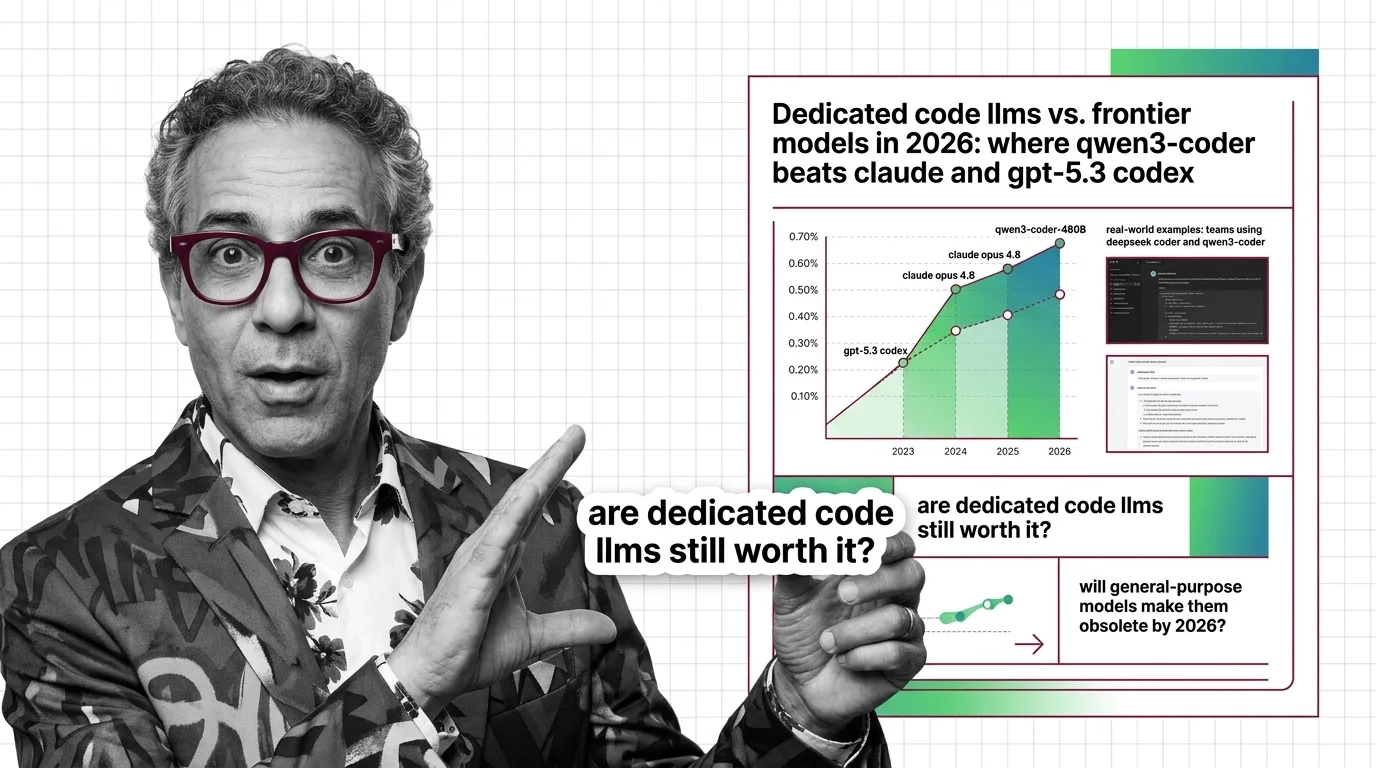
On raw accuracy, the frontier leads. As of late May 2026, Claude Opus 4.8 tops SWE Bench Verified at 88.6%, up from 87.6% on Opus 4.7, and posts 69.2% on the harder SWE-bench Pro (LLM-Stats). It launched May 28, 2026.
DeepSeek V4-Pro lands at 80.6% on SWE-bench Verified — and ships as open weights (NxCode). That is an open-weight model within striking distance of closed frontier accuracy. It launched April 24, 2026.
Qwen3-Coder-480B scores 66.5% on SWE-bench Verified, the best among open models and roughly comparable to Claude Sonnet 4 (Together AI Blog). It is a 480B Mixture Of Experts model with 35B active parameters and a 262K Context Window, under an Apache 2.0 license.
GPT-5.3-Codex, which replaced GPT-5.2 in February 2026 and runs 25% faster, reports 56.8% on the public SWE-bench Pro split (OpenAI). OpenAI did not publish a SWE-bench Verified score, so it does not slot cleanly next to the Verified numbers above.
Now the other axis. Qwen3-Coder-480B runs around $0.22 per million input tokens and $0.90 per million output (PricePerToken). DeepSeek V4-Pro sits near $0.435 input and $0.87 output (Codersera). Against frontier per-token rates, that is a different order of spending.
The accuracy gap is real. The cost gap is larger.
Who Wins
The clearest winners are teams that route by task instead of standardizing on one model.
Send the hard 20% to a frontier model. Send the routine 80% — boilerplate, test scaffolding, straightforward fixes — to an open-weight model at a tenth of the cost. The blended bill drops without the quality ceiling dropping.
Regulated shops win too. Banks, insurers, and health systems that can’t send source code to a third-party API can now self-host an open code model that’s genuinely good. Apache 2.0 weights and a model that fits on one GPU turn “compliance blocker” into “deployment detail.”
DeepSeek and the Qwen team win mindshare. They proved open weights can sit a few points behind the frontier instead of a generation behind.
You’re either paying frontier rates for everything or you’re routing by difficulty. The teams winning on cost in 2026 already route.
Who Gets Squeezed
The loser is the middle: any model that’s neither the most accurate nor the cheapest nor open.
A closed model priced at a premium that no longer leads its benchmark has nothing left to sell. Accuracy is a frontier story. Price is an open-weight story. The squeezed middle owns neither.
Superseded code models are already there. DeepSeek’s older Coder v2/v3 line now sits well below the current frontier on SWE-bench and has been replaced by V4 (NxCode) — running last year’s open model is a measurable accuracy tax for no savings.
And the “one model for everything” procurement strategy just aged badly. Standardizing your whole org on a single frontier API made sense when the alternatives were toys. The alternatives stopped being toys.
Either you control your weights and your data, or your vendor does. More teams are deciding that question deliberately now.
What Happens Next
Base case (most likely): Multi-model routing becomes the default architecture — a cheap open model for bulk work, a frontier model for the hard cases. Signal to watch: Coding tools and IDE assistants ship built-in model routing rather than a single hardwired backend. Timeline: Through the rest of 2026.
Bull case: Open-weight models close the accuracy gap further, and self-hosting tooling matures enough that mid-size teams run frontier-adjacent models in-house without a dedicated MLOps group. Signal: An open model crosses into the low 80s on SWE-bench Verified at commodity hosting cost. Timeline: Late 2026 into 2027.
Bear case: Frontier labs cut prices aggressively, collapsing the cost advantage and pulling routine work back to closed APIs. Signal: A major frontier provider drops per-token coding rates by half or more. Timeline: Any quarter — it’s a pricing decision, not a research milestone.
Frequently Asked Questions
Q: How does Qwen3-Coder-480B compare to Claude Opus 4.8 on SWE-bench in 2026? A: On SWE-bench Verified, Claude Opus 4.8 scores 88.6% versus Qwen3-Coder-480B’s 66.5% (Together AI Blog). Opus wins accuracy outright. Qwen wins on price and open Apache-2.0 weights you can self-host — a different competition entirely.
Q: Are there real-world examples of teams using DeepSeek Coder and Qwen3-Coder in production? A: No major team has publicly documented these models in production yet. The pattern is clear, though: regulated shops self-host open weights for data control, while cost-sensitive teams route bulk coding tasks to them and reserve frontier models for the hard problems.
Q: Are dedicated code LLMs still worth it when general models top coding benchmarks? A: Yes, but the reason changed. They no longer win on raw accuracy. They win on cost per token, data privacy, and running on your own hardware. If those matter more than the last few benchmark points, they pay off.
Q: Will general-purpose frontier models make dedicated code LLMs obsolete by 2026? A: No. Frontier models lead on the hardest tasks, but open code models are within a few points at a fraction of the cost. The market is splitting by use case, not collapsing into one winner. Obsolescence is the wrong frame.
The Bottom Line
Stop asking which code model is best and start asking which is best for which task. The frontier owns the hard problems; open weights own the cost and control story. The teams that win in 2026 route across tiers instead of betting on one.
Stay ahead, Dan.
AI-assisted content, human-reviewed. Images AI-generated. Editorial Standards · Our Editors