Conversation History, Memory Layers, and the Prerequisites for Multi-Turn LLM Design
ELI5
An LLM has no memory between API calls. Multi-turn prompt design is the architecture of re-injecting conversation history so the model can reason across exchanges — not as magic, but as engineered context.
You send a follow-up question to an LLM API, and the model answers as though it remembered the prior exchange. It did not. Your application did — by bundling the prior exchange into the new request before the call went out. The illusion of conversational memory is a construction, and understanding exactly how that construction works is the prerequisite for understanding every failure mode in multi-turn systems.
The Grammar the Model Actually Reads
Most developers learn that LLMs are stateless and then treat them as stateful anyway. The gap between those two facts is not a defect in developer cognition — it is a gap in the abstraction layer that the multi-turn system must fill. That filling has a grammar: structured message roles, a serialization format, and a re-injection pattern that the application must implement explicitly on every call.
What are the main components of a multi-turn LLM conversation system?
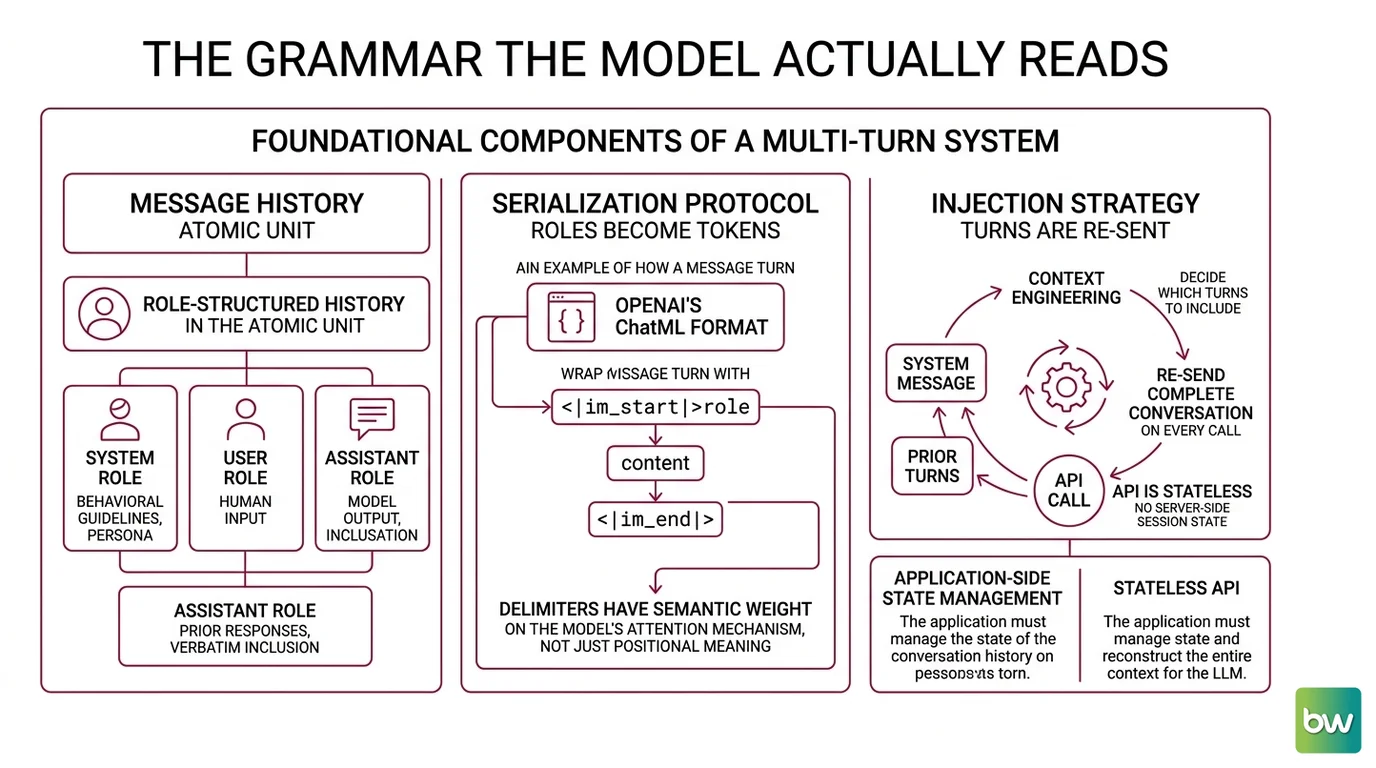
Every Multi-Turn Prompt Design system has three foundational components.
The history is the prompt. Role-structured message history is the atomic unit. LLM chat APIs recognize three fixed roles: system, user, and assistant (arpitbhayani.me). The system role carries behavioral guidelines — the
System Prompts layer that defines persona, constraints, and scope. The user role carries the human’s turns. The assistant role carries the model’s prior responses, included verbatim so the model conditions its current output on what it already generated.
The serialization protocol defines how those roles become tokens. OpenAI’s ChatML format — the canonical serialization example, used in variant form by other providers — wraps each turn with <|im_start|>role, the content, and <|im_end|> markers (arpitbhayani.me). These delimiters are not administrative scaffolding; the model was trained to recognize them, which means role boundaries carry semantic weight in the attention mechanism, not just positional meaning.
The injection strategy is the decision the application must make: which turns to include, in what order, and how many. This is where Context Engineering enters multi-turn design. Because the API is stateless, the application must re-send the complete conversation — system message plus every prior turn — on every call (arpitbhayani.me). There is no server-side session state. No continuity in the wire protocol.
The consequence is arithmetic: token cost grows linearly with conversation length (arpitbhayani.me). A conversation at turn N carries N times the token overhead of turn 1 — proportional to every prior turn accumulated — before a single word of new content is generated.
This is not an edge case to be optimized around later. It is the structural reason why context window size became a competitive signal for conversational AI. As of June 2026, thirteen frontier models ship 1M+ token windows — Claude Opus 4.8, GPT-5.4, and Gemini 3.1 Pro among them (Morph LLM Comparison). The window question, however, is not simply what fits. It is what is affordable to inject on every turn, for every user, across every concurrent session in production.
When the Context Window Runs Out of Room
A 1M-token context window handles a very long conversation in a single session. It does not handle anything across sessions, users, or time. When you need the system to recall a preference from last week, a constraint established in a prior session, or a user’s behavioral pattern accumulated over hundreds of interactions, you need a memory layer that lives outside the context — retrieved selectively into it, not re-injected wholesale.
What is the difference between conversation buffer memory and summary memory in LLMs?
Conversation buffer memory keeps raw message history: every turn, verbatim, in sequence. Summary memory compresses that history into a condensed representation, trading fidelity for token efficiency. Both strategies predate the LangChain memory API. Both are now beyond it.
ConversationBufferMemory was deprecated in LangChain v0.3.1, and RunnableWithMessageHistory was deprecated in LangChain v0.3 (db0.ai blog). The current recommendation for both is LangGraph persistence — a different architectural model that separates conversation state from application logic. Migration is not optional; both classes are on the LangChain 2.0 removal roadmap.
Security & compatibility notes:
- ConversationBufferMemory: Deprecated in LangChain v0.3.1, removed in the LangChain 2.0 roadmap. Migrate to LangGraph checkpointers.
- RunnableWithMessageHistory: Deprecated in LangChain v0.3. Migrate to LangGraph persistence.
- LangMem SDK (v0.0.30, Oct 2025): Pre-1.0 release — internal API surface may change before stable release. Avoid quoting internal class names in production code.
- Prompt injection in multi-turn agents: Multi-turn systems that accept external input face active exploitation risk. OWASP’s 2026 agentic AI guidance ranks prompt injection as the top agentic security risk, with documented attacks including a critical Copilot Studio vulnerability (CVE-2026-21520). Such systems also risk Prompt Leakage — where system prompt content surfaces in model outputs — when injected turns carry adversarial instructions. Any system that injects external data into conversation history requires explicit injection and leakage guards. (Help Net Security)
The LangGraph model distinguishes memory by persistence scope. Short-term memory is thread-scoped: LangGraph checkpointers preserve conversation state within a single session (LangChain Docs). When the session ends, the short-term state ends with it. Long-term memory is cross-thread: LangGraph’s BaseStore persists information across sessions, users, and time (LangChain Docs).
The LangMem SDK formalizes three memory types that operate on top of that foundation (LangMem Docs):
- Semantic memory stores facts and user preferences — information that persists because it is true, not because it happened in a particular session.
- Episodic memory preserves successful past interactions as behavioral examples the system can draw on when a similar situation arises.
- Procedural memory encodes behavioral guidelines and response patterns. It begins as a system prompt definition and is designed to evolve as the system accumulates interaction history.
Compression is lossy — how lossy is a design decision. The transition from buffer (verbatim history) to semantic store sacrifices specific detail in exchange for scope. Episodic memory lets you replay a successful interaction pattern across sessions; it does not let you quote a specific turn verbatim from three sessions ago. Both the in-session buffer and the cross-session store are architectural choices with distinct failure modes.
What the Stateless Layer Demands of You
Multi-turn systems do not fail randomly. They fail in the direction of their design gaps. A system built without a clear history management policy degrades silently as conversations age. A system built without injection controls fails loudly when a user pastes in an adversarial document. The structural facts of the LLM API create specific, predictable demands — and those demands must be understood before you write the first line of conversation management code.
What do I need to understand before designing multi-turn LLM prompts?
Three conceptual prerequisites matter most.
The first is Role Prompting discipline. In a single-turn prompt, a weakly defined system role is recoverable — the user’s message provides enough signal for a useful response. In a multi-turn session, the system role sets the behavioral prior that every subsequent turn is conditioned on. That prior accumulates authority as the conversation grows: the more turns there are, the more the model samples from a distribution shaped by what was established at turn zero. Instruction Following fidelity degrades across turns when the system message is underdetermined, because user messages progressively dilute the system-role signal. The system message is not initialization — it is the behavioral contract. Get it right before accumulating turns against it.
The second is understanding what Context Window size actually does and does not control. The window determines what fits inside a single inference pass. It does not determine what is attended to effectively within that pass, what persists between sessions, or what is foregrounded when the context grows long. There is a well-documented pattern in long-context inference: information in the middle of a long context receives less attention weight than information near the boundaries. Context engineering — the active management of what occupies each position in the context, in what order, and at what density — is the practice that makes window capacity useful. Window size is a capacity figure; it is not a substitute for structural design.
The third is recognizing that history is an attack surface. Multi-turn systems that accept external data — user-provided documents, retrieved chunks, tool outputs — expose each injected artifact as a potential vector. Any Meta Prompting strategy that manages history must include an adversarial model of what gets into that history. Injected instructions can persist across turns and accumulate influence without triggering immediate detection. Prompt injection risk in multi-turn systems scales directly with the system’s openness to external data; it is not a theoretical concern that can be addressed later.
One structural constraint, not a prerequisite but closely adjacent: Structured Output discipline. Multi-turn systems that pass model output from one turn as input to the next are sensitive to output format instability. If turn 3 produces a structured object that turn 4’s logic parses, any format drift in turn 3 compounds into downstream failures. Prompt Engineering for multi-turn systems must include explicit output contracts for every turn that feeds the next — not as documentation, but as enforced behavioral constraints.
Rule of thumb: Design each turn’s output contract before designing the next turn’s input expectations.
When it breaks: Multi-turn systems degrade most predictably when the effective context fills with low-signal history — prior turns that accumulate without contributing — and when the system message’s behavioral contract erodes as user turns dilute it. Retrieval-augmented history selection (choosing which prior turns to re-inject based on semantic relevance, not recency alone) partially addresses the first failure mode; periodic re-anchoring of the system role is the available response to the second.
The Data Says
The illusion of conversational memory is structural, not emergent: built by the application layer, paid for in tokens on every call, and made durable only through deliberate memory architecture that extends beyond the context window. The system role, the history selection policy, and the memory store design are not implementation details — they are behavioral contracts that determine what the system can know and how it degrades. Design the conversation layer with schema rigor: decisions made at turn zero propagate forward, compounding both utility and failure.
AI-assisted content, human-reviewed. Images AI-generated. Editorial Standards · Our Editors