Context Windows, Token Budgets, and Why System Prompts Longer Than 300 Words Backfire
ELI5
System prompts are instructions developers place before the conversation to shape model behavior. Beyond 300 words, additional instructions don’t improve compliance — they compete for the model’s attention, and the constraints buried in the middle are statistically the first to fail.
Most engineers treat System Prompts like legal contracts. More clauses feel safer. Anticipate every edge case; enumerate every constraint; cover every failure mode in advance.
The model’s attention mechanism has a different opinion.
There is a well-documented asymmetry in how transformers process long instruction sets: tokens near the beginning and end of a context receive disproportionately high attention; tokens in the middle receive the least. Write a 1,500-word system prompt and you have likely buried your most critical behavioral rules where the model is statistically least likely to honor them. The failure isn’t random. It’s geometric.
The Architecture Every System Prompt Has to Work Through
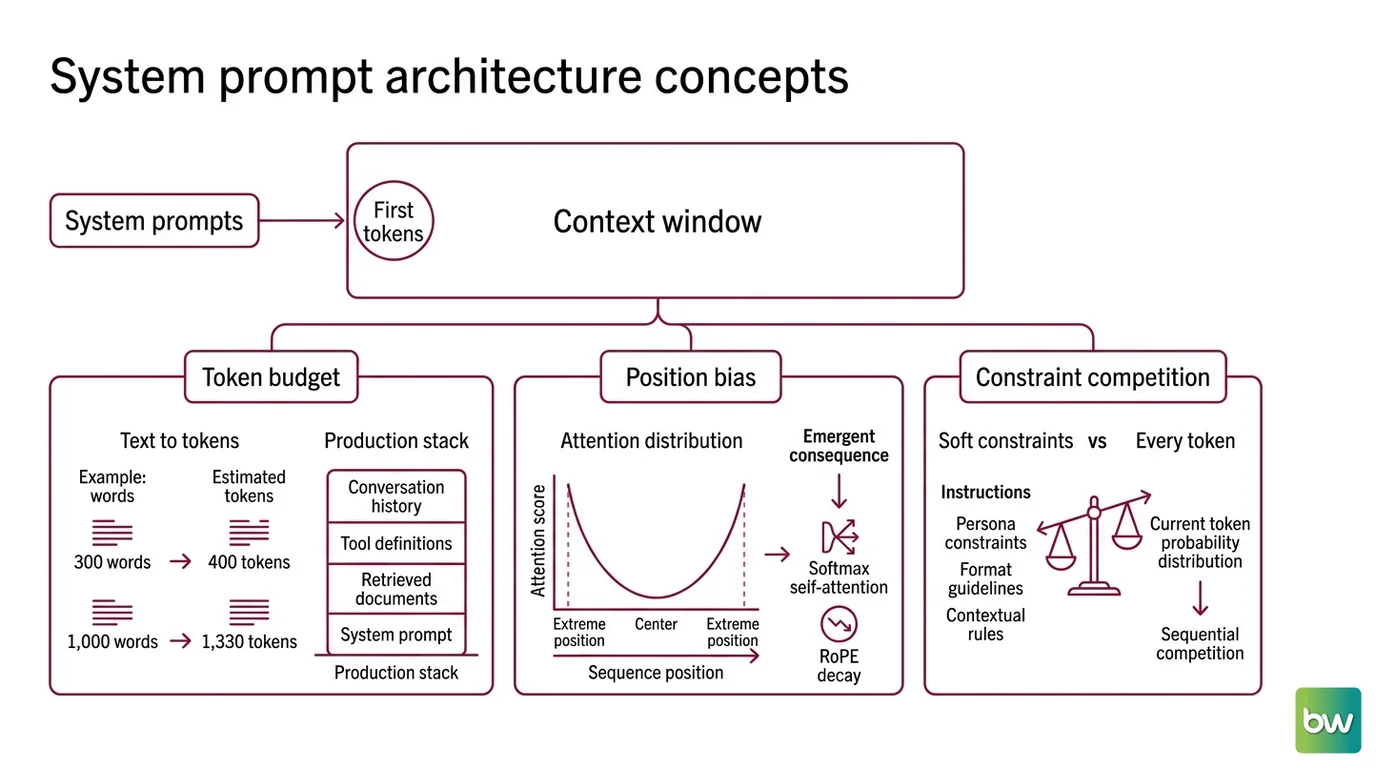
System prompts enter the model’s processing pipeline before any user message — they are the first tokens in the Context Window. But “first” doesn’t mean “foremost.” Every subsequent token in the conversation also occupies the context window, and the model’s attention must distribute across all of them simultaneously.
Understanding what that distribution means in practice requires grasping three properties of the underlying architecture — properties that determine when system prompts work and when they silently break.
What concepts must developers understand before writing system prompts for production?
The first concept is token budget. A system prompt written in plain English doesn’t arrive at the model as text; it arrives as tokens, at a conversion ratio of roughly 0.75 words per token. A 300-word system prompt consumes approximately 400 tokens. A 1,000-word system prompt consumes approximately 1,330. Production applications stack conversation history, tool definitions, and retrieved documents on top — and the model’s instruction-following depends on how those token categories interact inside the available window.
The second concept is position bias. Transformer attention is not uniform across a sequence. Research tracing the exact mechanism (arXiv 2603.10123) links this to the interaction between softmax self-attention and RoPE (Rotary Position Embedding) long-term decay: tokens at extreme positions accumulate higher attention scores than tokens at the center of the same sequence. This isn’t a bug. It’s an emergent consequence of the architecture’s positional encoding — and you cannot configure your way around it.
The third concept is constraint competition. A system prompt is not a ruleset applied sequentially before generation; it is a set of soft constraints on the probability distribution the model samples from, and those constraints compete with every other token in context. When the constraints are numerous, they do not stack cleanly. An empirical study (arXiv 2602.15228) found that increasing prompt specificity does not monotonically improve correctness — effectiveness is configuration-dependent and, past a certain point, counterproductive.
How do context windows and token limits constrain system prompt design?
By mid-2026, every major flagship LLM ships with context windows of at least one million tokens — Claude Fable 5, Opus 4.8, Sonnet 4.6, and GPT-5.5 all sit at that ceiling. The headline numbers are genuinely large. They are not, however, the binding constraint.
The binding constraint is reasoning fidelity under token load — how reliably the model follows instructions when the context is full rather than empty.
Anthropic Engineering describes what they call “context rot”: as the token count in the active context window grows, recall accuracy decreases. The attention relationships the model must maintain scale nonlinearly with sequence length — the same mechanism that enables global coherence also becomes strained when there is too much to be globally coherent about. Anthropic’s engineering guidance distills this to a single design principle: “the smallest possible set of high-signal tokens.” No hard limit specified, but the direction is unambiguous.
Production data gives the numbers their shape. Under 800 tokens in a system prompt is excellent; the range of 800–2,500 tokens is typical in production applications. Above 2,000 tokens is often a signal of architectural drift rather than genuine complexity. As a point of comparison: adding irrelevant history to the context — growing from a focused, 300-token version to a 113k-token one — can drop accuracy by 30% on the same task (MLOps Community).
Where Longer Prompts Start Breaking
The architecture establishes the conditions. The failure modes are what those conditions produce in practice.
What are the technical failure modes of system prompts in production applications?
There are four failure modes worth naming precisely, because each corresponds to a different architectural pressure point.
Middle burial is the most pervasive. Liu et al. documented accuracy degrading by more than 30% when critical information is placed in the middle of a long context — a phenomenon named “lost in the middle” (arXiv, Liu et al., 2023). A system prompt that places its core behavioral rules after an introductory persona section and before a formatting preferences list has structurally buried those rules in the low-attention zone. Position bias does not represent a reading comprehension failure; it represents a probability mass redistribution that the model cannot override by “trying harder.”
Constraint overflow occurs when the number of simultaneous requirements exceeds the model’s capacity to satisfy them concurrently. Research shows that even capable frontier models demonstrate marked degradation as constraint count increases. Adding a tenth constraint to a nine-constraint prompt does not yield a proportional compliance improvement — it frequently produces compliance collapse on the most complex constraints first. The relationship is sublinear, then nonlinear, then counterproductive.
Instruction-following non-linearity is the subtlest failure mode. The same study that documented non-monotonic specificity (arXiv 2602.15228) also found the effect is sharply model-dependent: an identical long system prompt produced −3.7% accuracy degradation in one model family and −38.8% in another. There is no single safe length that generalizes across architectures.
System prompt leakage is the security failure mode. OWASP classifies it as LLM07:2025 — a top-10 vulnerability in production LLM applications. When a system prompt grows large enough to encode business logic, internal tooling references, or security constraints, the probability that a user prompt can extract its contents increases. Attack surface and prompt length are not independent variables.
Security & compatibility notes:
- Copilot Studio (CVE-2026-21520, CVSS 7.5): Indirect prompt injection vulnerability affecting production deployments. No complete architectural fix exists — defense requires layered controls (input validation, output filtering, privilege scoping).
- GitHub Copilot (CVE-2025-53773, CVSS 9.6): Critical prompt injection via malicious repository content, enabling arbitrary instruction execution through context. Treat all user-controlled content reaching the context window as untrusted input.
Why do system prompts longer than 300 words degrade LLM reasoning performance?
The 300-word figure is a practitioner threshold, not a vendor specification. No Anthropic, OpenAI, or Google documentation specifies 300 words as a hard limit. What the underlying research does specify is a reasoning degradation threshold of approximately 3,000 tokens in combined system prompt and context load — beyond which instruction-following quality drops measurably for moderate tasks (MLOps Community). The 300-word guideline is a practical proxy: 300 words converts to roughly 400 tokens for the system prompt alone, leaving substantial headroom before the degradation zone begins. Practitioners converge on it because it consistently tracks below the inflection point.
Not thoroughness. Interference.
When a system prompt exceeds the 150–300 word range for moderate tasks — the range where practitioners observe reliable instruction-following — the problem is not that the model “forgets” instructions. The problem is that the attention mechanism distributes probability mass across a larger token surface, reducing the relative weight assigned to any individual constraint. Additional rules past this range do not accumulate into higher compliance; they dilute the statistical influence of what is already there. Diminishing returns set in by 500 words (MLOps Community). The attention math does not distinguish intent from noise.
The math is architectural. Attention scores that drive next-token prediction are computed over the entire context simultaneously. A longer system prompt doesn’t add influence — it redistributes it.
What the Architecture Predicts
Understanding position bias and constraint competition turns observation into engineering rules.
If you extend a system prompt past 500 words, the constraints in the middle third will be the first to fail. Not randomly. Geometrically. Front-load your highest-priority behavioral rules, place secondary constraints toward the end, and treat the middle of a long prompt as a structurally low-attention zone.
If your production application shows inconsistent instruction-following that is not reproducible in a fresh session, the likely cause is context accumulation across turns. Each conversational turn adds tokens; the effective attention weight of the system prompt decreases relative to the growing history. A system prompt that performs reliably in turn one may not perform reliably in turn fifteen, because the denominator has changed.
If you need to handle many behavioral constraints, Context Engineering offers a structural alternative: organize the system prompt hierarchically, with a short core — under 200 words — containing your highest-priority rules, and a retrieval layer that fetches additional constraints dynamically when relevant. This is how Meta Prompting patterns address scale: rules on demand rather than rules in full, so the active context never exceeds the high-fidelity zone.
Role Prompting interacts with position bias in a specific way: assigning a clear role at the very beginning of the system prompt concentrates early attention on behavioral framing before any specific constraints appear. The role statement becomes an anchor; subsequent instructions are interpreted relative to it. This is not a workaround — it is a deliberate use of position bias working in your favor.
Rule of thumb: if a system prompt cannot be read aloud in under 90 seconds, it likely contains constraints that belong in retrieval, not in the prompt.
When it breaks: the 300-word guideline assumes a stationary context — a fixed exchange between one system prompt and one user message. In production agentic pipelines where tool outputs, retrieved documents, and multi-turn history all accumulate in the same context window, the binding constraint shifts from system prompt length to total context load. A well-trimmed 200-word system prompt can fail inside a 150k-token conversation, because the absolute token weight of the system prompt instructions has been diluted by everything else in the window.
The Data Says
The constraint is not the context window ceiling — by mid-2026, one million tokens is the standard for flagship models. The constraint is attention fidelity: position bias degrades instruction-following at roughly 3,000 tokens of combined context load, and middle-positioned instructions lose statistical weight first. The practitioner guideline to keep system prompts under 300 words exists because it keeps the model inside the zone where attention is reliably distributed. Past that threshold, additional instructions do not accumulate — they compete.
AI-assisted content, human-reviewed. Images AI-generated. Editorial Standards · Our Editors