Context Windows, KV Cache, and Model Pricing: Prerequisites for Optimizing LLM Spend

ELI5
Before you can cut your LLM API bill, grasp three fundamentals: how context windows accumulate cost per request, why output tokens cost five to ten times more than input, and how the KV cache turns repeated context into a steep discount.
Most developers who encounter a large API invoice reach the same diagnosis: the wrong model. It is a reasonable reflex — and usually the wrong analysis. LLM inference costs are not primarily a pricing-table problem; they are a memory and computation problem, embedded in how attention mechanisms process context during the decode phase.
Not a pricing problem. A memory problem.
The Hidden Arithmetic of LLM Inference
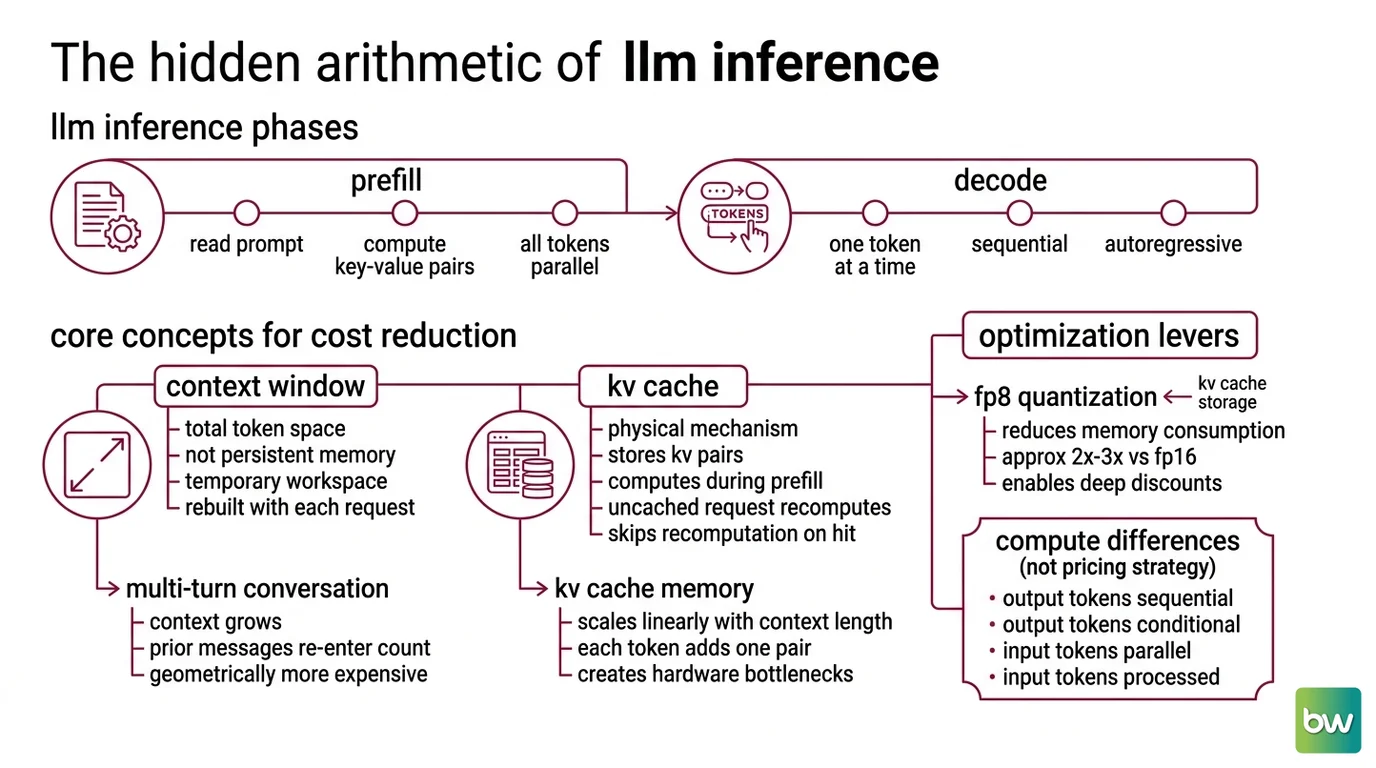
API cost has two distinct phases: prefill, where the model reads your prompt and computes key-value representations for every token, and decode, where it generates one token at a time. These phases differ in compute profile, memory footprint, and which optimization levers apply. Understanding the split is the prerequisite for everything that follows.
what concepts do I need to understand before I can reduce my LLM API costs
A Context Window is the total token space available to the model in a single inference call — not a persistent memory, but a temporary working space rebuilt with each request. In a multi-turn conversation, every prior message re-enters the token count with each new turn. The context grows; so does the bill. Longer conversations are not merely longer — they are geometrically more expensive per token as the context fills.
The KV Cache is the physical mechanism behind prompt caching. During prefill, the attention mechanism computes a key-value pair for each input token and stores it. For an uncached request, this computation runs fresh with every call. When prompt caching is active, the provider stores those KV pairs and skips recomputation on a hit. KV cache memory scales linearly with context length — each additional token adds exactly one KV pair — which is why long-context inference creates hardware bottlenecks. FP8 quantization of KV cache storage can reduce memory consumption by roughly two to three times compared to FP16 representations, per arXiv KV Cache paper; that compression is part of what lets providers offer deep discounts on cache hits without absorbing the full infrastructure cost.
Output tokens are sequential and autoregressive — each one generated conditionally on all preceding tokens inside the context window. Input tokens are processed in parallel during prefill. The difference is compute, not pricing strategy. As of June 2026, Claude Sonnet 4.6 charges $3 per million input tokens and $15 per million output tokens (Anthropic Docs); GPT-5.4 charges $2.50 in and $15 out (OpenAI Docs). If your system prompts are long and your outputs are brief, you have different levers than if the inverse holds.
Model Tiering organizes available models by capability-cost ratio. As of June 2026, the budget tier runs from $0.10 to $0.75 per million input tokens (Gemini 2.5 Flash-Lite, GPT-5.4-Nano); mid-tier from $1 to $3 (Claude Haiku 4.5, GPT-4.1, Claude Sonnet 4.6); premium from $5 to $10 (Claude Opus 4.8, Claude Fable 5, GPT-5.5), per major provider pricing pages. Model Routing directs each request to the appropriate tier — often through proxies like LiteLLM, which supports 100+ LLM APIs via an OpenAI-compatible interface (LiteLLM Docs). The economics only hold when routing includes quality validation: a budget model requiring two retries will outspend a mid-tier model that answers correctly on the first attempt.
The discount stack compounds quickly. Both Anthropic and OpenAI’s current model families offer a 90% discount on cache hits — input tokens served from the KV cache rather than recomputed (Anthropic Docs). Cache writes cost more upfront: 1.25× base input for a five-minute TTL, or 2× for a one-hour window (Anthropic Docs). The five-minute write cost is recovered after a single re-read; the one-hour window breaks even after two reads. The Batch API adds a separate 50% discount on asynchronous requests — both Anthropic and OpenAI offer this, in exchange for up to 24-hour turnaround (OpenAI Docs). Stacking prompt caching with the batch API on eligible workloads can reduce effective spend by more than 90% compared to synchronous, uncached calls (Anthropic Docs). The Token Budget is the upstream control: constraining how much context accumulates per request keeps the cacheable prefix stable and limits the total token footprint before the discount mechanisms even fire.
LLM Observability is how you locate the actual cost driver before guessing which lever to pull. Open-source tracing with Langfuse, proxy-based cost attribution with Helicone, and OpenTelemetry-compatible stacks like Arize Phoenix and OpenLLMetry give per-request cost decomposition — which model served the request, whether the cache was warm, which prompt variant was active. LLM Cost Management without this instrumentation is pattern-matching against symptoms, not diagnosis.
One compatibility note before you build cost estimates: Anthropic’s tokenizer changed with Opus 4.7, using up to 35% more tokens for identical text compared to earlier model families (Anthropic Docs). Any token count assumptions built on pre-4.7 behavior will systematically undercount actual spend on newer models.
Where Optimization Quietly Fails
The concepts above describe the levers. Each lever has a failure mode — a condition under which the expected saving either doesn’t materialize or introduces a new problem downstream. The failure modes are mechanical too; they follow from the same architecture as the savings.
what are the technical failure modes of LLM cost optimization including cache invalidation routing latency and quality regression
Cache invalidation: the prefix stability dependency. The KV cache is keyed to the exact byte sequence of the cached region. Any modification to the beginning of that region — a session timestamp injected into the system prompt, a dynamically generated preamble, a request-specific identifier prepended to the context — invalidates the entire cached entry. The correct pattern is static content anchored at the top of the prompt, with dynamic content appended at the end; the common mistake is the reverse. When the cache is invalidated consistently, every write incurs its upfront cost with no recovery from subsequent reads. Cache hit rate is the signal: if it stays near zero despite prompt caching being active, the prompt architecture is the cause.
Routing latency: overhead that accumulates under load. Adding a proxy routing layer introduces per-request latency before the inference call begins. Latency-based routing compounds this: it requires measuring response times across providers before selecting one. For latency-sensitive pipelines, or pipelines where request volume makes even small per-call overheads significant, the latency cost of the routing layer can outweigh the cost savings it delivers. The routing layer earns its overhead when task distribution is highly variable and the model-capability spread across the route is wide; it earns less when most requests have similar requirements.
Quality regression: the total-cost trap. Routing to budget models without quality instrumentation produces a failure mode the invoice doesn’t surface directly: increased retry rates, human review, and downstream corrections. A budget model with a high error rate on a given task class may cost more per successful outcome than a mid-tier model would have. Measure cost per outcome, not per call — that is the only number that separates apparent savings from actual ones.
Semantic caching: real potential, variable results. Semantic caching stores responses for queries that are semantically similar rather than byte-identical, potentially reducing API calls significantly. Academic benchmarks report reductions of roughly 61 to 69 percent in API calls in controlled settings (arXiv semantic caching), though real-world hit rates depend heavily on query diversity; workloads with high semantic entropy may see substantially lower effective rates. GPTCache is a common open-source implementation, though it has not added new model or API adapters since mid-2025 and relies on an OpenAI-compatible compatibility layer for newer models (GPTCache GitHub). Factor current maintenance status into any production evaluation.
LiteLLM security: LiteLLM is widely used for multi-provider routing and cost management. As of June 2026, it carries multiple critical, actively exploited vulnerabilities. Do not run any version below 1.83.7 in an environment with authenticated user traffic, and audit whether your exposure to these vulnerabilities aligns with the current advisory.
Security & compatibility notes:
- LiteLLM SQL Injection (CVE-2026-42208, CVSS 9.3): Actively exploited in the wild. Affected: versions v1.81.16–v1.83.6. Fix: upgrade to v1.83.7+ (LiteLLM Docs).
- LiteLLM Command Injection (CVE-2026-42271, CVSS 8.7): Listed in the CISA Known Exploited Vulnerabilities catalog. Any authenticated user can execute arbitrary commands on the host.
- LiteLLM Privilege Escalation + RCE (CVE-2026-47101/47102/40217, CVSS 9.9): Chained vulnerabilities allow escalation from low-privilege user to admin to remote code execution.
- LiteLLM Supply Chain Attack (March 2026): PyPI packages litellm==1.82.7 and litellm==1.82.8 were compromised for approximately 40 minutes before quarantine; verify package integrity if these versions appear in any dependency chain.
What the Architecture Predicts
The mechanics above generate predictable consequences — conditions you can reason about before they appear in your billing dashboard.
If your system prompt is stable and long, prompt caching is your highest-leverage lever. If your context grows with each conversation turn without explicit management, costs grow with it — and the cache warm-up requires the cached prefix to remain identical across sequential requests. If you route to budget models without measuring quality per task class, you are optimizing the line item without measuring the outcome. If you introduce a routing proxy without measuring per-request latency overhead in your specific workload, you may be adding cost in the dimension you cannot see on the invoice.
The stacking arithmetic is also directional: batch processing eliminates latency tolerance as a constraint, which means it pairs naturally with tasks where async completion is acceptable — document processing, scheduled analysis, batch inference over datasets. Real-time conversational use cases cannot use the batch discount by definition.
Rule of thumb: measure cache hit rate and cost per successful outcome before measuring cost per API call.
When it breaks: Prompt caching fails when the cache TTL expires before enough reads accumulate to recover the write cost. In low-traffic environments — or workloads where requests arrive in bursts separated by gaps longer than the TTL — every write incurs its cost with no offset from reads. The five-minute window in particular requires consistent request volume to remain economically favorable. Measure the actual distribution of inter-request intervals in your workload before committing to a caching architecture; the breakeven math depends on traffic patterns, not on the discount rate alone.
The Data Says
The token pricing asymmetry between input and output, the KV cache as the physical mechanism underlying prompt caching, and the compounding of cache hits with batch discounts together define the cost architecture. Any optimization that starts with model selection before understanding these mechanics is addressing a symptom. The failure modes — cache invalidation from dynamic prefixes, latency accumulation in routing layers, quality regression from undertested model swaps, security exposure in proxy tooling — are each predictable from the same architecture that makes the discounts possible. The map and the trap are drawn on the same diagram.
AI-assisted content, human-reviewed. Images AI-generated. Editorial Standards · Our Editors