Closed APIs and Opaque Scoring: The Ethics of Outsourced Reranking
The Hard Truth
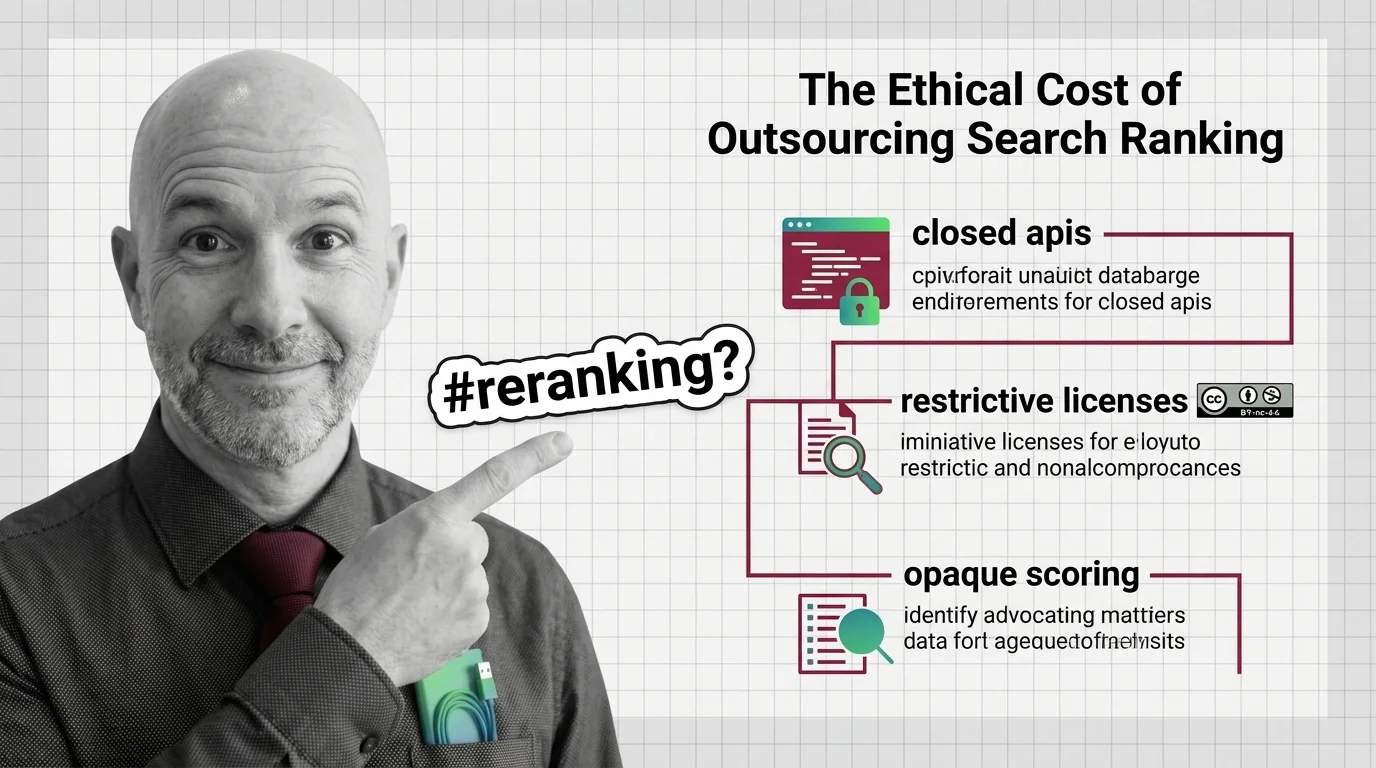
The model that decides which documents your AI sees first arrives with a license forbidding commercial use, or it does not arrive at all and lives behind a billed API. The scoring is invisible, the rules are someone else’s, and the consequences belong to you. What does it mean to outsource judgment without auditing it?
The Agentset Reranker Leaderboard tells a quiet story most teams never read. As of April 2026, three of the five strongest Reranking models on that leaderboard carry non-commercial licenses, and two more are closed APIs without public weights. Of the leaders engineers race to integrate, exactly zero combine state-of-the-art quality with permissive open-source terms. That is not an accident. It is a choice — about who gets to own the layer that decides what counts as relevant.
The Question We Stopped Asking About Search
Search ranking used to be a public debate. Librarians fought about it. Editors fought about it. Newspapers had ombudsmen who answered for the choices their pages made. When Google rose, the debate moved into computer science papers, but we still recognized ranking as a contested human act. Then Retrieval Augmented Generation happened, and ranking became infrastructure. The Cross-Encoder that scores your top fifty candidates does not appear in your product copy or your privacy policy. It is, in most stacks, a single API call almost nobody on the team can explain.
The cross-encoder is not neutral. It is a learned function that absorbed a worldview from its training distribution and now applies that worldview, query by query, to whatever your users ask. Who built it? Under what license can you study it? And when its choices affect a hiring shortlist or a credit decision, who is accountable for what the model preferred?
What the Strongest Defense Sounds Like
The serious case for closed and restrictively licensed rerankers is not silly. Zerank-2 from ZeroEntropy reaches the top of the public leaderboard with a 4-billion-parameter model fine-tuned from Qwen3-4B, per ZeroEntropy’s Hugging Face card. Jina Reranker v3 leads on latency; its Listwise Reranking architecture is real progress on multilingual retrieval. Cohere Docs lists Rerank 3.5 at $2.00 per 1,000 searches with enterprise SLAs. Voyage Rerank, hosted-only inside MongoDB Atlas after the February 2025 acquisition described in MongoDB’s investor release, gives buyers a single throat to choke.
Restrictive licenses, the argument continues, are how research labs recoup training costs. A CC-BY-NC release at least lets researchers benchmark and study. Closed APIs are a service agreement — like any other piece of cloud infrastructure your company already pays for.
This is not a strawman. Smart people believe it. And inside its own frame, it is correct.
The Assumption Hiding Inside the Defense
The defense assumes ranking is a technical service like CDN delivery or DNS resolution — a commodity utility we can rent without thinking about who provides it. But ranking is not utility. Ranking is editorial. Each score is a quiet vote about which voice wins, which document gets read, which perspective shapes the answer your user sees.
A BGE Reranker run by your team and a Cohere Rerank API call may produce similar nDCG numbers on a public benchmark, yet they sit in radically different governance positions. With BGE you can audit the weights, run interpretability probes, and explain — to a regulator, to a user, to yourself — what the model is doing. With a closed API you cannot. Accountability cannot be subcontracted.
The CC-BY-NC-4.0 middle ground is the most uncomfortable. Zerank-2’s weights are downloadable today. Jina Reranker v3 carries the same non-commercial license despite its open-source framing, per the Jina AI Blog. Contextual AI’s reranker-v2 attaches an even stronger CC-BY-NC-SA clause requiring derivatives to inherit non-commercial terms, per Contextual AI’s Hugging Face card. The “open source” framing tells you the model is transparent. The license tells you transparency stops at the door of any system that actually serves users.
A Different History Tells a Different Story
There is a useful historical parallel. Library science once treated cataloging as a moral activity. The Dewey Decimal classification and Library of Congress subject headings were public documents revised across decades in response to bias claims they could not ignore. Catalogers were credentialed; their decisions were inspectable. When researchers showed a subject heading erased a community’s experience, you could point to the heading and demand a revision.
Algorithmic ranking has none of that. The cross-encoder cannot tell you why it preferred one document over another beyond a scalar score. Mechanistic interpretability research is genuinely promising — arXiv 2502.04645 shows that BERT cross-encoders implicitly learn BM25-like circuits — but no production reranker currently provides explanations alongside its scores. The score is the only artifact. When the scoring engine is non-commercial, hosted-only, or fully closed, even the score becomes a number you cannot interrogate.
We had a centuries-old tradition of treating those who organize knowledge as accountable to the public they serve. The reranker layer has erased that tradition without replacing it.
The Position This Argument Reaches
Thesis: When a system that ranks human-relevant information is governed only by license terms and uptime SLAs, and not by any inspectable account of why it ranked the way it did, the team integrating it has accepted editorial responsibility it cannot exercise.
This conclusion holds even when the underlying engineering is excellent — perhaps especially then. The better the model, the more deference users grant its top result, and the heavier the moral weight of any quiet bias in its training distribution. Mixedbread Rerank and BGE Reranker v2-m3 are not the strongest rerankers on every benchmark, but their Apache 2.0 licenses, per BAAI’s Hugging Face card, are not just a procurement detail. They are a precondition for the kind of inspection a serious team owes its users.
The EU AI Act, effective August 2026 according to the European Commission’s AI Act page, does not name search reranking as a high-risk category. It lists employment, credit, justice, education, and essential services. But rerankers feed those systems. When a CV-screening pipeline relies on a closed API to decide which resumes the model even sees, the obligation to explain that decision under Article 6 cannot stop at the API boundary. Whether existing licenses make that possible is a question vendors have not been asked seriously.
What Engineers Owe Users They Will Never Meet
There are no clean answers, only better questions. Before integrating a reranker, what would it take for your team to explain — to a regulator, an auditor, or a user whose application was rejected — why this document scored above that one? If the license forbids your kind of use, are you renegotiating, switching, or quietly hoping nobody notices?
The question is not whether closed and restrictively licensed rerankers should exist. It is whether teams that integrate them should keep pretending the license file is somebody else’s problem.
Where This Argument Is Weakest
The argument depends on the claim that openness enables meaningful accountability, and that is not always true. Open weights nobody actually probes are not much better than closed weights nobody can. If interpretability research stalls — if BGE’s transparency remains nominal because no team has the time to use it — the moral distinction narrows. A future where every reranker is auditable in principle but none are audited in practice would prove this essay too optimistic.
The Question That Remains
The reranker is the layer where retrieval becomes recommendation, and recommendation becomes speech the system makes on your behalf. If the conditions of that speech are decided by a license file you did not write and a vendor you cannot interrogate, somewhere in your stack a small unaccountable editor is making decisions you will eventually be asked to defend. Are you ready to defend them, and on whose authority?
Ethically, Alan.
AI-assisted content, human-reviewed. Images AI-generated. Editorial Standards · Our Editors