Claude Code, Cursor, and Copilot in 2026: How Context Engineering Decides the AI Coding Race
TL;DR
- The shift: AI coding vendors stopped racing on model quality and started racing on context pipelines — sub-agents, repo-scale retrieval, auto-compaction.
- Why it matters: The bottleneck moved from “which model is smartest” to “which tool gives the model the right context at the right token budget.”
- What’s next: A multi-tool stack era. Developers will pick context primitives, not vendors — and Model Context Protocol is the wire that connects them.
Something quiet happened in the AI coding market this year. The headline benchmarks barely moved, but the tools shipped a flood of features that have nothing to do with model quality. Sub-agents. Auto-compaction. Repo-scale retrieval. Multi-repo cloud workers. The vendors stopped fighting over who has the smarter model. They started fighting over who controls what the model sees.
The Race Moved One Layer Up
Thesis: In 2026, the AI coding race is no longer about model intelligence. It is about who engineers the context pipeline best — and the three category leaders have each placed a different bet.
Claude Code is betting on isolation. Each sub-agent runs in its own context window with its own system prompt and tools, and returns only a summary to the parent (Claude Code Docs). The promise: long agentic runs that do not poison the main thread with noise.
Cursor is betting on retrieval. @Codebase, @Docs, @Git, @file — every primitive is a way to inject the right slice of a repository into the prompt on demand. Multi-repo cloud agents extend that across services, not just files (Cursor Changelog).
GitHub Copilot is betting on automation. The CLI starts compacting context at roughly 80% of the window and pauses tool calls near 95% if compaction has not happened (GitHub Docs). The developer does not manage the budget. Copilot does it for them.
Three vendors. Three architectures. One shared assumption: the model is not the constraint anymore.
That assumption is the trend.
The Evidence Is in the Shape of the Releases
You can read the bet in what shipped, not in what got benchmarked.
Anthropic launched Claude Code in May 2025 and built the entire interface around an agentic loop, then added sub-agents as a first-class primitive. The product is structured around context discipline, not model selection.
GitHub Copilot hit agent mode general availability on VS Code and JetBrains by March 2026, with inline agent mode entering preview in JetBrains the next month (GitHub Changelog). The investment is going into orchestration surfaces, not new base models.
Cursor’s changelog reads like a context-engineering roadmap: repo-scale vector indexing, @-references that scope what the model sees, visualization showing exactly how much of the window is consumed by what. Pricing shifted from request-based to credit-based in mid-2025 — a change that only makes sense if the unit of cost is context throughput, not requests (Vantage / Cursor pricing page).
And the substrate underneath all three: the Model Context Protocol, introduced by Anthropic in November 2024 and donated to a Linux Foundation–hosted Agentic AI Foundation in December 2025. By March 2026, the ecosystem reported roughly 10,000 active public MCP servers and around 97 million monthly SDK downloads across Python and TypeScript (The New Stack). MCP is no longer one vendor’s protocol. It is the wire format the whole category agreed on.
The term itself has a clean origin. Andrej Karpathy popularized “context engineering” over “prompt engineering” in a June 2025 post on X — not as a rename, but as a category shift (Karpathy on X). The naming caught on because the work did.
Who Moves Up
The winners are the developers who stopped picking one tool.
Survey data reported by Cosmic JS, drawing on a Pragmatic Engineer–style respondent pool, shows roughly 70% of developers running two to four AI coding tools concurrently. Workplace share splits roughly 29% Copilot, 18% Cursor, 18% Claude Code in early 2026 — and Claude Code separately drew a 46% “most loved” rating in the same survey, versus 19% for Cursor and 9% for Copilot. The methodology is not vendor-neutral and should be read as developer-survey data, not a leaderboard. But the pattern is clear: workplace footprint and developer enthusiasm are no longer the same metric.
The strategic move is composition, not loyalty.
Use Claude Code for long agentic refactors where sub-agent isolation matters. Use Cursor inside the IDE when @-scoping pulls in exactly the right files. Use Copilot CLI when auto-compaction lets a long-running task survive its own context budget. Each tool wins a specific job. The developer wins by orchestrating them.
Vendors who ship interoperable context — MCP servers, structured outputs, replayable sessions — get pulled into more stacks. Vendors who ship walled gardens get evaluated, then dropped.
Who Gets Left Behind
Anyone still optimizing for a single-tool workflow is running last year’s playbook.
Tools that compete on raw completion quality without exposing the context window are losing ground. Developers can read their token budgets now. Cursor visualizes context consumption inline. Copilot reports compaction events. Claude Code shows sub-agent summaries explicitly. Once you can see the budget, you start picking tools that respect it. Tools that hide it look like a black box you cannot debug.
Vibe Coding as a standalone practice is also getting compressed. Asking an LLM to generate a file without scoping context is fine for prototypes. It is not how anyone ships a production refactor. The Agentic Coding tools have moved the bar — and the AI Code Migration use case in particular now lives in tools that engineer the context, not just the prompt.
And the older Cursor guides still circulating? They cite “unlimited Pro” pricing that no longer exists. Cursor’s mid-2025 shift to credit-based pricing produced enough surprise charges that the company issued refunds between June 16 and July 4 2025 (We Are Founders). Anyone planning a tooling budget off pre-2025 documentation is planning for a market that already moved.
What Happens Next
Base case (most likely): Multi-tool stacks become the default for professional dev teams. MCP-compatible workflows let developers carry context across Claude Code, Cursor, and Copilot without re-onboarding. Signal to watch: MCP server count crossing 20,000 by late 2026; enterprise IDE extensions advertising MCP support natively. Timeline: 12–18 months.
Bull case: A neutral orchestration layer emerges on top of MCP — one pane of glass for sub-agents, retrieval, and compaction across vendors. Developers stop caring which tool runs which sub-task. Signal: A meaningful open-source orchestrator or a category leader publishing a cross-vendor agent runtime. Timeline: 18–24 months.
Bear case: Vendors fork MCP and add proprietary extensions that break interop. The protocol stays nominally open but practically Balkanized. Signal: Vendor-specific MCP extensions documented but undocumented elsewhere; large vendors quietly disabling competing MCP servers. Timeline: 6–12 months.
Frequently Asked Questions
Q: How are Claude Code, Cursor, and Copilot competing on context engineering in 2026?
A: Claude Code competes on sub-agent isolation, Cursor on repo-scale retrieval with @-references, and Copilot on automatic context compaction at fixed token thresholds. Each tool wins a different job, and most developers run more than one.
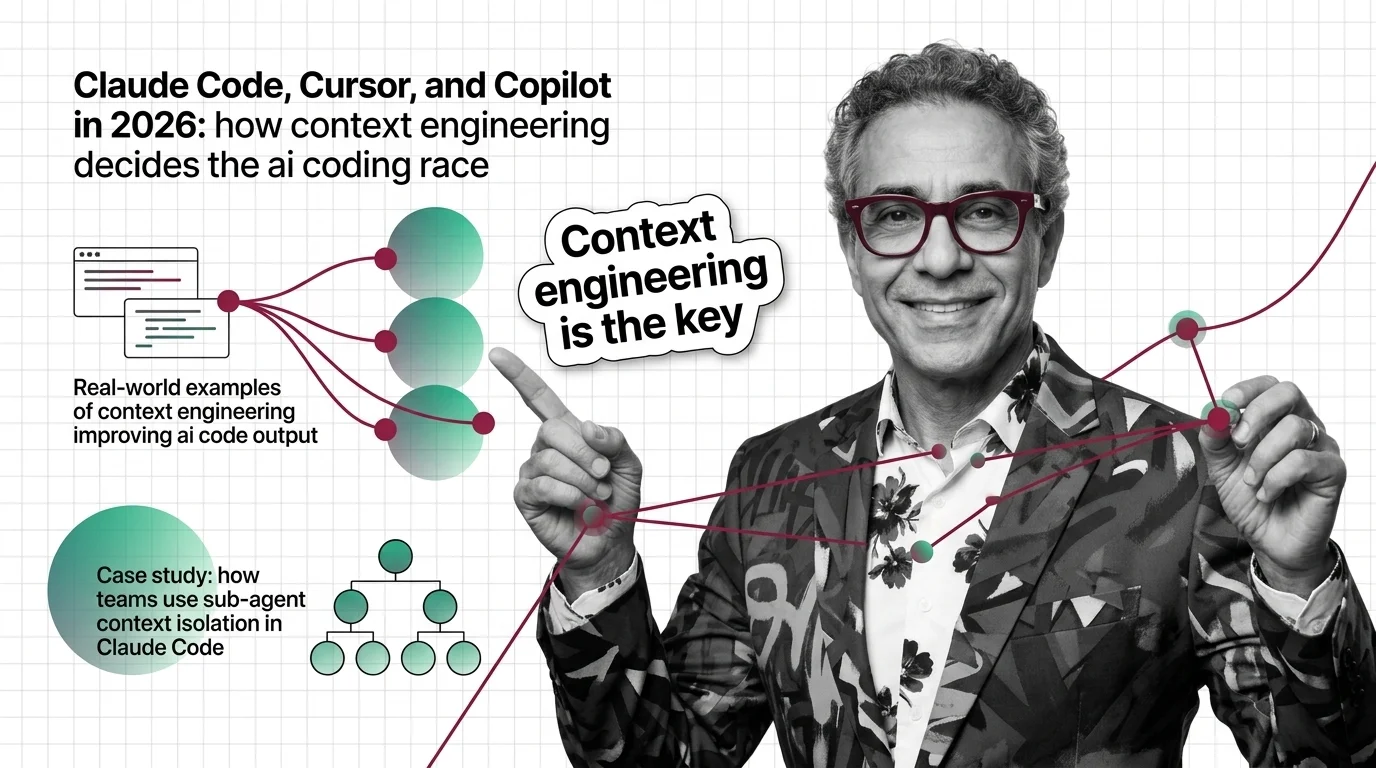
Q: Real-world examples of context engineering improving AI code output?
A: Cursor’s @Codebase lets developers retrieve relevant files instead of relying on the model’s memory. Copilot CLI compacts long sessions automatically near 80% window fill. Claude Code summaries from sub-agents prevent main-thread noise during long refactors.
Q: Case study: How teams use sub-agent context isolation in Claude Code? A: Teams running multi-file refactors spawn sub-agents per file or per concern. Each sub-agent gets its own window, its own tools, and returns only a summary. The parent thread keeps its budget for high-level reasoning rather than burning tokens on per-file detail.
The Bottom Line
The model is not the bottleneck anymore. The context pipeline is — and the tools that win 2026 are the ones that let developers see, control, and compose it across vendors. Context Engineering For Code is the unit of competition now. Watch the MCP server count and the compaction telemetry. That is where the next year of share gets decided.
AI-assisted content, human-reviewed. Images AI-generated. Editorial Standards · Our Editors