Cerebras vs. Groq vs. GPU Clouds: The Custom Silicon Bet Reshaping Inference Economics in 2026
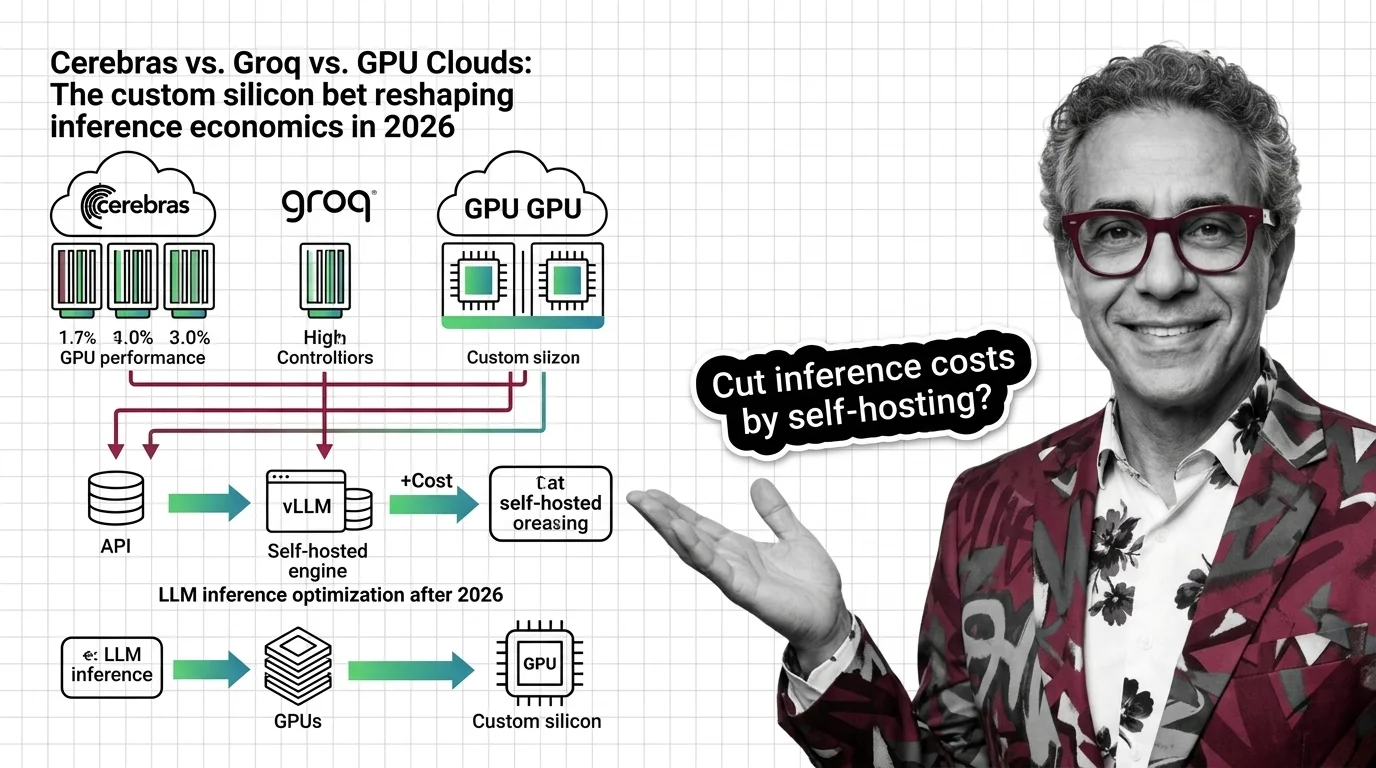
Table of Contents
TL;DR
- The shift: Custom silicon vendors are outrunning GPUs on inference speed, and hyperscalers are buying in rather than competing
- Why it matters: Inference cost and latency determine which AI products ship — custom chips are repricing both
- What’s next: By late 2026, every major cloud will offer non-GPU inference paths, splitting the market between speed and flexibility
Three companies built chips that don’t look like GPUs, don’t act like GPUs, and — as of early 2026 — don’t lose to GPUs on Inference speed. NVIDIA’s response wasn’t to out-engineer them. It was to acquire one.
That’s not a competitive move. That’s a concession.
The GPU Monopoly Just Cracked
Thesis: Custom silicon has moved from benchmark novelty to production infrastructure, and the hyperscaler response — acquisition and partnership — confirms GPU-only inference is no longer the default.
For five years, NVIDIA’s GPU stack owned the inference conversation. Every optimization — Continuous Batching, Paged Attention, Speculative Decoding — was designed to squeeze more tokens from the same CUDA cores.
That playbook just stopped being enough.
Cerebras hit 2,522 tokens per second on Llama 4 Maverick with its WSE-3, against 1,038 t/s on NVIDIA’s DGX B200 (Cerebras, as of May 2025 benchmarks). NVIDIA acquired Groq for $20 billion in cash in December 2025 (IntuitionLabs).
SambaNova raised $350 million, partnered with Intel, and announced the SN50 RDU shipping H2 2026 — claiming internal benchmarks at five times Blackwell speed (BusinessWire). That last claim has no independent verification.
Three bets on non-GPU architectures. The direction is unanimous.
This is not a research agenda. It is a capital allocation decision by the largest companies in computing.
Three Receipts, One Verdict
The speed numbers are public. The leaderboard is still forming.
Cerebras delivers 2,100 t/s per user on Llama 3.1 70B — roughly eight times an H200 and double a Blackwell system (Cerebras). API pricing undercuts most GPU providers: $0.60 per million tokens for Llama 3.1 70B, though pricing for newer models like Qwen 3 235B remains in preview.
NVIDIA unveiled the Groq 3 LPU at GTC in March 2026 — 150 TB/s memory bandwidth, shipping Q3 2026 (Motley Fool). Those specs come from press materials, not independent testing.
Pre-acquisition, the Groq LPU hit 284 t/s on Llama 3 70B at competitive pricing. GroqCloud continues to operate independently under CEO Simon Edwards, though product direction now flows through NVIDIA.
AWS and Cerebras announced a hybrid architecture: prefill on AWS Trainium, decode on Cerebras CS-3, served through Amazon Bedrock — GA expected within months (AWS Press Center).
On the software side, SGLang v0.5.8 hit roughly 16,200 t/s on H100 clusters. Software optimization on commodity GPUs still has headroom. The question is how long that headroom lasts against wafer-scale silicon with an order-of-magnitude bandwidth advantage.
The Cerebras-AWS deal is the real tell. Splitting the inference pass across two different chip architectures means serving pipelines are no longer bound to a single silicon vendor.
Hyperscalers are integrating custom silicon. Not fighting it.
Who Moves Up
High-volume inference operators. If your Time To First Token budget is tight and throughput runs in millions of daily tokens, Cerebras and Groq APIs already undercut GPU-cloud pricing on raw speed.
Self-hosted teams. GPU cloud H100 pricing dropped to roughly $3.90 per hour — down from $7 — and neo-clouds run 40-85% cheaper than hyperscalers (Spheron Blog). Pair that with vLLM v0.16 — the V0 engine is deprecated; V1 is now the default — or SGLang, and self-hosted breakeven drops below four months at high utilization.
TensorRT-LLM sits at v1.3.0rc9, still a release candidate. Open-source frameworks with Quantization support are becoming the default serving layer regardless of silicon underneath.
Abstraction builders. The teams that can benchmark across silicon types and route workloads dynamically own the integration point — and the margin.
Who Gets Caught Flat
GPU-only cloud providers charging 2024 rates. The price floor moved. If your inference offering is still an H100 at $7 per hour, you are not in the conversation.
Teams locked into single-vendor silicon. The Cerebras-AWS hybrid — prefill on one chip, decode on another — signals that inference is becoming composable. Teams that cannot split workloads across chip types will overpay for every token.
Anyone treating inference as a commodity line item. The gap between the cheapest and fastest option has inverted — the fastest is no longer the most expensive. That repricing changes procurement logic for every team running production LLMs.
Anyone waiting for the dust to settle. Cerebras is targeting a Q2 2026 IPO at a $22 billion valuation (SiliconANGLE). Capital markets are pricing custom inference silicon as infrastructure, not experiment.
That’s not speculation. That’s a filing.
What Happens Next
Base case (most likely): Custom silicon captures the high-throughput, latency-sensitive tier while GPUs hold the flexible, multi-workload middle. Hybrid architectures — prefill on one chip, decode on another — become standard by late 2026. Signal to watch: Cerebras or SambaNova landing two or more hyperscaler partnerships. Timeline: Q3-Q4 2026.
Bull case: Groq 3 delivers on the 150 TB/s promise, NVIDIA routes its own inference cloud through LPU silicon, and custom chips claim majority share of production inference within 18 months. Signal: Independent benchmarks confirming Groq 3 at scale. Timeline: Q1 2027.
Bear case: Custom silicon stays fast but narrow — limited model support, poor fine-tuning flexibility, and supply constraints keep GPUs dominant for anything beyond standard Llama-class models. Signal: Cerebras IPO underperforms or delays past Q3. Timeline: H2 2026.
Frequently Asked Questions
Q: How are Cerebras and Groq using custom silicon to break LLM inference speed records in 2026? A: Both bypass the GPU memory wall. Cerebras uses a wafer-scale engine with 44 GB on-chip SRAM and 21 PB/s bandwidth. Groq’s LPU eliminates external memory transfers with deterministic scheduling. The result: multi-thousand tokens per second on large models.
Q: How are companies cutting inference costs by switching from API providers to self-hosted engines like vLLM? A: Open-source serving engines like vLLM and SGLang now match commercial performance on commodity GPUs. With cloud GPU prices dropping significantly, self-hosted setups break even in under four months at high utilization — making the math straightforward for teams with steady workloads.
Q: Where is LLM inference optimization heading after 2026 and will custom silicon replace GPUs? A: Custom silicon will own the latency-critical tier. GPUs will hold the flexible, multi-workload middle. Hybrid architectures — mixing chip types within a single inference pipeline — are the likely default by 2027.
The Bottom Line
The inference stack just split. Custom silicon owns the speed ceiling, GPUs own the flexibility floor, and the gap is closing from both sides. You’re either evaluating hybrid architectures now or locking in costs the market already repriced.
Disclaimer
This article discusses financial topics for educational purposes only. It does not constitute financial advice. Consult a qualified financial advisor before making investment decisions.
AI-assisted content, human-reviewed. Images AI-generated. Editorial Standards · Our Editors