C2PA Manifests, Cryptographic Signing, and the Technical Limits of AI Watermark Detection
ELI5
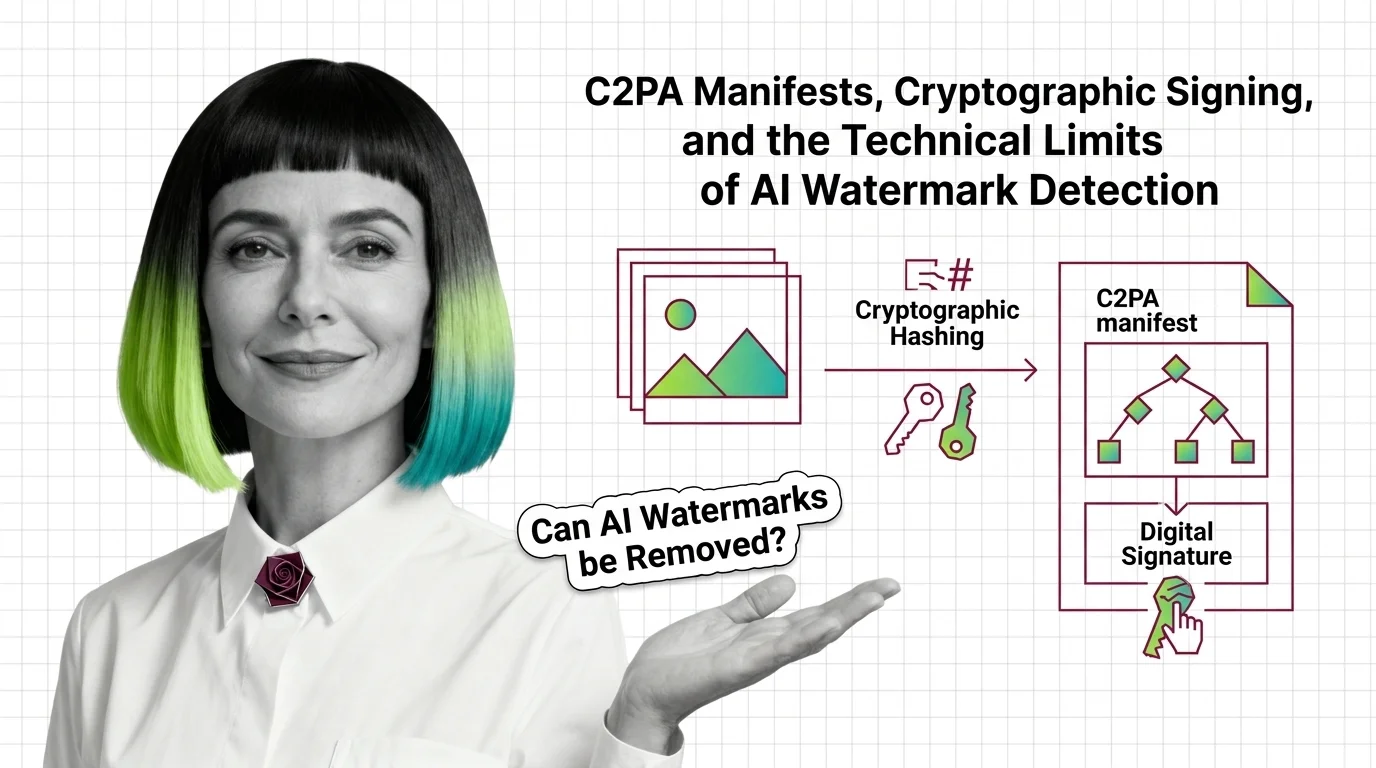
C2PA Content Credentials are cryptographically signed manifests that record an image’s edit history — they prove who touched a file and when, not whether the scene itself is real. Watermarks work differently: they’re hidden inside the pixels themselves.
Photograph something with a Galaxy S25 or a Pixel 10, and the file leaves the camera with a cryptographic signature already attached — proof of origin baked in at the hardware level. Screenshot that same photo and the proof is gone, not because it was falsified, but because the signature lived in metadata that screenshotting never carries forward. The pixels are identical. The Content Provenance is not.
Two Different Defenses Wearing One Label
This is the confusion at the center of AI Watermarking And Content Provenance, and it shows up constantly in how teams build Generative Media APIs integrations: assuming a “watermarked” output and a “C2PA-verified” output carry the same guarantee.
Myth: An AI watermark and a C2PA Content Credential are the same protective layer — strip one and you’ve defeated both. Reality: They are architecturally unrelated systems with different failure modes. A Content Credentials manifest is metadata, a signed record bolted onto the file’s container. Digital Watermarking works the opposite way: the signal — whether it’s Digimarc’s image markings or a statistical pattern baked into an LLM’s token choices — lives inside the content’s own data, not beside it. Symptom in the wild: A screenshot defeats a C2PA manifest instantly, because the metadata never survives the capture. The same screenshot can leave a watermark fully intact, because the mark rides inside the pixel or token data the screenshot still carries.
The Lock Before the Label: What Signing a File Actually Does
Before any of this makes sense, two cryptographic primitives need to be precise rather than hand-wavy, because C2PA’s entire trust model sits directly on top of them. Skip this layer and “cryptographically signed manifest” sounds like marketing language. Understand it, and the manifest’s guarantees — and its limits — become obvious.
What do you need to know about cryptographic hashing and digital signatures before understanding C2PA?
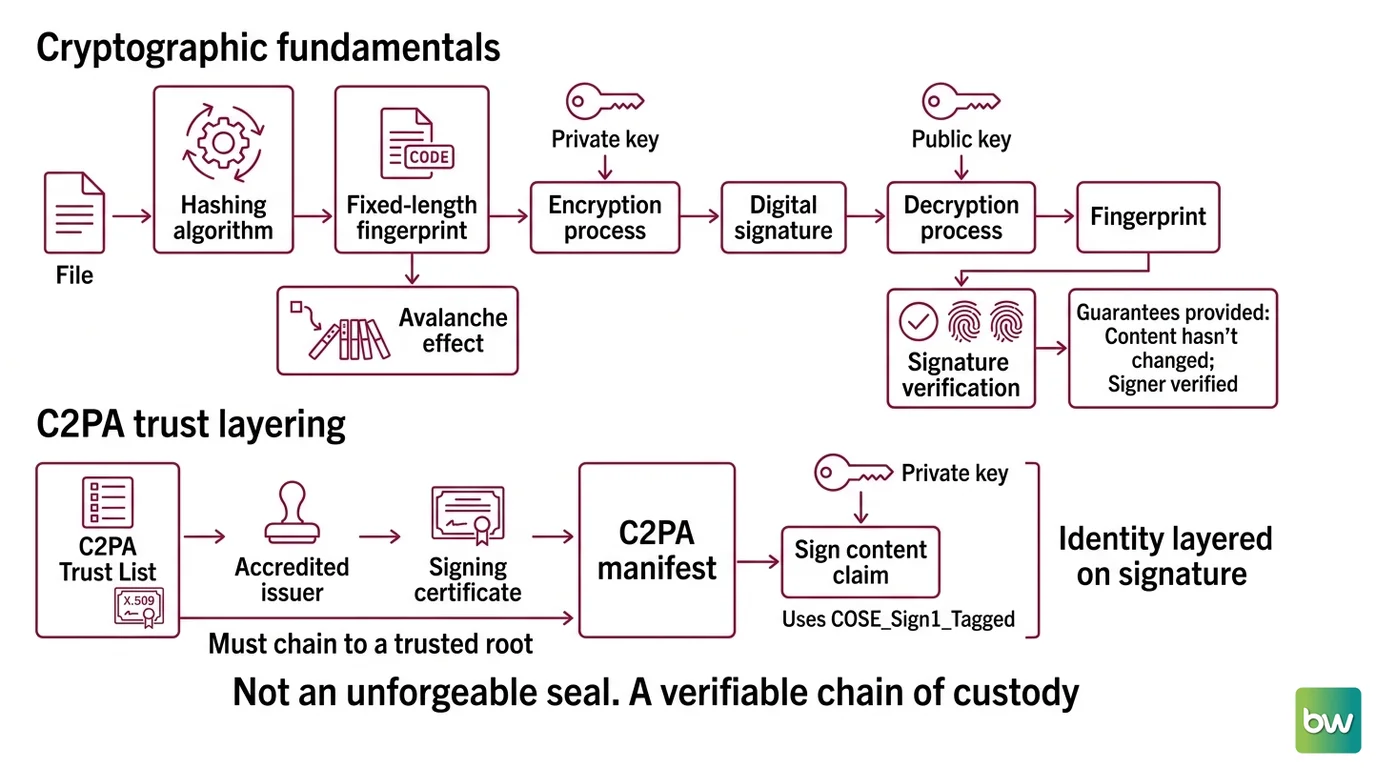
Cryptographic Hashing converts a file into a fixed-length fingerprint. Change a single pixel and the entire fingerprint changes unpredictably, a property cryptographers call the avalanche effect. That fingerprint, not the file itself, is what gets signed. A Digital Signature takes the hash and encrypts it with the signer’s private key; anyone holding the matching public key can verify the signature decrypts back to that exact hash, proving two things at once — the content hasn’t changed since signing, and whoever held that private key vouched for it at that moment.
C2PA layers a third piece on top: identity. The claim inside a manifest is signed using COSE (COSE_Sign1_Tagged), and the signing certificate must chain to an X.509 root on the official C2PA Trust List (C2PA Specifications). Not just any signature counts — only ones traceable to an accredited issuer. The Conformance Program that launched in 2026 formalized this: a new official Trust List superseded the older “Interim Trust List” certificates that earlier C2PA implementations relied on (Content Authenticity Initiative).
Not an unforgeable seal. A verifiable chain of custody — and chains only protect what’s still attached to them.
Inside the Box: Claims, Assertions, and the JUMBF Container
With the cryptographic primitives in place, the manifest itself stops looking mysterious. It’s a container format with a few nested parts, each doing a specific job, and every C2PA-conformant tool writes to the exact same structure.
What are the parts of a C2PA Content Credential manifest?
A Content Credentials manifest lives inside a JUMBF container — JPEG Universal Metadata Box Format, an ISO standard (ISO 19566-5) for nesting structured metadata inside a media file (C2PA Specifications). Three things sit inside that box: a claim, the manifest’s spine — a JUMBF superbox labeled c2pa.claim.v2 that references everything else and gets hashed and signed as a unit; assertions, the actual content — statements like “this was generated by an AI tool,” “this edit used inpainting,” or a thumbnail of a prior state — serialized as CBOR (RFC 8949) rather than verbose JSON; and the signature itself, which binds the claim using COSE, anchored to the Trust List chain described above.
A manifest isn’t one static stamp — it functions as a running history of every signed edit, where each new claim references the one before it. Truepic’s Lens SDK is built for exactly that first link: it replaces a phone’s native camera app so the very first frame already carries a signed, tamper-evident claim before any editing software gets near it (Truepic Blog). A reader can walk the chain backward, edit by edit, and verify every signature independently.
The Backup Layer: Why Pixels Get Marked, Not Just Files
C2PA’s manifest approach has one structural weakness: it lives in the container, not the content, so anything that strips or rebuilds the container — a screenshot, a re-encode, a social platform’s re-upload — takes the proof with it. Watermarking exists specifically to survive that failure mode, by hiding the signal somewhere a screenshot can’t reach.
Can AI watermarks be removed, and how reliable is watermark detection?
Steganography embeds information directly inside the content’s own data — subtle adjustments to pixel values, audio samples, or token probabilities that survive recompression because they’re not metadata, they’re signal. On the text side, watermarking systems like SynthID-Text nudge an LLM’s token-sampling distribution itself, so the statistical fingerprint persists through ordinary copying.
Detecting that fingerprint usually relies on Perceptual Hashing rather than cryptographic hashing — a deliberately fuzzy fingerprint, designed to stay similar after resizing, cropping, or compression, the opposite design goal of the avalanche-effect hash used for signing. That tolerance for minor change is also the attack surface: research on SynthID-Text-class systems documents that paraphrasing, back-translation, and “layer inflation” attacks measurably degrade detection reliability (arXiv research). No published benchmark gives one universal detection-accuracy figure, because robustness is method- and attack-specific — an image watermark surviving a JPEG re-compress says nothing about a text watermark surviving a paraphrase.
The honest answer to whether a watermark can be removed is: usually weakened, not cleanly erased. As of mid-2026, the arms race between watermarking schemes and removal attacks remains active, and no scheme has been proven removal-proof (arXiv research).
What the Architecture Predicts About Trust in the Wild
Once the two mechanisms are separated, the failure modes stop being surprising and start being predictable.
If a platform strips metadata on upload — and most social platforms do — expect the C2PA chain to vanish even though nothing about the image content changed. Absence of a Content Credential proves nothing about authenticity either way.
If provenance needs to survive re-encoding and re-uploading, a watermark is the more resilient choice. But expect detection confidence to degrade under adversarial paraphrasing or aggressive recompression, not fail cleanly to zero.
If manifests are being verified programmatically with open-source tooling, expect to handle parsing carefully: Adobe’s c2pa Rust crate carried a flaw that let a malformed manifest exhaust resources during parsing.
Security & compatibility notes:
- Adobe
c2paRust crate /c2pa-web: Uncontrolled resource-consumption vulnerability (CVE-2026-34677, CVSS 6.2) in manifest parsing, affecting versions ≤0.78.2 / ≤0.7.0. Patched via APSB26-53 — upgrade before parsing manifests from untrusted sources.
Rule of thumb: treat a Content Credential as proof of custody, not proof of truth, and treat a watermark as a resilience layer, not a tamper-proof one.
When it breaks: C2PA’s chain only proves what happened to a file after it was signed — it can’t verify the scene a camera captured was real, and a generator that simply declines to write a manifest leaves no record at all. Watermarking inherits the opposite gap: a scheme can be weakened by a new transformation attack faster than detection can be hardened against it.
The Standard-Setters Are Also the Subjects
One detail is easy to miss while focused on bytes and signatures: C2PA’s steering committee spans both sides of the problem it’s solving. Capture-side members like Truepic and Sony build the cameras meant to prove a scene was real; generation-side members like OpenAI and Google build the models meant to be flagged when a scene wasn’t (Content Authenticity Initiative). Both groups write to the same specification, sign with certificates from the same Trust List, and have equal say in what counts as a valid assertion.
That isn’t a flaw in the standard. Broad participation is exactly how a shared trust layer gets adopted. It is, however, a reminder that a Content Credential records a declaration, not an independent fact.
The Data Says
A C2PA manifest and a watermark solve the same trust problem with opposite architectures — one binds a signed history to the file’s container, the other binds a signal to the content itself — and each fails exactly where the other holds. As of April 2026, C2PA sits at spec version 2.4 with a formal Conformance Program backing its Trust List, and CAI counts more than 6,000 members five years after its founding (Content Authenticity Initiative). Neither layer proves a scene happened. Both only prove who touched the file, and when.
AI-assisted content, human-reviewed. Images AI-generated. Editorial Standards · Our Editors