Debugging RAG Failures: Why Developers Need a New Diagnostic Model
The ticket says the assistant gave a customer the wrong answer. You open the trace expecting the usual: an exception somewhere, a timeout, a 500 in the call graph. There is none. The retriever returned five candidates. The top one is the actual policy document. The reranker didn’t reorder anything suspicious. The model wrote a full paragraph and attached a citation to a real page. Every stage did exactly what it was built to do. The answer is still wrong.
RAG failures rarely look like software bugs: the right document can come back, every stage’s log can read clean, and the answer can still be wrong — the fault lives in how several independently probabilistic stages compound, not in one line you can step through. Reproduce, breakpoint, root cause: all assume a single deterministic fault — and that assumption breaks here. A RAG pipeline doesn’t hand you one.
No Single Line Broke
Retrieval Augmented Generation looks like search plus a language model from the outside, and your first move when it misbehaves is the one that works on everything else you own: find the failing line. That move assumes you own the code path end to end. Plenty of the developers who get this ticket don’t — someone wired together a vector database, a hosted embedding API, and a reranker from a vendor, and you’re the one holding it. Not owning the pipeline doesn’t exempt you from diagnosing it. It just means you have less visibility into any single stage than the person who built it, and the wrong answer doesn’t wait for you to catch up. Knowing which of the five stages is the likely culprit is what turns “the bot is broken” into a ticket someone can actually act on — pointed at an owner, not routed by guesswork.
A request that fails this way already passed through several sequential decisions before it reached you — a chunker’s boundary rule, an embedder’s similarity call, a retriever’s ranked list, and a reranker’s rescoring pass, each with its own narrow contract. Every one of those stages can satisfy its own contract — the chunk was a valid size, the embedding was well-formed, the retriever returned a ranked list, the reranker reordered it sensibly — while the assembled request still produces a wrong answer. Nothing in that chain has to throw for the whole thing to fail.
The instinct that still helps is the one behind a good bisect: don’t guess, compare. Log what the chunker produced, what the retriever ranked, what the reranker reordered, and what the generator wrote — each against a stored baseline from before the request degraded — and you can usually see which stage’s output moved. What doesn’t transfer is the ending. Bisect assumes exactly one commit flipped behavior from correct to incorrect. A RAG pipeline rarely hands you one commit. The retriever drifted a little because a document entered the index last week; the reranker drifted a little because the retriever’s candidate distribution shifted under it. Two or three stages, each individually defensible, compounding into one wrong answer nobody logged as an error.
For the component-by-component map of what each of those stages actually does, the RAG topic hub has the full breakdown. The rest of this piece assumes you already know roughly what a chunker and a reranker are, and is about what to do once one of them is the reason a customer got a wrong answer.
Mental Model Map: RAG Failure Diagnosis From: A wrong answer means one broken line — reproduce it, set a breakpoint, find the line. Shift: A wrong answer can come from several independently correct-looking stages compounding, with no single line to blame. To: Instrument every stage boundary independently and diff against a known-good baseline, because “correct” at one stage doesn’t mean “correct” for the request. Key insight: The bug isn’t hiding in a line of code — it’s hiding in the handoff between stages that each did their job correctly.
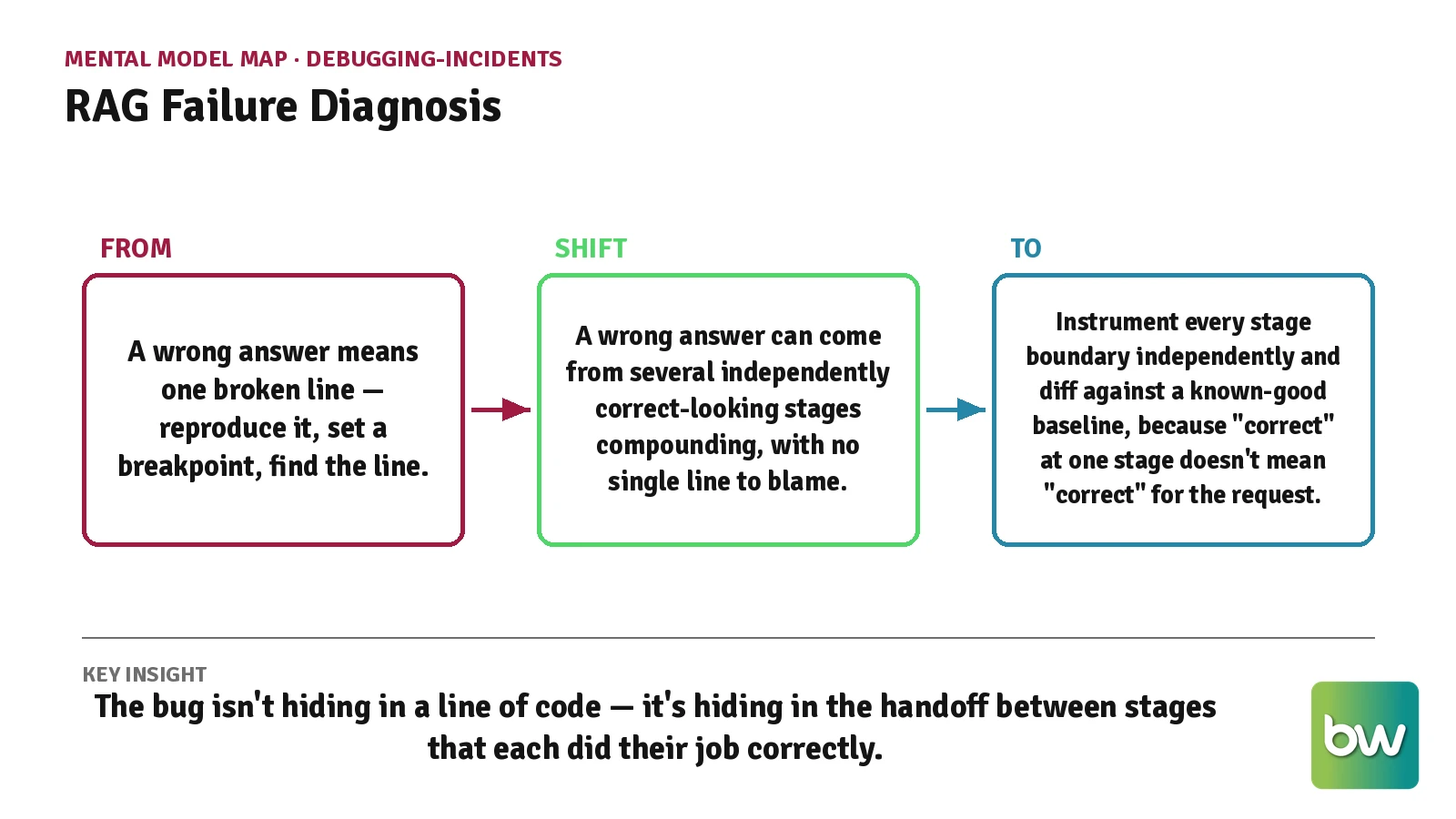
In practice, this means an incident review that ends with “we found the bug” is describing a coincidence, not a repeatable method — the next incident will hide in a different combination of the same stages, and the fix is instrumentation at every boundary, not a smarter breakpoint.
Correct Retrieval Doesn’t Clear the Case
The most common wrong turn in this kind of incident is closing the retrieval question too early. Someone checks the retriever’s log, sees the right document sitting in the candidate list, and moves on to blame the generator, the prompt, or “the model being weird today.” A study of multi-document question answering found accuracy dropping by more than 30 percentage points when the correct document sat in the middle of a twenty-document context window instead of at the start or the end — a shape that held across multiple model families. The document was retrieved. It was ranked. It made it into the prompt. The model still read past it.
That’s the instinct worth keeping and the instinct worth distrusting in the same breath. Keeping: a retrieval log that shows the correct chunk present is real evidence, and it does narrow the search — you’ve cleared one stage. Distrusting: clearing a stage’s own contract has never meant the system as a whole behaved correctly, and there’s no log line for a reranker placing the gold chunk at rank seven of ten and the model reading it through a lens that systematically under-weights that position. This isn’t a retrieval miss you can grep for. It’s an attention miss — a stage that met its contract while the layer above it quietly discounted what that contract delivered.
The fix costs almost nothing to add and gets skipped almost every time: when you log a retrieval result, log the rank and the eventual position in the assembled prompt alongside the chunk ID. That single field turns “was it retrieved” into “was it visible” — and the second question is the one that actually explains the incident.
The only way to catch this case is recording where in the assembled context the right answer actually sat — not just whether it made the list. The practical fix: retrieval logs need a position field, not just a presence field. A bug report that starts with “the right document was retrieved” is a partial diagnosis, not a completed one.
A Passing Citation Isn’t a Passing Claim
The next place naive debugging stalls is the citation. The answer arrives with a real link attached, resolving to a real page, and the instinct is to treat that as proof: the model read something, the something exists, case closed. Google Research’s sufficient-context experiments found the model’s incorrect-answer rate jump from 10.2% with no retrieved context at all to 66.1% when the retrieved context was insufficient — the noisy context didn’t stop the model from answering, it gave the model material to sound confident with.
RAG Guardrails And Grounding and faithfulness sound like the same guarantee. They are not. Grounding means the evidence made it into the prompt. Faithfulness means the generated claim is actually supported by that evidence. The two separate the moment the model’s own training prior disagrees with what it just retrieved — and a citation, by itself, records only that something was read, never that it was read correctly.
Detector research spanning HHEM, Lynx, TruLens, and NeMo Guardrails converges on the same limit: every one of them scores an entailment relationship between the answer and the retrieved passage, and none of them checks whether the passage supports the claim in the way the model implied. A citation that resolves to a real, on-topic page can still misrepresent what that page says — and the detector approves it, because the words are there.
The practical read: a citation check and a faithfulness check each clear a narrower claim than “the answer is correct.” Treating either one as a correctness proof is how a wrong answer ships with a real source attached.
The Regression That Never Threw
The last trap hits after the incident is already closed. Nothing crashed. Nothing paged anyone. A model version changed, a reranker got swapped, an index got re-embedded — and answer quality quietly dropped, with no exception anywhere to point at. Here the classical instinct that transfers best is the regression-suite instinct: don’t wait for a user to notice, run a fixed set of known-good queries against every change and diff the result.
A production RAG harness decomposes “is the pipeline good?” into separate retrieval and generation scores precisely so a regression can be attributed to a layer instead of averaged into one number that moves for reasons nobody can name. The rule worth keeping from your own CI discipline: if you can’t say retrieval failed or generation failed without re-running the query by hand, the harness isn’t doing its job yet.
But here the regression-suite instinct misleads: it has a blind spot specific to this stack, and it’s a bigger one than most teams expect. A RAG evaluation suite run twice on the same unchanged pipeline, in the same afternoon can still report a different faithfulness score — because the framework scores your pipeline with a language model as the judge, and that judge itself gets upgraded, swapped, or silently re-versioned by whoever maintains it. Nothing about your retriever, your reranker, or your prompt changed. The instrument moved.
RAG Evaluation exists because the pipeline has two failure surfaces — retrieval and generation — and an honest score needs at least one metric per surface. Collapsing both into one number is exactly the habit that makes a real regression and a judge swap indistinguishable from each other.
This is why a harness earns trust the same way a test suite does: by failing on purpose first. Swap in a deliberately worse reranker and confirm the retrieval-side scores actually drop; break the prompt’s grounding instruction and confirm the generation-side score drops while the retrieval score holds steady. A harness that can’t fail on a known-bad pipeline won’t catch an unknown-bad one in production, and that validation step is the part most teams skip because the demo already looked fine.
Shift Diagram: Classic Debugging vs RAG Debugging Classic: Reproduce the bug → Set a breakpoint → Step through the call stack → Fix the broken line AI: Log each stage’s output independently → Diff against a known-good baseline → Attribute the divergence to a stage, not a line → Treat “correct-looking” output as unverified until the next stage confirms it
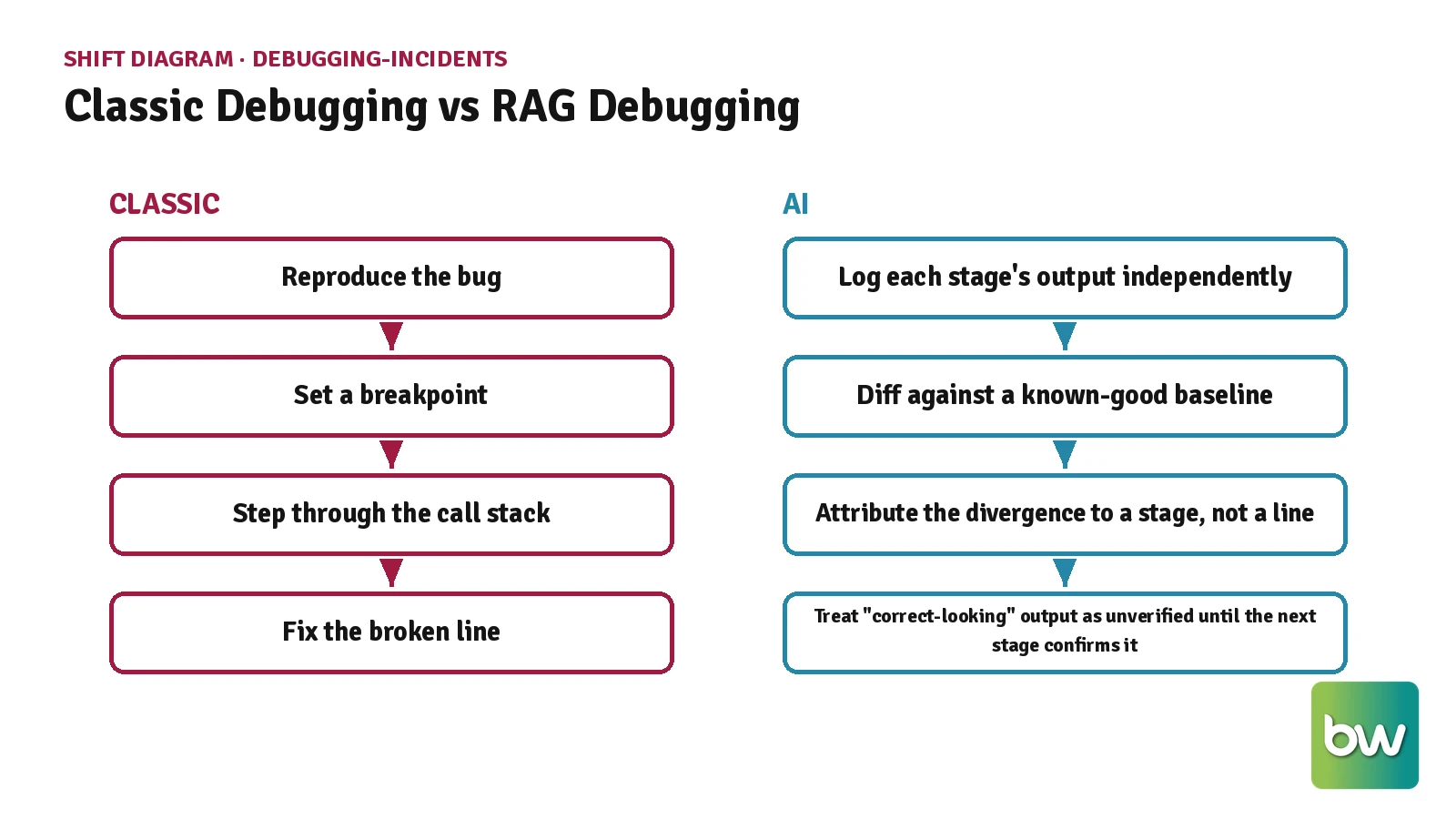
In practice, this means a passing eval run only tells you the harness didn’t catch a problem today — it says nothing about whether the harness itself, specifically its judge model, is the same instrument that scored last month’s release. Pin the judge version alongside the pipeline version, or you’re diagnosing two moving targets as one.
Before You File That Bug
| Diagnostic question | Why it matters |
|---|---|
| Does the retrieval log show the correct document present — not just the final answer? | A wrong answer can start with correct retrieval; you need the boundary, not just the outcome. |
| Where did that document land in the assembled context — start, middle, or end? | Position bias can make a model under-read a document it was correctly handed. |
| Does your faithfulness check run separately from your citation check? | Citation proves usage. Faithfulness proves correctness. A passing one says nothing about the other. |
| Did anything upstream change — model version, embedding model, reranker, or index — since this last worked? | Any stage can regress independently, and none of them throw an exception when they do. |
| Do you have a stored baseline to diff against, or only “it felt worse this week”? | Without a baseline, a real regression and normal model variance look identical. |
| Is the judge model behind your evaluation harness pinned and versioned? | An unpinned judge can move your score without your pipeline changing at all. |
The updated model: a RAG incident isn’t one broken line — it’s several independently probabilistic stages that can each look correct while the request still fails. Stop looking for the bug. Start instrumenting the boundaries, pin your judge, and keep a baseline to diff against. That’s the diagnostic model that actually holds up.
AI-assisted content, human-reviewed. Images AI-generated. Editorial Standards · Our Editors