A Prompt Is an Interface Contract That Breaks Without a Changelog
The output parser started throwing on a Tuesday. The prompt feeding it had not changed in three months: same string, same file, same commit hash. Nobody deployed. Nobody touched the template. But the JSON coming back from the model now had a reordered field, an extra sentence of preamble the regex never expected, and one enum value the parser had never been taught to handle. You bisect your own commits and find nothing, because the thing that changed was not in your repository. It sat on the other side of the API call, and it shipped without a version bump you could point at.
The string in your repo was never the contract. The model’s behavior on that string was — and it moved under you.
A prompt is an interface contract with a nondeterministic counterparty, and it earns the same discipline you already give any API you depend on: versioning, tests, and a regression alarm. The assumption that breaks is the intuitive one — that the text you wrote is the contract. It isn’t. The contract is how the model behaves on that text, and the model can change without telling you. This is about the model you call, not the one you train.
Why Your Prompt Is an Undocumented Interface
Prompt Engineering looks like copywriting, so it gets treated like copywriting: a string somebody tweaks in place until the output looks right, then leaves alone. That framing is the root of the Tuesday incident. The prompt is not copy. It is the interface sitting between your application and a model, and its output shape is a contract that downstream code silently depends on — the parser that reads the JSON, the retry logic that keys off a status field, the next stage of the chain that expects a specific structure.
You already know what an undocumented interface costs. It is the internal service with no OpenAPI spec, the shared database column three teams read and nobody owns. The prompt is worse, because it does not even look like an interface. It looks like a paragraph. So it never gets a schema, never gets a version, never gets a test — and every component downstream inherits a dependency on behavior that was never written down.
Mental Model Map: the prompt as interface From: A prompt is a message you write and send to a model. Shift: Its output shape is a contract that downstream parsers, retries, and chain stages depend on. To: A prompt is a versioned interface whose counterparty can change without notice. Key insight: You version the string, but the behavior lives inside a model you do not control.
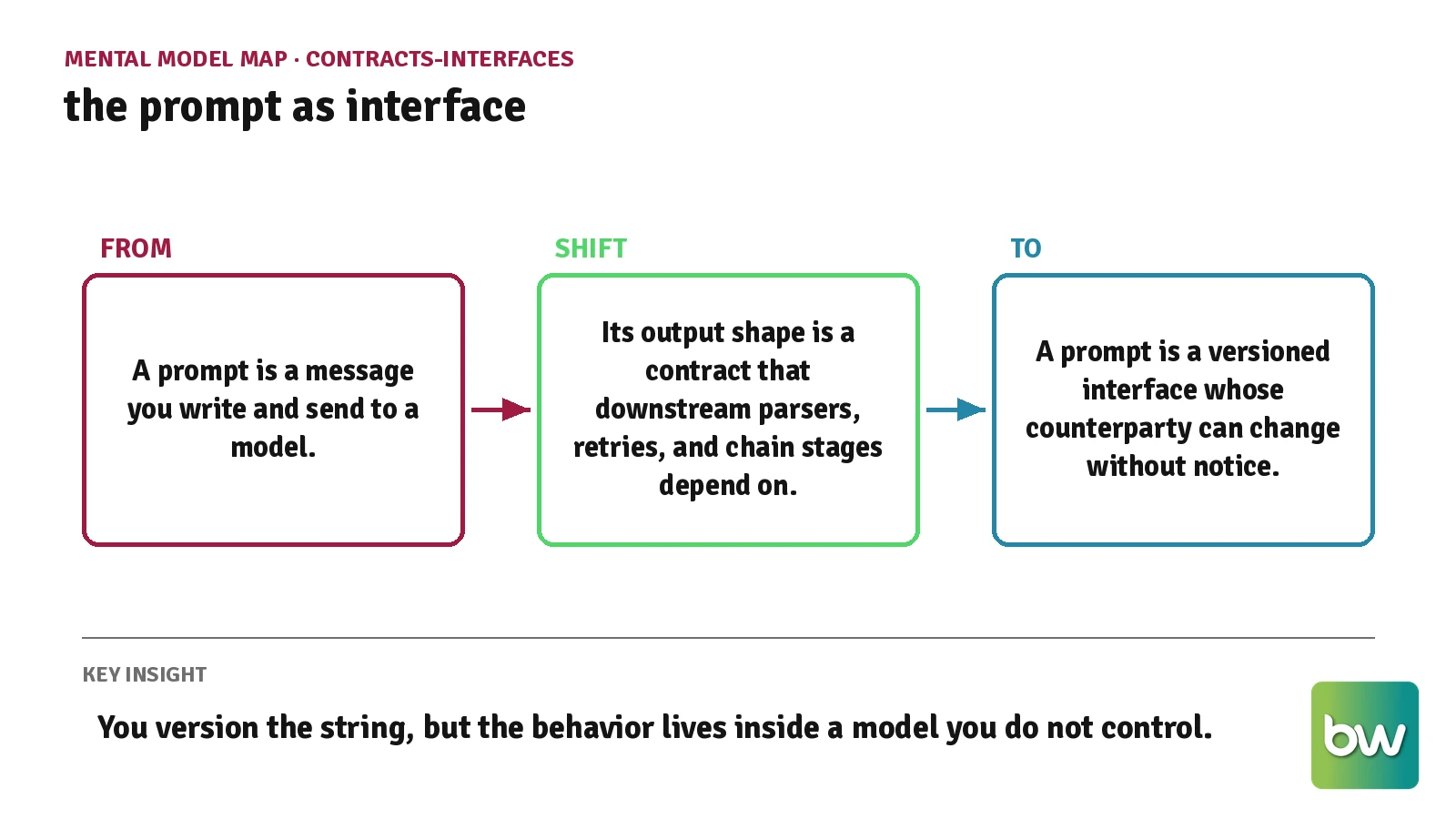
In practice, this means the first fix is not a better prompt. It is treating the prompt as an artifact with a defined output shape and a name, so the next time it breaks you have something to diff instead of a paragraph to squint at.
What Your Versioning Instincts Still Buy
Most of what you know transfers, and it transfers cleanly. Store the prompt as an artifact, not an edited-in-place string. Diff every change. Keep a changelog. Pin the dependency. These are not new habits you have to learn for AI — they are the habits you already have, applied to a surface that has been getting none of them.
The tooling already exists and it speaks your language. Braintrust, PromptLayer, and Agenta each treat a prompt as a versioned artifact — the system message, the examples, the output contract, and the model ID travel together, and a change to the temperature becomes a diff instead of a mystery, as MAX’s walkthrough of production prompt versioning lays out. Braintrust’s Pro tier goes one step further and gates promotion on evaluation scores: a prompt version cannot move from staging to production until it clears a threshold. That is a quality gate on an artifact. You have built that pipeline before, for code.
Your contract-testing instincts survive too. A golden-output suite — a set of inputs with known-good outputs that runs on every change — is the same idea as a Pact test or a snapshot suite: pin the observable behavior at the boundary so a breaking change trips a test instead of a customer. This is what the industry started calling context engineering once hand-tweaking stopped scaling — a shift one production retrospective framed as the specification that should have existed two years ago, and that DAN traces from artisanal tweaking to evaluation pipelines. Shops running dozens of engineers now share a single evaluation harness rather than a folder of favorite prompts.
| Software instinct | Transfers to prompts | Where it stops |
|---|---|---|
| Version every change, diff before deploy | Store prompts as named artifacts with history | Nothing versions the model behind the prompt |
| Pin a dependency to freeze behavior | You can pin a model name or snapshot | A pinned name is not a pinned behavior |
| Contract tests catch breaking changes (Pact, golden tests) | A golden-output suite is your regression alarm | A passing run is evidence, never a proof |
| A type signature guarantees output shape | — | A schema in the prompt is a request, not a compiler check |
The left two columns are why you are not starting from zero. The right column is the rest of this article.
No Compiler Enforces This Contract
Here is where the interface analogy earns its caveat. When you define a REST contract or a typed function signature, a compiler or a schema validator enforces it: violate the shape and the build fails, loudly, before anything ships. A prompt has no such enforcement. You can specify a JSON schema inside the System Prompts layer, spell out every field, give three examples — and the model will still, on some fraction of calls, return prose before the JSON, drop a required field, or invent an enum value. The schema in the prompt is a strongly-worded request. It is not a type signature.
The misconception that reaches production is “the schema guarantees valid JSON.” It does not, and the day it does not is the day an unhandled parse exception takes down the request. The fix is the one you would reach for with any untrusted input: enforce the contract outside the model. A typed validator at the boundary — a JSON-schema check, a Pydantic model, a regex gate — is what actually holds the shape. When a stage in a Prompt Chaining pipeline emits the wrong structure, the failure-mode analysis of prompt chaining is blunt about the cure: the fix is almost never rewriting the upstream prompt, it is enforcing a typed output contract at the stage boundary. In practice, treat every model output as data crossing a trust boundary — validate it before anything downstream reads it, and give the validator a fallback for the call that violates its own declared shape.
The Changelog You Never Get to Read
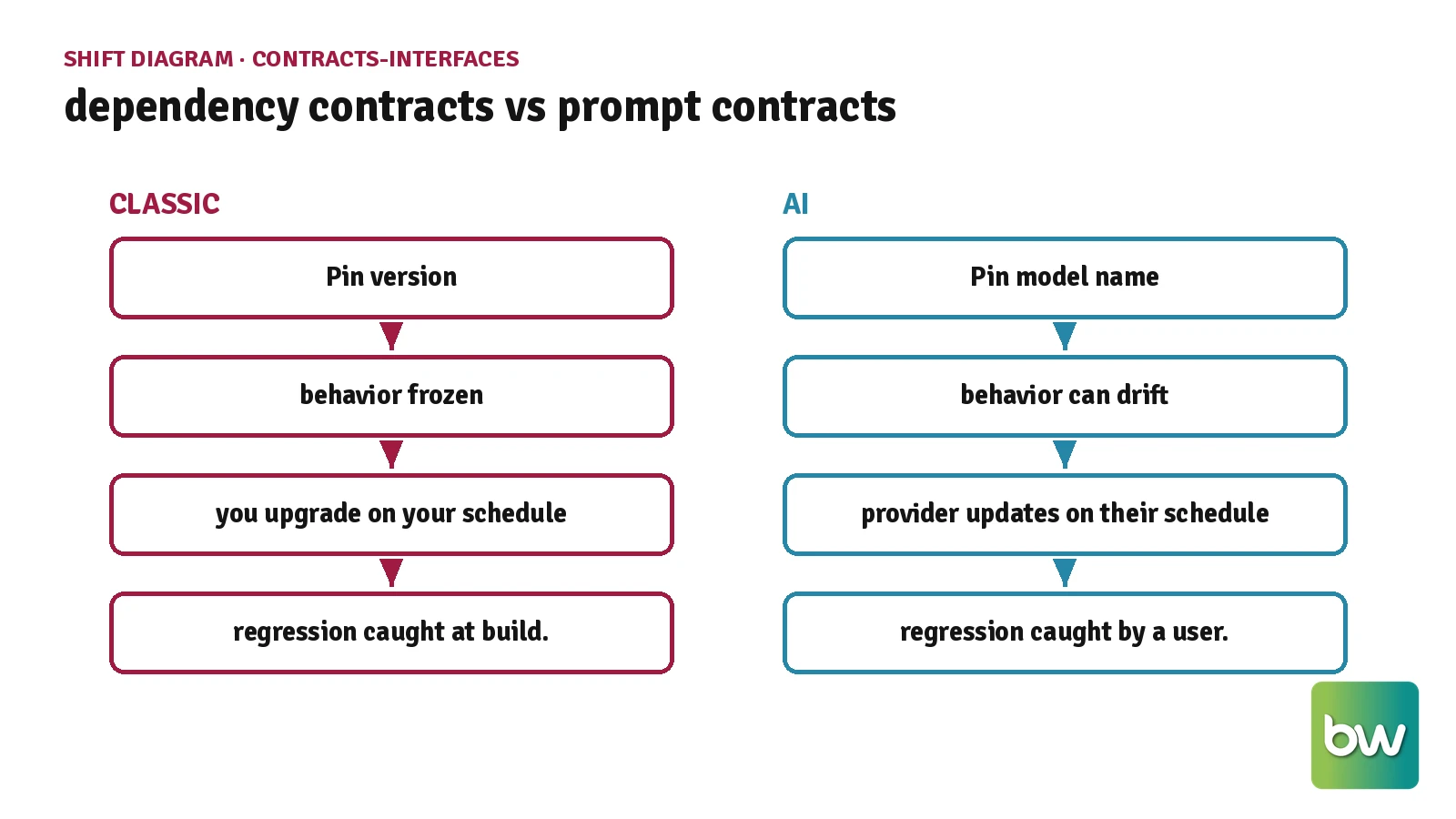
The deepest break is the one that made Tuesday possible: a prompt contract can fail with zero change on your side. You pinned the model name, so you assume the behavior is frozen — the way pinning library@1.4.2 freezes that library until you choose to upgrade. That analogy is the trap. A pinned dependency version is immutable; you upgrade on your schedule, and a regression surfaces at build time. A model behind an API is a service the provider updates on their schedule, sometimes in place, and the only alarm you get is the one you built yourself.
The scale of this is not anecdotal. In the GPT-3.5 era, simple prompts regressed across roughly 75% of model updates, and prompts that left their requirements implicit degraded about twice as often — some accuracy drops topped 20% — a pattern MONA documents in her analysis of why prompts break. Most model updates broke something that had been working, and the detection burden fell entirely on the teams built on top of the API, never on the vendor who moved the distribution. That is a maintenance tax you pay on every deployed prompt, and the invoice arrives without warning.
Shift Diagram: dependency contracts vs prompt contracts Classic: Pin version -> behavior frozen -> you upgrade on your schedule -> regression caught at build. AI: Pin model name -> behavior can drift -> provider updates on their schedule -> regression caught by a user.
Even the tools that version your prompts live under the same rule — Braintrust shipped an API breaking change in May 2026 that removed a key-creation endpoint, so the platform you use to tame drift ships drift of its own. In practice, this means two things belong in your runbook: pin the most specific model snapshot the provider offers, and wire a regression suite that runs against every candidate model before it reaches users. The suite is not optional hardening. It is the changelog the provider does not give you, reconstructed on your side.
Before You Ship the Next Prompt
Contract discipline is only real if it survives contact with your actual stack. Run these questions against a prompt you already have in production. If the answer to any of them is a shrug, that is your next ticket.
| Question about your stack | Why it matters |
|---|---|
| Is every production prompt stored as a versioned artifact with diff history? | An edited-in-place string has no changelog; you cannot bisect a regression you cannot see. |
| Do you pin an exact model snapshot, or a floating alias like “latest”? | A floating alias upgrades behavior on the provider’s schedule, not yours. |
| Does a golden-output suite run on every prompt change and every model change? | Without it, the first report of a regression is a customer, not a test. |
| Is output shape enforced by a validator outside the model? | The model can violate its own declared schema on any call; only external validation catches it. |
| When quality drops with no deploy on your side, is there a named owner for the incident? | If the answer is “nobody,” a provider’s silent update becomes your untracked outage. |
None of these require you to understand transformer internals. They require you to treat a probabilistic dependency with the same seriousness you already give a flaky third-party API — because that is what it is. The mechanism behind the drift, if you want it, is in MONA’s breakdown of the anatomy of a production prompt; the point here is that you can act on the contract without it.
What Actually Changes on Monday
Stop editing prompts in place and start treating them as versioned interface contracts against a counterparty that can change without notice. The concrete next step is small: put one production prompt under version control with a golden-output suite, and pin the model to its most specific snapshot. That single move turns your next silent regression from a Tuesday mystery into a failed test — which is exactly where you already know how to work.
AI-assisted content, human-reviewed. Images AI-generated. Editorial Standards · Our Editors