Background Removal API Wars: BRIA, SAM 2, Photoroom in 2026
TL;DR
- The shift: AI Background Removal forked into two markets — open weights for self-host, commercial APIs for workflows.
- Why it matters: Quality stopped being the differentiator. Licensing, latency, and integrations now decide who gets the contract.
- What’s next: The cutout itself is a commodity. The pipeline around it is where the margin moved.
Two years ago, removing a background cleanly meant calling Photoroom or remove.bg and paying for the result. The cutout was a moat. That moat just turned into a puddle. The models that used to live behind paid APIs now ship with a pip install — and the incumbents are pricing for a market that already changed.
The Cutout Stack Just Forked
Thesis: Background removal stopped being one market — open weights and commercial APIs now compete on different axes, and quality is no longer the differentiator.
Pixel-accurate cutouts are table stakes across both camps. What separates them is everything that wraps the cutout: integrations, licensing provenance, latency budget, compliance posture.
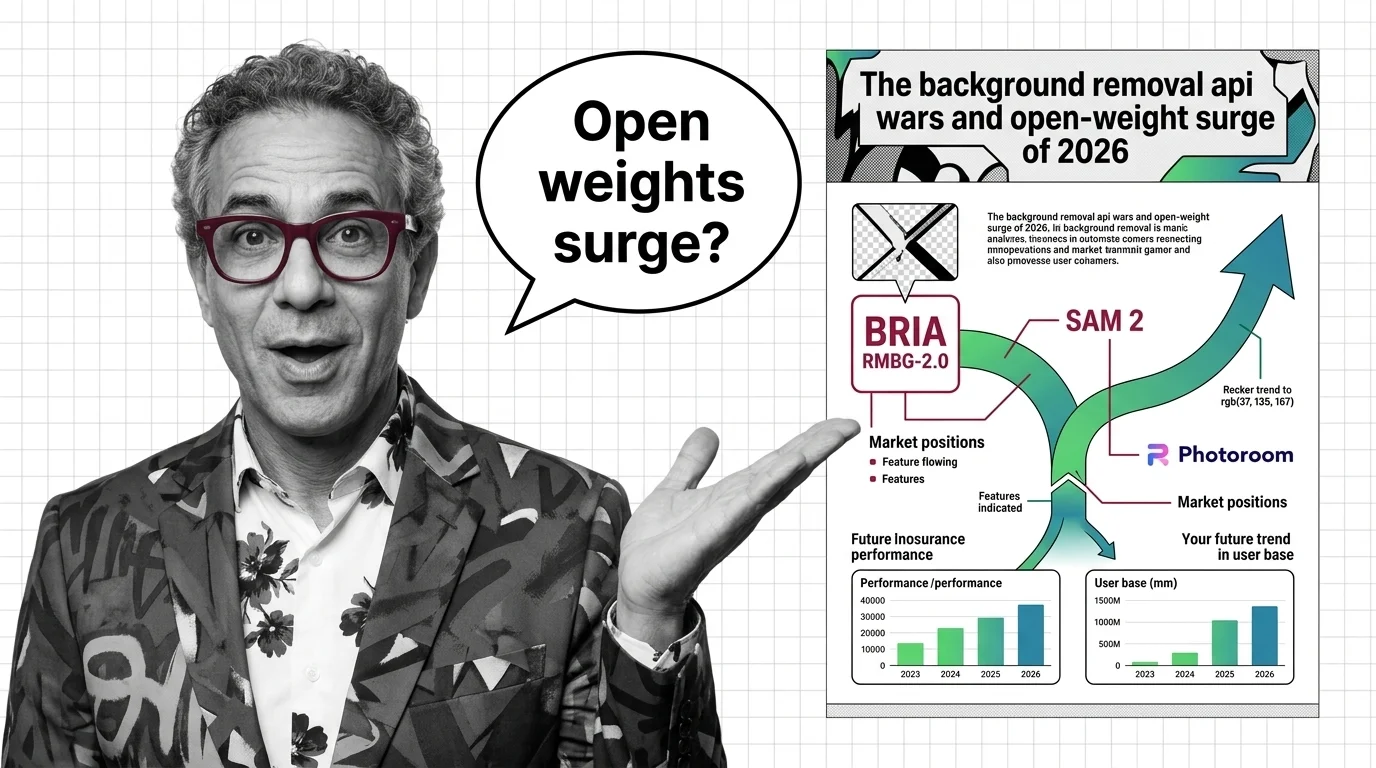
Three independent moves prove the split. BRIA shipped RMBG-2.0 with weights pullable from Hugging Face. Meta released SAM 2 — a Semantic Segmentation foundation model — under Apache 2.0 (Meta AI Research). Photoroom kept its API price flat while doubling its commercial footprint. Background removal isn’t following the Diffusion Models consolidation curve. It’s running its own race.
That’s not three companies competing. That’s two markets forming.
Open Weights Closed the Quality Gap
The numbers tell the same story from three angles.
BRIA RMBG-2.0 trains on roughly 15,000 manually labeled, fully licensed images (Hugging Face model card) — the opposite of “scrape the web and hope,” and the reason commercial buyers will actually deploy it. The model specializes in Salient Object Detection and Image Matting, with the Alpha Matting detail that traditionally needed a hand-built Trimap to hit production quality. Bria raised a $40M Series B in March 2025 (TechCrunch) on exactly that pitch: provenance you can defend in an enterprise contract.
SAM 2 hits ~44 FPS real-time on images and video (Meta AI Research). SAM 2.1 — released in late 2024 — fixed the occlusion and visually-similar-object failures that kept SAM 1 out of production cutout pipelines.
Rembg sits at 21.7K stars on GitHub with active maintenance and four model variants — U²-Net, u2netp, u2net_human_seg, and isnet-general-use (rembg USAGE). The barrier to “good enough” self-hosted removal is now a package install.
The catch: BRIA RMBG-2.0 weights are CC BY-NC 4.0 (Hugging Face model card). “Open weights” does not mean “free for commercial use”. Production deployments need a Bria license or a managed host like fal.ai ($0.018 per image) or Replicate ($0.058 per image).
This is where the open-weight wave gets honest.
Who Just Got Faster
Photoroom is winning by accelerating, not defending. Median latency runs ~300ms (per Photoroom docs). The Remove BG endpoint sits at $0.02 per call on the Basic plan; the bundled Image Editing endpoint runs $0.10 (Photoroom API pricing). And in February 2026, Photoroom shipped a direct Shopify Product Catalog connector (Photoroom Blog). That’s not a feature. That’s a distribution wedge.
Photoroom hit $94M ARR in late 2024, up 89% YoY (Sacra). If you can’t out-quality the open weights, out-integrate them.
BRIA wins the regulated buyers. Fully licensed training data is the only image-AI story that survives a Fortune 500 procurement review. Every enterprise that watched the Getty-versus-Stable-Diffusion litigation cycle is the next Bria customer.
Self-host shops win on cost. rembg with isnet-general-use on a GPU you already own beats $0.02 per call once volume crosses break-even. That line moves left every quarter.
Who’s Selling Yesterday’s Moat
Remove Bg is the cautionary tale. Acquired by Canva and now sold through credit subscriptions ($9 for 40 credits, $39 for 200 credits — remove.bg API page), the product still works. But the moat — proprietary U²-Net derivatives — is now a public model variant in rembg. The pricing power is gone.
Anyone selling generic cutouts as a standalone API is in the same boat. What’s left is the integration story, and remove.bg never built one outside Canva.
Generalist image suites that bundle removal as a feature face the same compression. If your only “AI” is a cutout endpoint, you’re competing with a Python package — and losing.
The pure-API era of background removal just ended.
What Happens Next
Base case (most likely): Commercial APIs survive by becoming workflow products, not algorithm products. The cutout becomes one step in a Shopify-to-storefront pipeline, not a SKU. Signal to watch: More API vendors shipping platform-native connectors instead of accuracy benchmarks. Timeline: 12-18 months.
Bull case: BRIA’s licensed-data pitch becomes the default for enterprise image AI. Provenance becomes the feature. Signal: A Fortune 500 publicly deploying RMBG-2.0 inside a creative pipeline. Timeline: 18-24 months.
Bear case: Open-weight quality stalls and the market bifurcates with no compression — enterprise buyers keep paying premium prices because the open baseline never crosses the procurement bar. Signal: Two or more enterprise buyers publicly switching back from open-weight to commercial APIs. Timeline: 24+ months.
Frequently Asked Questions
Q: How are e-commerce platforms and creator tools using Photoroom and remove.bg in 2026? A: Photoroom ships native Shopify integration, batch APIs, and bundled editing endpoints — pricing as a workflow tool. remove.bg lives mostly inside Canva’s creator suite. Commercial APIs now sell pipelines, not raw cutouts.
Q: Which background removal models are leading the BRIA, SAM 2, and U²-Net family in 2026? A: BRIA RMBG-2.0 leads on commercial-grade cutouts with licensed training data. SAM 2.1 leads on segmentation foundations and video. rembg with isnet-general-use is the self-host baseline. Each owns a different lane.
Q: Where is the AI background removal market heading in 2026 as open weights challenge closed APIs? A: Two markets, not one. Open weights win on cost and self-host. Commercial APIs win on latency, compliance, and integrations. Quality is no longer the axis of competition — workflow and provenance are.
The Bottom Line
The cutout itself is a commodity now. What sells in 2026 is everything around the cutout — the licensing trail, the Shopify connector, the latency SLA, the compliance memo. Pick which game you’re playing or pay the toll for someone who already did.
Stay ahead, Dan.
AI-assisted content, human-reviewed. Images AI-generated. Editorial Standards · Our Editors