Black-Box Routing: Who Decides Which Model You Get — and What You Don't Know About It
The Hard Truth
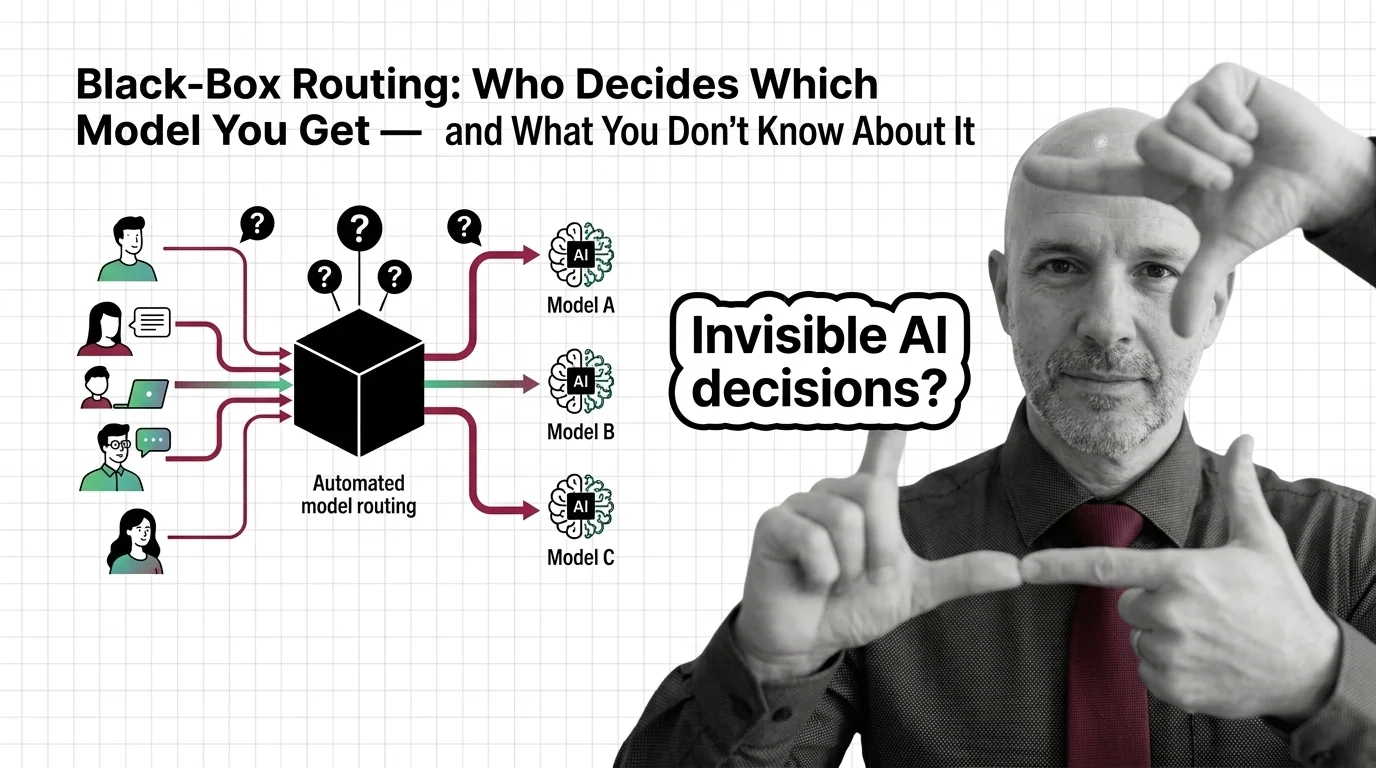
A developer sends a request to an AI gateway. The response comes back coherent. The system log shows success. Nobody — not the developer, not the end user — knows which model answered. The routing decision is not in the response. It happened, and then it vanished.
This is not a failure state. It is the designed default of an entire class of infrastructure — the LLM Gateway layer that now sits between most production AI applications and the models they depend on. We built abstraction to solve reliability problems. In the process, we built opacity into the foundation of how AI quality gets distributed — quietly, at scale, without anyone voting on it.
The 400-Word Answer Nobody Logged
The pattern is documented and recurring. A production application routes requests through an AI gateway. By default, the gateway selects the cheapest reliable provider — the standard criterion is cost optimization, weighted so that providers experiencing recent outages are deprioritized (OpenRouter Blog). A request that warranted a capable, high-context model arrives at a moment when that optimization is working exactly as designed. The gateway routes it to a smaller model. The response comes back at 400 words instead of 2,000 — not an error, not a timeout, not a flag in any log. A success, measurably reduced in scope, delivered to a user who had no means of knowing the difference, per documented production cases in the LLM Fallback Guide.
The Model Routing layer made a quality decision. It made it silently. And the person who received the result — the human being who asked a question and trusted the answer — had no mechanism by which to know what had happened.
This is the incident that is not reported as an incident. There is no alert because the system behaved correctly. There is no review because the log shows green. There is no accountability because nobody designed for it.
What the Default Reveals
The Fallback Strategy built into modern AI gateways is genuinely useful. Provider outages are real. Rate Limiting matters. The ability to reroute traffic when a primary endpoint becomes unavailable is infrastructure maturity, not ethical failure. The question is not whether routing should exist, but what the default behavior communicates about whose interests it serves.
Openrouter’s provider failover is automatic and enabled by default — active without any prompt to the developer. What is available versus what is visible are two different things by design: the routing metadata that would tell a developer which provider was selected, which strategy was applied, which endpoints were tried — that information requires an explicit opt-in via a request header. And for cached responses, the routing context is never included, even when the opt-in is active (OpenRouter Docs). The disclosure mechanism exists. It is not on.
The API Gateway layer was designed to abstract complexity. Abstraction is valuable. But abstraction that conceals quality decisions is not the same as abstraction that conceals routing paths. Those are categorically different things, and treating them equivalently is a choice — one the market has made consistently and quietly.
The Asymmetry Behind the Abstraction
Follow the incentive, and the design becomes legible. Managed router platforms charge a meaningful premium above direct API pricing for what they call a decision-making service: the classifier that chooses the right model for this request (DEV Community). Portkey — now integrated into Palo Alto Networks’ Prisma AIRS platform following its acquisition in May 2026 — built its value proposition on exactly this: a unified AI gateway that handles complexity so developers do not have to. The gateway logs every request in a fallback chain, accessible via a trace ID in the developer dashboard. But this is server-side visibility, available only to the developer who built the application — not to the end user who received the answer.
Virtual Keys abstract the credential layer further, routing requests through the gateway without exposing which underlying provider or model is being used. The developer gains control and gains the option to inspect. The end user gains nothing. Is that an oversight, or the architecture?
The EU AI Act’s Article 50, effective August 2026, requires that users be informed when they are interacting with an AI system. It does not require that they be told which model, which version, or which provider answered their specific query (EU AI Act). The governance framework names the existence of AI. It says nothing about the identity of the intelligence that responded.
The Case for Infrastructure That Just Works
The strongest version of the opposing argument runs like this: infrastructure is supposed to be invisible. You do not know which data center serves your HTTP request. You do not know which CDN node cached your page. The routing decisions that happen below the application layer are, by convention and by sound engineering, outside the concern of end users — and for good reason. Most developers do not want to manage model selection request-by-request; that is precisely the complexity the gateway is designed to absorb. If the output is good enough, the routing path is an implementation detail.
Helicone, which operated as an LLM observability and proxy platform before its acquisition by Mintlify in March 2026 — and is now in maintenance mode, no longer under active development — represented this philosophy at its most coherent: surface the metrics developers care about, abstract away the complexity they don’t. The infrastructure optimizes automatically. The developer focuses on the application. This argument is not wrong. It is, in fact, the reason routing gateways became indispensable.
Where the Abstraction Breaks Down
The problem is the analogy itself. Network packets are fungible. An IP packet carries the same information regardless of which route it takes through the internet. AI model responses are not fungible. A request routed to a smaller model does not merely travel a different path — it returns a qualitatively different answer. The routing decision is not an infrastructure choice. It is a quality decision. And quality decisions carry consequences that infrastructure choices do not.
Research on what academics call “update opacity” (arXiv 2606.00037) makes the mechanism precise: practitioners develop tacit calibration of how a system behaves over time — they learn its tendencies, its vocabulary, its failure modes. When a model swap happens silently, that accumulated understanding no longer maps to the system they are using. The practitioner is calibrated to something that no longer exists, without being told. They continue to trust output they have learned to trust, through a process that is no longer the process they learned.
How do you calibrate trust in a system that may not be the system you calibrated? The question is not rhetorical. It is the practical problem that developers in production systems face when routing changes happen beneath them.
The Governance Layer Nobody Named
Thesis: Automated model routing — by making consequential quality decisions silently, within the gateway layer, by default — has become a governance mechanism that operates without governance.
The routing layer is not neutral infrastructure. It decides which intelligence answers a question, at what quality level, at what cost. Those decisions affect the information people receive, the advice they trust, the tasks they complete or fail to complete. The managed router market has built a category on the premise that these decisions are best left to classifiers, with a premium for the privilege of not choosing. What it has not built is a mechanism by which anyone outside the developer tier can audit, contest, or even observe those decisions.
The EU AI Act tells users that AI is involved. It does not tell them what AI answered, or whether that AI was what the application intended. That gap — between disclosure that AI exists and disclosure of which AI responded — is where accountability currently ends. It is a narrow gap only if you believe the identity of the model is an implementation detail. It is a significant gap if you believe that quality, consistency, and trust are properties of a specific system that users develop relationships with over time.
The governance of model choice has quietly moved from developer intent to vendor incentive. We have not yet built the institutions to notice.
What Would Make This Argument Wrong
There is a version of this world in which the ethical concern dissolves, and it is closer than this essay implies. OpenRouter already exposes a model field in every response indicating which model actually answered — always present, requiring no opt-in. The router metadata system exists and can be enabled. If platforms made transparency the default rather than the opt-in, if EU AI Act Article 50 were extended to require model-identity disclosure as a baseline, or if developer tooling surfaced routing decisions automatically rather than requiring deliberate configuration, the structural opacity this essay describes would shrink considerably.
What would make this argument wrong is evidence that these mechanisms are widely used in practice — that developers routinely surface model identity to end users, that the gap between “AI disclosure” and “model disclosure” is already being closed by convention rather than by regulation. That evidence does not currently exist, but its absence reflects a data gap, not a proven failure. The governance problem is solvable in principle. Whether it is solved depends on whether the incentives align — and on that question, the current architecture is not encouraging.
The Question That Remains
We have built a layer of infrastructure that makes consequential quality decisions on behalf of people who cannot see inside it. The technology to make those decisions visible exists and is largely left off by default. The regulation that might require transparency has stopped short of the specific question — which model answered? Whose responsibility is it to close that gap, before the gap closes the question for us?
AI-assisted content, human-reviewed. Images AI-generated. Editorial Standards · Our Editors