Biased Training Data, Copyright Gray Zones, and Accountability Gaps in Fine-Tuned LLMs
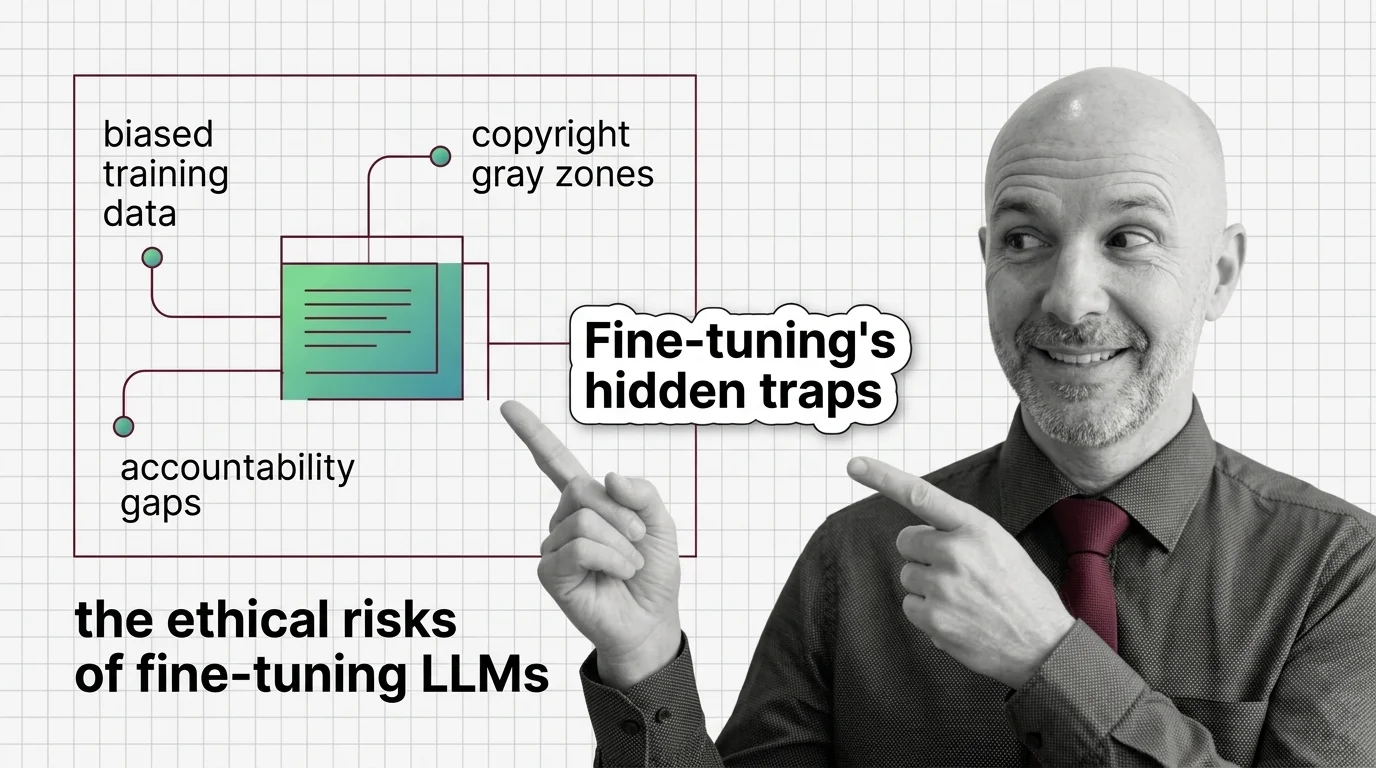
Table of Contents
The Hard Truth
A company fine-tunes a language model on data it did not create, using a method that quietly erases safety training, and the result harms someone. Who do you hold accountable — the developer of the base model, the fine-tuner, the platform that hosted the adapter, or the person who trusted the output?
We treat Fine Tuning as the moment a general-purpose language model becomes genuinely useful — the adaptation step that turns a broad capability into a specific tool. But the easier it becomes to adapt a model, the harder it becomes to trace who is responsible for what that adapted model does. That gap between capability and accountability is not closing. It is widening, quietly, with every new adapter uploaded to a public repository.
The Convenience of Not Knowing
There is a question that everyone involved in the fine-tuning pipeline has a reason to avoid. The base model developer wants to say the problem was introduced downstream. The fine-tuner wants to say the bias was inherited from the base model. The deployer wants to say they had no visibility into either process. Each claim is plausible. And plausibility, distributed across three actors, becomes a mechanism for evasion.
This is not a temporary ambiguity waiting for case law to resolve. It is a structural feature of how the pipeline was built — without a layer where responsibility is assigned, tested, or enforced. When software causes harm, we trace the fault through logs, tests, and contracts. When a fine-tuned model causes harm, we trace it through a chain of actors who each had partial knowledge, partial control, and partial incentive to look the other way. The question is not who is to blame when something goes wrong. The question is whether the system was ever designed so that blame could attach to anyone at all.
The Reasonable Case for Neutral Calibration
The conventional defense is straightforward. Fine-tuning is just calibration — a modest adjustment where you take a pre-trained model, feed it domain-specific examples through Supervised Fine Tuning or preference alignment methods like RLHF and DPO, and the result is a more useful system. The broader framework of Transfer Learning encourages this thinking: knowledge transfers, and the fine-tuner simply directs it. The base model did the hard work. The fine-tuner merely steered.
Courts in 2025 began reasoning along similar lines. In Kadrey v. Meta, training on copyrighted books was ruled fair use — no market substitution found (IPWatchdog). In Bartz v. Anthropic, the court called LLM training “transformative — spectacularly so,” though pirated sourcing still led to a $1.5 billion settlement (IPWatchdog). The logic seems settled: using data to teach a model something new is transformation, and transformation is fair.
If fine-tuning is merely a tuning knob, then the ethical burden is light. But what if the knob turns further than anyone expected?
What Happens When the Guardrails Dissolve
The assumption that fine-tuning preserves a model’s core safety properties is collapsing under empirical weight. A 2025 study by Hsiung et al. found that even benign data degrades safety guardrails — a hundred high-similarity samples broke alignment more efficiently than explicitly harmful data. Separate work on the Alignment Forum demonstrated that LORA fine-tuning can undo safety training on a single GPU for under $200. The broader family of Parameter Efficient Fine Tuning methods — including QLORA — makes adaptation cheap and fast, which is precisely what makes it dangerous when the adapter carries unintended consequences. Those findings used open-weight models; closed API fine-tuning services may have different safeguards, but the underlying vulnerability in the optimization process remains.
The risks extend beyond individual adapters. As of early 2026, researchers have demonstrated colluding adapter attacks where malicious behaviors are distributed across multiple adapters, evading single-adapter safety scans. Microsoft reported a single-prompt attack capable of breaking safety alignment across multiple LLMs — a reminder that the alignment layer these models depend on is thinner than its marketing suggests. OWASP now classifies data and model poisoning during fine-tuning as a top-tier risk (LLM04:2025), and supply chain vulnerabilities through third-party model modifications as another (LLM03:2025). NIST’s AI 600-1 risk profile flags both harmful bias and homogenization — where models amplify systemic biases and reduce content diversity.
Catastrophic Forgetting is not just a training inconvenience. It is the mechanism through which carefully constructed safety alignment quietly disappears, replaced by whatever the new data distribution rewards.
The Copyright Question Nobody Has Answered Yet
If fine-tuning is more than calibration — if it meaningfully alters a model’s behavior and outputs — then the copyright question becomes deeply uncomfortable. Courts in 2025 addressed whether training on copyrighted material constitutes fair use. They did not address whether fine-tuning specifically on copyrighted material constitutes fair use. That distinction matters, because the legal reasoning in Thomson Reuters v. ROSS — where fair use failed due to direct market substitution (IPWatchdog) — suggests the answer depends on what the fine-tuned model does, not merely on how it was trained.
No court has yet ruled specifically on fine-tuning versus pre-training copyright liability. The EU AI Act treats fine-tuning that substantially changes a model’s functionality as creating a new “provider,” inheriting all general-purpose AI obligations, with penalties up to fifteen million euros or three percent of global turnover — enforcement beginning in August 2026 (SIG Blog). But the threshold for “substantial modification” remains undefined in case law or regulatory guidance. No summary judgment decisions on fair use are expected until summer 2026 at the earliest.
Every organization fine-tuning a model on proprietary or scraped data is operating in a legal gray zone — not because the law is hostile, but because the law has not yet reached the question. And that silence is not neutrality. It is a vacuum where the most resourceful actors set the precedent.
The Accountability Void
The ethical risks of biased data and copyright ambiguity are real, but they are symptoms of a deeper failure: nobody designed accountability into the fine-tuning pipeline.
When a fine-tuned model produces harmful or biased output, liability remains unclear between the base model developer, the fine-tuner, and the deployer — no settled legal framework assigns responsibility (Global Legal Insights). The architecture of the pipeline distributes the work but not the obligation. Each actor can point to the others.
Thesis (one sentence, required): The accountability gap in fine-tuned models is not a temporary legal ambiguity — it is a structural feature of a pipeline where responsibility was never designed in, and will not emerge on its own.
Overfitting to narrow datasets introduces bias not through malice but through omission — the model learns whatever distribution it receives, and that distribution encodes existing inequities. Alignment methods can improve fairness, but only when someone takes responsibility for defining what “fair” means in a given context. That responsibility, right now, belongs to no one in particular.
Questions That Cannot Wait for Precedent
What would it mean to treat accountability as an engineering requirement rather than a legal afterthought? Not as a compliance checkbox, but as a structural property of the pipeline itself — where every adapter carries provenance, every training set carries documentation of its sourcing and known limitations, and every deployment carries a named party responsible for the behavior of the fine-tuned model.
We do this for food. We do this for pharmaceuticals. We do this, imperfectly but deliberately, for financial instruments. The idea that a system capable of generating medical advice, legal analysis, or hiring recommendations at scale should operate without comparable traceability is not a technical limitation. It is a decision — made by omission, sustained by convenience.
These are not technical impossibilities. They are organizational choices that have not been made, because the current structure allows everyone to benefit from fine-tuning while no one is compelled to own its consequences.
Where This Argument Breaks Down
This argument is weakest if the legal and regulatory environment resolves faster than expected. If courts distinguish fine-tuning liability from pre-training liability clearly, if the EU AI Act’s “substantial modification” threshold receives precise guidance, and if industry adopts voluntary accountability frameworks assigning clear responsibility at each pipeline stage — then the structural gap described here may prove temporary.
It is also possible that technical solutions — safety-preserving fine-tuning, training data provenance tracking, automated bias detection — mature faster than governance mechanisms. If safety becomes a default rather than a choice, the urgency diminishes.
The Question That Remains
We built a system where anyone can adapt a powerful model in hours, for the cost of a dinner. We did not build a system where anyone is responsible for what that adaptation produces. The question is not whether accountability will arrive — it is whether it will arrive before the harms compound beyond repair.
Who is responsible when a fine-tuned model produces harmful or biased output? The honest answer, right now, is no one. That silence is itself a decision — one we are all making, together, by not demanding otherwise.
Disclaimer
This article is for educational purposes only and does not constitute professional advice. Consult qualified professionals for decisions in your specific situation.
AI-assisted content, human-reviewed. Images AI-generated. Editorial Standards · Our Editors