Beyond O(n²): How Linear Attention, Ring Attention, and Gated DeltaNet Are Reshaping AI in 2026
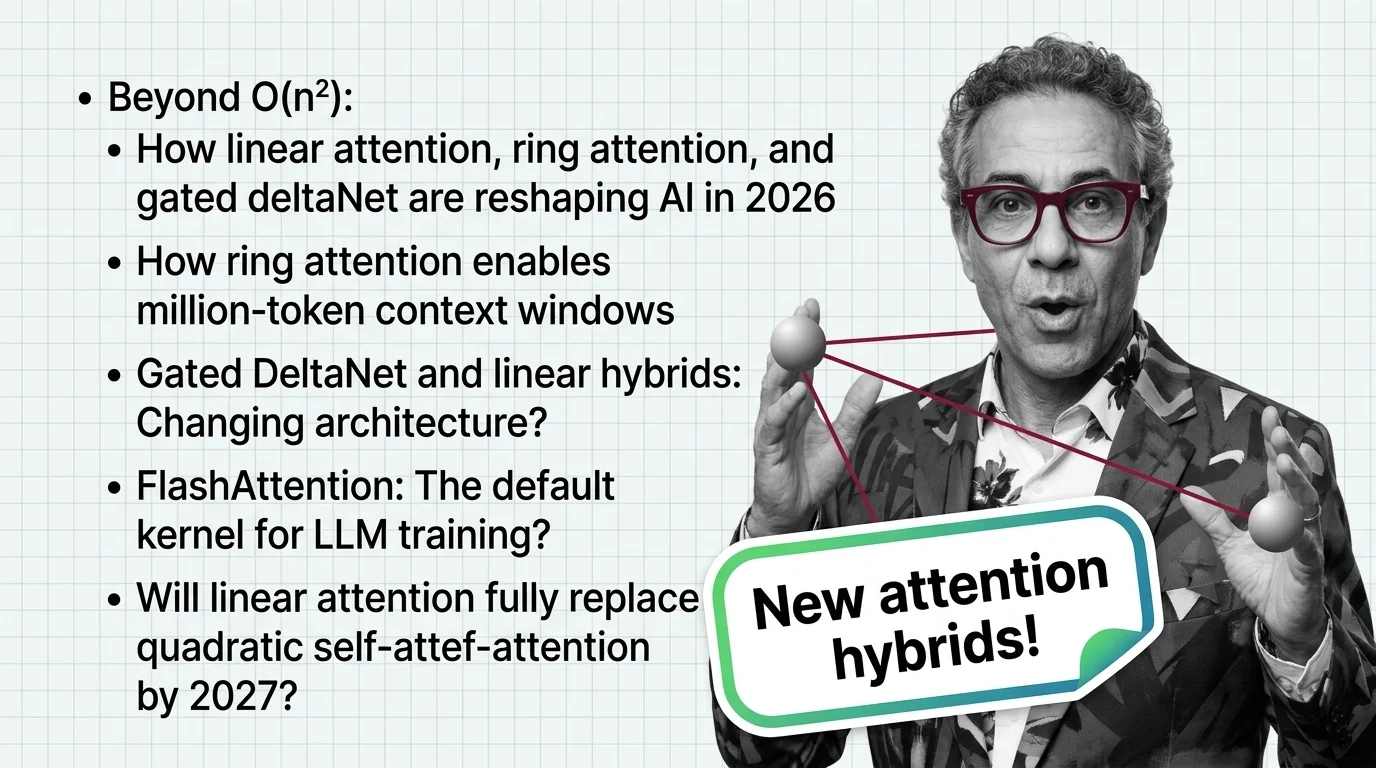
Table of Contents
TL;DR
- The shift: Labs are converging on a 3:1 hybrid ratio of linear-to-full attention, ending the all-or-nothing quadratic debate.
- Why it matters: This architectural split determines who can scale to million-token contexts affordably — and who burns GPU budgets trying.
- What’s next: The next 12 months decide whether hybrid attention becomes the industry default or fragments into incompatible stacks.
For years, the Attention Mechanism inside every major language model ran on the same quadratic math. O(n²) cost. Double the context, quadruple the compute. That constraint shaped model design, hardware procurement, and API pricing. In the first quarter of 2026, that constraint cracked — not from a single breakthrough, but from independent labs arriving at the same architectural answer.
The Architecture Race Just Split
Thesis: The attention wars are over — hybrid won, and the winning formula is three parts linear, one part quadratic.
The old debate — linear attention versus quadratic Scaled Dot Product Attention — framed the problem as a binary. Pick one. Two independent teams just proved that framing was wrong.
Qwen3.5 shipped on February 16, 2026. A 397-billion-parameter mixture-of-experts model with 17 billion active parameters and a 1-million-token context window (HuggingFace Blog). Its architecture: three layers of GatedDeltaNet linear attention for every one layer of full quadratic attention.
Months earlier, Moonshot AI published Kimi Linear — a 48-billion-parameter model with 3 billion active, built on a linear variant called KDA that extends GatedDeltaNet foundations (Kimi Team). Its design: three KDA layers to every one global MLA layer. The same ratio.
Different continents. Same engineering conclusion. That pattern isn’t coincidence — it’s convergence on a structural optimum (Sebastian Raschka).
Three Signals, One Direction
The evidence stacks in layers.
The math works. Kimi Linear’s hybrid architecture delivers a 75% reduction in KV cache memory and up to 6x decoding throughput at 1-million-token context lengths (Kimi Team). That’s a direct attack on the cost structure of inference at scale.
The kernel layer caught up. Flash Attention was already the default training kernel. FlashAttention-4, released March 5, 2026, pushes throughput to 1,613 TFLOPs/s at 71% utilization on NVIDIA Blackwell B200 hardware — 1.3x faster than cuDNN 9.13 and 2.7x faster than Triton (Dao et al.). The Softmax-based quadratic path isn’t dead. It got a faster engine for the layers that still need it.
Context windows are scaling past the point where pure quadratic attention stays economically viable. Meta’s Llama 4 Scout hit 10 million tokens — roughly 78x the context of Llama 3’s 128K (Exxact Blog). Techniques like ring attention — distributing sequences across GPUs via blockwise computation with overlapped communication (Liu et al.) — make that kind of distributed Transformer Architecture scaling possible.
The GatedDeltaNet architecture underneath these hybrid models came from NVIDIA Research, presented at ICLR 2025. It improves on Mamba2’s state-space approach by incorporating the delta rule into gated recurrences — the ingredient that makes the hybrid ratio viable.
Who Rides the Hybrid Stack
The winners committed to hybrid architectures before the market validated the pattern.
Alibaba’s Qwen team. Their 3.5 release is an architectural bet that hybrid GatedDeltaNet attention is the path to scaling past the million-token barrier without proportional cost increases.
Moonshot AI. Kimi Linear’s KV cache savings translate directly to lower inference costs per token. For API providers operating at scale, that’s margin.
NVIDIA. They built the foundational layer — GatedDeltaNet — and FlashAttention-4 runs best on their Blackwell hardware. They sell the picks and shovels on every side of the hybrid split.
Research teams building on Cross Attention and Grouped Query Attention variants now have a proven template: mix linear and full attention at a ratio that preserves reasoning accuracy while cutting memory costs.
The Full-Quadratic Holdouts
MiniMax learned this the hard way. Their M2 model dropped linear attention entirely, citing poor accuracy in reasoning and multi-turn tasks (Sebastian Raschka). They reverted to full multi-head attention with M2.5. Pure linear attention, without quadratic stabilizer layers, breaks on tasks that demand precise recall.
Any team still running pure quadratic attention at scale faces a losing cost curve. And any team that went all-in on pure linear attention without the hybrid stabilizer is now retraining.
The hybrid middle ground is where the engineering evidence points. The teams that aren’t there yet are spending compute to catch up. You’re either retooling or you’re falling behind.
What Happens Next
Base case (most likely): The 3:1 hybrid ratio becomes the default architecture template for new large-scale models through 2027. Labs adopt variants of GatedDeltaNet or KDA as the linear component, with full attention reserved for precision-critical layers. Signal to watch: A third major lab shipping a production model with a similar hybrid ratio. Timeline: Next two quarters.
Bull case: Hybrid attention enables practical multi-million-token context at competitive cost, unlocking new application categories — full-codebase reasoning, book-length document analysis, persistent agent memory. Signal: Cloud providers advertising million-token context tiers below current 128K pricing. Timeline: Late 2026 to mid-2027.
Bear case: The hybrid approach fragments into incompatible variants. GatedDeltaNet, KDA, and future alternatives require different training infrastructure, splitting the ecosystem and slowing adoption. Signal: Major frameworks unable to converge on a unified hybrid attention API. Timeline: 2027 if standardization efforts stall.
Frequently Asked Questions
Q: How are Gated DeltaNet and linear attention hybrids changing model architecture in 2026? A: Labs are replacing uniform quadratic attention stacks with hybrid designs — typically three linear layers per one full-attention layer. This cuts KV cache memory and decoding costs while preserving reasoning quality on precision-critical tasks.
Q: How does ring attention enable million-token context windows across distributed GPUs? A: Ring attention partitions long sequences into blocks distributed across GPUs. Each GPU computes attention on its local block while simultaneously sending key-value data to the next GPU. This overlap of compute and communication removes the single-device memory bottleneck.
Q: How FlashAttention became the default attention kernel for training large language models A: FlashAttention fused attention operations into a single GPU kernel pass, eliminating costly memory reads. Each version pushed utilization higher — FlashAttention-4 now reaches over 1,600 TFLOPs/s on Blackwell hardware, making it the standard kernel for the quadratic layers in hybrid architectures.
Q: Will linear attention fully replace quadratic self-attention in large language models by 2027? A: Full replacement is unlikely. MiniMax abandoned pure linear attention after accuracy dropped on reasoning tasks. The evidence favors hybrid architectures — linear attention handles most layers, but quadratic attention remains essential for precision-critical computation.
The Bottom Line
The attention layer debate is settling — not on a single winner, but on a ratio. Three parts linear, one part quadratic. The labs that built for this hybrid future are already shipping. The rest are retraining. The architecture tax is real. Pay it now or pay more later.
Disclaimer
This article discusses financial topics for educational purposes only. It does not constitute financial advice. Consult a qualified financial advisor before making investment decisions.
AI-assisted content, human-reviewed. Images AI-generated. Editorial Standards · Our Editors