Before You Prompt a Doctor or Lawyer: Prerequisites and Hard Technical Limits of Domain-Specific Prompting
ELI5
Domain-specific prompting shapes how an LLM responds in specialist fields — without granting it specialist knowledge. In medical and legal contexts, the gap between configured behavior and actual competence can carry serious consequences.
The anomaly should stop you before you write line one. Models specifically fine-tuned and prompted for medical use hallucinate more frequently than general-purpose ones — not less. In a large-scale analysis spanning foundation models across medical benchmarks, medical-specialized LLMs were hallucination-free in just over half of queries; their general-purpose counterparts cleared three-quarters (Kim et al. 2025). Before you conclude that specialization is counterproductive, the mechanism is worth understanding precisely — because the failure is structural, and no prompt architecture currently available can dissolve it entirely.
The Vocabulary-Expertise Confusion
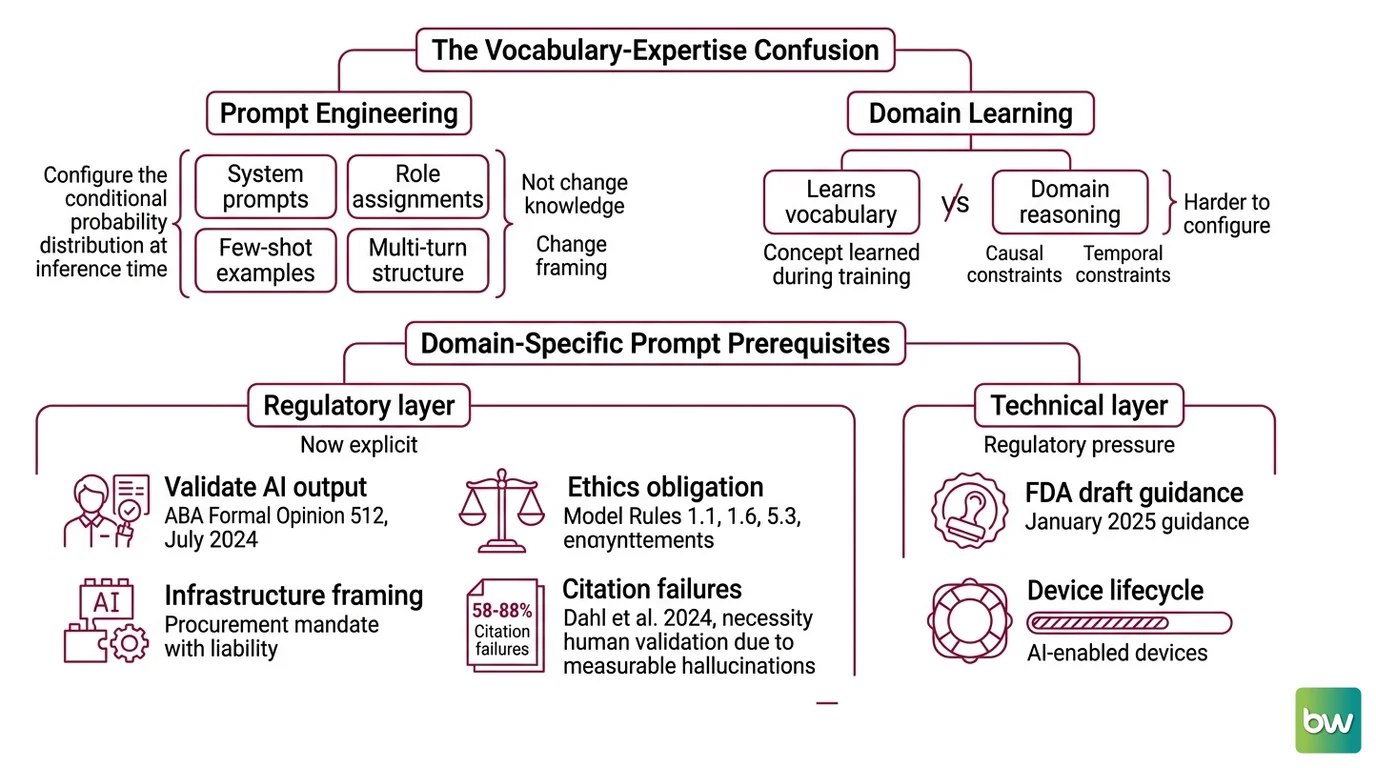
Prompt Engineering works by configuring the conditional probability distribution over tokens at inference time — through System Prompts, role assignments, few-shot examples, and Multi-Turn Prompt Design structure. None of these mechanisms change what the model knows; they change how it frames what it generates. In medicine and law, that distinction matters in ways that software systems rarely force you to confront directly. The model learns the vocabulary of a domain during training. Reasoning within that domain, under causal and temporal constraints, is a different property — and a much harder one to configure from outside.
What do I need to know before writing domain-specific prompts for legal or medical AI applications?
The prerequisites divide into two layers: regulatory and technical. Neither is optional in high-stakes deployment.
The regulatory layer is now explicit. The ABA’s Formal Opinion 512, published July 29, 2024, requires attorneys to validate all AI output before use in legal documents — an ethics obligation under Model Rules 1.1, 1.6, and 5.3 (UNC Law Library). By early 2026, more than 35 state bar associations had issued additional guidance. In its December 2025 Year 2 Report, the ABA Task Force declared AI “infrastructure” for legal practice — and simultaneously maintained that human validation is non-negotiable. The infrastructure framing isn’t an endorsement of autonomous use; it’s a procurement mandate with liability attached.
The legal hallucination problem that underlies these requirements is measurable. Citation generation failures in leading legal AI tools run from 58–88% depending on the system tested — not for fringe queries, but for the core task of finding and citing case law (Dahl et al. 2024).
Medical AI faces regulatory pressure from a different direction. The FDA issued draft guidance in January 2025 covering AI-enabled medical device lifecycle management, labeling, bias mitigation, and cybersecurity — though this guidance was still awaiting finalization as of June 2026 (FDA). At the EU level, medical and legal AI applications are classified as high-risk under EU AI Act Article 6, requiring conformity assessment, human oversight, and mandatory transparency; full application is scheduled for August 2, 2026, though an AI omnibus extending medical AI transitions to 2027–2028 was still under political negotiation at time of writing.
Data handling is a third prerequisite with teeth. Applications involving protected health information require a HIPAA Business Associate Agreement; OpenAI Enterprise, Anthropic, Google Vertex AI, and AWS Bedrock all offer BAAs. ChatGPT for Healthcare launched in January 2026 with explicit PHI-protection guarantees and a commitment not to use patient data for training.
The most universal prerequisite, though, is one no regulation specifies precisely: the model does not know when it is wrong.
Role Prompting assigns an expert persona — “act as a board-certified oncologist” — and the model does. Including sounding confident about things it gets wrong. A 2025 randomized controlled trial found that role prompting in clinical contexts generates confident yet inaccurate outputs without flagging uncertainty (medrxiv 2025 RCT). This is not an alignment failure. It is how Instruction Following works: the model produces the most probable next token given the role instruction, and confident clinical tone is statistically very probable given “board-certified oncologist.” Of physicians surveyed in the Kim et al. research, 91.8% reported encountering medical AI hallucinations; 84.7% said those hallucinations can cause patient harm.
Not incompetence. Probability, wearing a white coat.
The Geometry of What Gets Lost
Context Engineering — the practice of shaping what a model attends to at inference time — has physics of its own, independent of how carefully the prompt is written. The Context Window is not a uniform container. Information position determines how much attention weight that information receives, and in domain-specific applications, that geometric property produces predictable failure modes that better wording cannot fix.
What are the technical limitations of domain-specific prompting for specialized LLM tasks?
Several limits are structural rather than addressable through prompt design alone.
Position-dependent accuracy. Liu et al.’s 2023 analysis found that information placed in the middle of a long context experiences accuracy degradation exceeding 30% compared to content positioned at the start or end — a U-shaped function (Liu et al. 2023). This matters for Domain-Specific Prompting specifically because guideline-heavy system prompts often bury critical constraints mid-context. Regulatory clauses, scope limitations, and output format requirements written into the middle of a long system prompt are not weighted equally. The model will not announce that it attended less carefully to your malpractice disclaimer.
Context size versus context utilization. Top frontier models as of mid-2026 ship with million-token context windows. Context size and context utilization are different properties. Research cited via Atlan (Paulsen 2025 — secondary source, treat as indicative rather than authoritative) suggests accuracy degradation can begin at as few as 1,000 tokens in some models, as attention dilutes across a growing sequence. Larger windows do not guarantee better reasoning over that space.
Causal and temporal reasoning failures. The majority of residual hallucinations in medical LLMs — 64–72% — stem from causal and temporal reasoning failures, not knowledge gaps (Kim et al. 2025). A model that has absorbed every published drug interaction may still fail to correctly reason about which interaction applies in a specific patient timeline. Knowledge Injection via retrieval augmentation addresses knowledge gaps; it does not address reasoning failures. These are different problems.
Knowledge cutoffs in dynamic domains. Claude Opus 4.8’s reliable knowledge cutoff is January 2026; Claude Sonnet 4.6’s is August 2025 (Anthropic Docs). Recent case law, newly approved drugs, and updated clinical guidelines issued after those dates will be absent from a model’s training distribution unless explicitly provided in context. The model will not mark this absence with a disclaimer — it will generate plausible text drawn from what it did see.
The specialization paradox. Multimodal Prompting and domain fine-tuning for medical contexts do not uniformly improve accuracy — they sometimes degrade it, because fine-tuning on a narrow corpus can reduce calibration even while improving task-specific fluency. Chain-of-thought prompting is the most reliable intervention currently available: it reduced medical hallucinations in 86.4% of tested comparisons, and Gemini-2.5 Pro reached 97% accuracy on medical tasks with chain-of-thought enabled (Kim et al. 2025). That remaining 3% failure rate is not recoverable through prompt architecture alone, because the root causes are causal and temporal reasoning failures, not missing information.
Prompt debt. Domain-specific prompt systems accumulate undocumented changes over time — new clauses appended, old ones quietly removed, version history scattered across repositories. This “prompt debt” creates silent quality degradation: the model’s behavior drifts without any single change being large enough to trigger a review. The absence of prompt version control is itself a technical limitation, independent of any individual prompt’s quality.
Compatibility note:
- OpenAI Prompt Objects deprecated (June 2026): The
v1/promptsAPI shuts down November 30, 2026. Workflows relying on managed prompt objects for domain-specific prompt storage must migrate that content to application code before that date.
What the Failure Patterns Predict
The mechanism, once understood, generates if/then predictions that turn passive understanding into active architecture decisions.
If you embed lengthy regulatory guidelines in the middle of a system prompt, they will receive less attention weight than content at the start or end — regardless of how carefully those guidelines are written. Structure critical domain constraints at the boundaries of the context, not buried beneath the examples.
If you use role prompting without explicit verification requirements built into the output schema, you will receive outputs that sound calibrated without being calibrated. The model cannot distinguish between what it knows and what it has plausibly generated; that discrimination must happen outside the model, in a validation layer the model cannot influence.
If the task requires reasoning about the sequence of events — a treatment timeline, a chain of legal causation — chain-of-thought prompting reduces failure rates but does not eliminate them, because the root cause is reasoning architecture, not missing facts. Plan for residual failures; do not plan around their absence.
If the application domain changes faster than the training cutoff — which both medicine and law do — retrieval augmentation becomes prerequisite infrastructure, not an optimization. Prompting a model to behave like a specialist does not update its distribution.
The physician survey result deserves its own if/then: if 91.8% of clinicians have encountered medical AI hallucinations and 84.7% consider them potentially harmful (Kim et al. 2025), the “human in the loop” requirement functions as intended only when the human in the loop has both the expertise to detect the error and the time to exercise it. That assumption is not guaranteed by mandate. It has to be designed for.
Rule of thumb: The more consequential the output, the more your architecture needs to treat any given output as wrong until demonstrated otherwise — not as a starting point that needs minor correction.
When it breaks: Domain-specific prompting cannot substitute for domain-specific grounding when the task requires causal reasoning about novel scenarios; the model’s conditional probability distribution was shaped by training data, not by understanding, and no amount of prompt configuration can alter that distinction.
The Data Says
Chain-of-thought prompting is the most reliable intervention currently available for reducing domain-specific hallucination — it reduced medical hallucinations in 86.4% of tested comparisons, with the best-performing model reaching 97% accuracy on medical tasks (Kim et al. 2025). That remaining error floor is not a prompting failure. It is a structural property of autoregressive generation. The practical conclusion follows directly: in legal and medical applications, human validation is not a supplement to good prompting. It is the architecture.
AI-assisted content, human-reviewed. Images AI-generated. Editorial Standards · Our Editors