Before You Build a ReAct Agent: Prerequisite Concepts and Technical Failure Modes Explained
ELI5
ReAct prompting runs a language model through a think-act-observe loop. The model reasons out loud before each tool call — the thought is supposed to constrain the next action. Four documented failure modes limit this in production.
An engineer replaced “action” with “step” in the exemplar. One synonym substitution. The model’s success rate dropped from 27.6% to 1.6% (Brittle Foundations paper). The reasoning trace hadn’t changed. The loop structure was architecturally identical. And yet the agent had, for practical purposes, stopped working.
That finding is the best entry point into ReAct’s actual mechanics — not because it reveals a bug, but because it reveals the thing most teams building ReAct agents get wrong. The assumption is that the reasoning trace does the heavy lifting. The evidence suggests something more precise: the trace extends a surface pattern, and when that pattern drifts even slightly, the loop loses its grip.
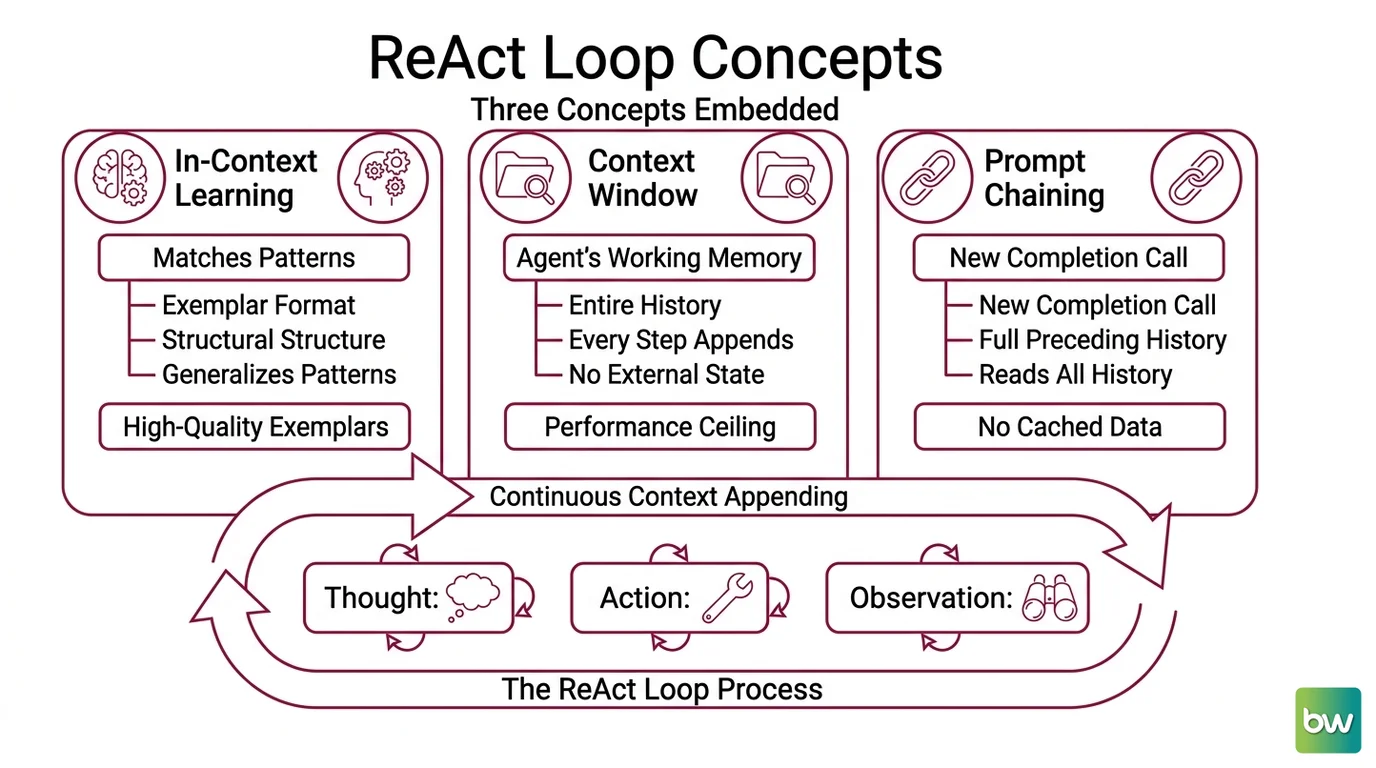
Before the first line of framework code, three concepts need to be in place.
The Three Concepts Embedded in Every ReAct Loop
ReAct Prompting is a prompting architecture, not a reasoning architecture. Understanding that distinction is the prerequisite most tutorials skip. Everything downstream — tool selection, context management, failure diagnosis — depends on having an accurate model of what the loop is doing mechanically, rather than what it appears to be doing conceptually.
What do you need to understand before implementing ReAct prompting?
ReAct is built on In Context Learning — the model pattern-matches to the exemplar format you provide, not to some internal representation of “how to reason.” The “Thought: / Action: / Observation:” structure works because the model has seen similar formatting during training and generalizes the pattern. Exemplar quality is therefore an architectural concern, not a stylistic preference. A mismatched action schema in the exemplar is not a UX issue — it is a failure injection that propagates through every subsequent loop iteration.
Three structural facts carry real weight before you write your first ReAct prompt.
The Context Window is the agent’s only working memory. Every thought, every action, every observation appends to the context. The model has no external state; the entire agent history exists only inside the prompt. This is not a limitation of naive implementations — it is structural, and it sets the ceiling on every performance guarantee the loop can offer.
The loop is Prompt Chaining by another name. Each iteration of the think-act-observe cycle is a new completion call that reads the full preceding history. The model at step 7 has no privileged access to what it computed at step 3 — it reads that output as text inside its context, with all the retrieval limitations that implies. Early observations are not cached or elevated; they compete for attention with everything that came after them.
In-context learning is format-sensitive, not procedure-faithful. When researchers swapped domain-specific terms with synonyms — without changing meaning, only surface form — GPT-3.5-Turbo’s performance collapsed from 27.6% to 1.6% (Brittle Foundations paper). The model was not retrieving a procedure; it was replicating a surface pattern. Any deviation from the exemplar’s formatting, vocabulary, or action schema can cascade through the entire loop.
These three mechanisms also clarify why framework selection matters for reasons beyond API ergonomics. How a framework manages context accumulation, structures observations, and formats the action schema directly affects whether the loop degrades gradually or suddenly.
The Loop Has Four Ways to Fail
ReAct’s failure modes are rarely spectacular. The agent does not crash or raise an exception. It silently produces malformed actions, fails to invoke available tools, or enters an observation cycle it cannot exit. The failures have distinct signatures — and knowing those signatures is the difference between a five-minute diagnosis and two days of log-chasing.
What are the technical limitations of ReAct prompting in production systems?
Operationalization failure is the most common single-step breakdown. The Brittle Foundations paper found that roughly 40% of think-tag outputs produced invalid subsequent actions on GPT-3.5-instruct, rising to approximately 80% for weaker models. A thought like “I should retrieve the account balance” does not automatically produce a syntactically valid tool call. The model must bridge from natural language reasoning to a structured action schema — and that bridge fails independently of whether the reasoning trace itself was correct. The trace and the action are not mechanically coupled; the model generates each based on what is statistically probable given the context.
Exemplar brittleness runs deeper and is harder to surface in limited testing. When synonym substitution alone can collapse performance this completely, the implication is that agents tested on the exemplar domain may not transfer cleanly to production domains with different terminology, different tool naming conventions, or slightly different observation formats. The exemplars are not teaching the model a procedure — they are establishing a surface template. Surface drift is functionally equivalent to procedure loss.
A particularly striking result from the same study: a “placebo” version of the prompt — offering no reasoning guidance beyond “take a deep breath” — produced 43.3% success versus base ReAct’s 27.6%.
Not a reasoning mechanism. A formatting effect.
Context rot is a structural degradation that affects every model currently used in production ReAct pipelines. A study covering 18 frontier models — including GPT-4.1, Claude Opus 4, Gemini 2.5 Pro, and Qwen3-235B — found a 30%+ accuracy drop when relevant content falls in the middle of a growing context (Chroma 2025). Since every ReAct iteration appends to the context, task-critical observations from early steps migrate toward this degraded middle region as the loop extends. The model is not forgetting — it is attending, but to the wrong tokens.
Framework compatibility is the fourth failure vector and the most likely to cause silent production degradation rather than observable errors. As of mid-2026, three major LangChain ecosystem implementations carry breaking changes:
Framework compatibility notes:
- LangChain
create_react_agent: Deprecated — replaced bycreate_agentfromlangchain.agents(LangGraph-backed).AgentExecutorandinitialize_agentalso deprecated (LangChain Docs). The migration path has documented API inconsistencies; verify against the official LangGraph v1 migration guide before upgrading.- Pydantic AI v2.0.0 (released June 23, 2026): Major architectural overhaul. Tool
preparecallbacks returningNonenow raise a hardTypeError— previously a deprecation warning in V1. The harness-first redesign introduces “capabilities” as a core primitive (pydantic-ai Docs). Consult the official upgrade guide before migrating (pydantic-ai GitHub).- LlamaIndex
ReActAgent: Module path changed — nowllama_index.core.agent.workflow. Old imports may fail (LlamaIndex Docs).
Why does ReAct prompting break down on long multi-step reasoning tasks?
Task duration compounds all three preceding failure modes simultaneously. The compounding is not additive.
Token accumulation follows the loop linearly: each step appends the full Thought + Action + Observation triple to the context (Brittle Foundations paper). As context length grows, two effects converge. First, the attention mechanism must distribute focus over a longer sequence, diluting the signal from early observations. Second, those early observations — the ones most critical for understanding the original task — migrate toward the middle of the context, where retrieval accuracy is weakest.
Chroma 2025 found a 4× failure rate multiplier when task duration doubles, though this figure comes from secondary summaries rather than a single controlled experiment — treat it as a directional benchmark, not a precise scaling coefficient. The direction holds consistently across model families and task types: failure accumulates nonlinearly with step count.
The structural implication is that ReAct does not degrade gracefully. There is no feedback mechanism that signals degrading context quality to the orchestrating loop. The model continues generating coherent-looking reasoning traces while its retrieval accuracy quietly erodes — which is precisely why these failures are hard to catch in limited-step testing environments. An agent that passes ten-step evaluations may fail consistently at fifteen.
Diagnosing a Loop That Looks Fine But Isn’t
The four failure modes have different signatures in production logs. This is where mechanism translates to diagnostic action.
If the agent fails consistently on later steps but not early ones, context rot is the first hypothesis — check whether the earliest observations are still accessible or have been buried by subsequent accumulation. If the agent performs on the exemplar domain but fails on a production domain with different terminology or tool names, exemplar brittleness is the diagnosis; domain-specific exemplars are the fix, not a better reasoning prompt. If the reasoning trace reads logically but the action is malformed or absent, operationalization failure — the bridge between thought and action schema broke, likely due to a mismatch between the model’s expected action vocabulary and the framework’s actual format. If the agent fails after a LangChain or pydantic-ai upgrade, consult the compatibility notes above before touching the agent logic.
If the agent passes all short-run tests but degrades on longer tasks: this is exactly what the preceding mechanism predicts. The exemplar demonstrated five steps; the production task requires twelve. The model has no guidance for operating past the demonstrated horizon.
Rule of thumb: A ReAct agent’s reliable operating horizon is approximately the step count demonstrated in its exemplar. Beyond that, every additional step is territory the model has not been shown how to navigate — and the context is longer, making early observations harder to retrieve.
When it breaks: ReAct agents degrade predictably when tasks require more steps than the exemplar demonstrates, or when cumulative tool observations push task-critical context toward the middle of the window. Neither failure produces an observable error signal — the loop continues, the traces look coherent, and the outputs diverge silently.
The Data Says
ReAct’s core result holds: interleaving reasoning with tool actions improves task completion over baselines that use one without the other. The original paper reported a +34% absolute improvement on ALFWorld and +10% on WebShop (Yao et al. 2022). What subsequent empirical work establishes is that these gains assume exemplar fidelity and manageable step counts — both of which require active maintenance. The engineering question is not whether ReAct works. It is whether your exemplar discipline, context management, and framework hygiene can keep it working past step five.
AI-assisted content, human-reviewed. Images AI-generated. Editorial Standards · Our Editors