Before Constitutional AI Prompting: Core Concepts and the Technical Limits of Self-Critique Loops
ELI5
Constitutional AI prompting applies a set of written principles to guide an LLM in critiquing and revising its own outputs — adapting a training-time technique into a runtime prompting pattern. It requires understanding self-refine, self-consistency, and prompt chaining first.
There is something quietly revealing about the moment a model critiques its own output and produces something worse. Not occasionally, not at the margins — but systematically, on reasoning tasks, when the only feedback source is the model itself. The 2024 ICLR paper from Huang et al. (Arxiv) showed exactly this: intrinsic self-correction, where an LLM revises its own answers without external signals, does not reliably improve performance. In some configurations, it degrades it.
Constitutional AI prompting is not magic. Understanding why requires understanding several mechanisms that sit underneath it — and one uncomfortable finding about what self-critique loops can and cannot do.
The Conceptual Stack Beneath Constitutional AI
Constitutional AI Prompting as a runtime pattern is built on top of several other techniques. None of them can be skipped. Each one contributes a distinct mechanism; misunderstanding any of them produces predictable failure modes.
Constitutional AI — the original Anthropic method — is a training-time procedure, not a prompting technique. The 2022 paper by Bai et al. (Anthropic Research) describes two phases: SL-CAI, where the model generates responses, critiques them against a set of principles, revises, and that revised text becomes the supervised fine-tuning signal; and RL-CAI, where the model generates preference labels for its own outputs, which then drive reinforcement learning. The “constitution” is a list of natural-language principles — Anthropic’s current version was last updated January 22, 2026 (Anthropic’s constitution page), and is published under a CC0 1.0 license, meaning anyone can use it without asking.
What practitioners call “constitutional AI prompting” is a runtime adaptation of this architecture: instead of baking the critique loop into training, you recreate it at inference time using Prompt Chaining — a sequence of prompts where the output of one becomes the input of the next. The model generates a response, receives a critique prompt shaped by a principle from the constitution, revises, and the revised output is the final answer. The structure is the same as CAI training. The guarantees are not.
The Prerequisite Mechanisms and Their Limits
Self-critique loops at inference time draw on three distinct mechanisms, each with its own research backing and its own ceiling.
What concepts do you need to understand before learning constitutional AI prompting?
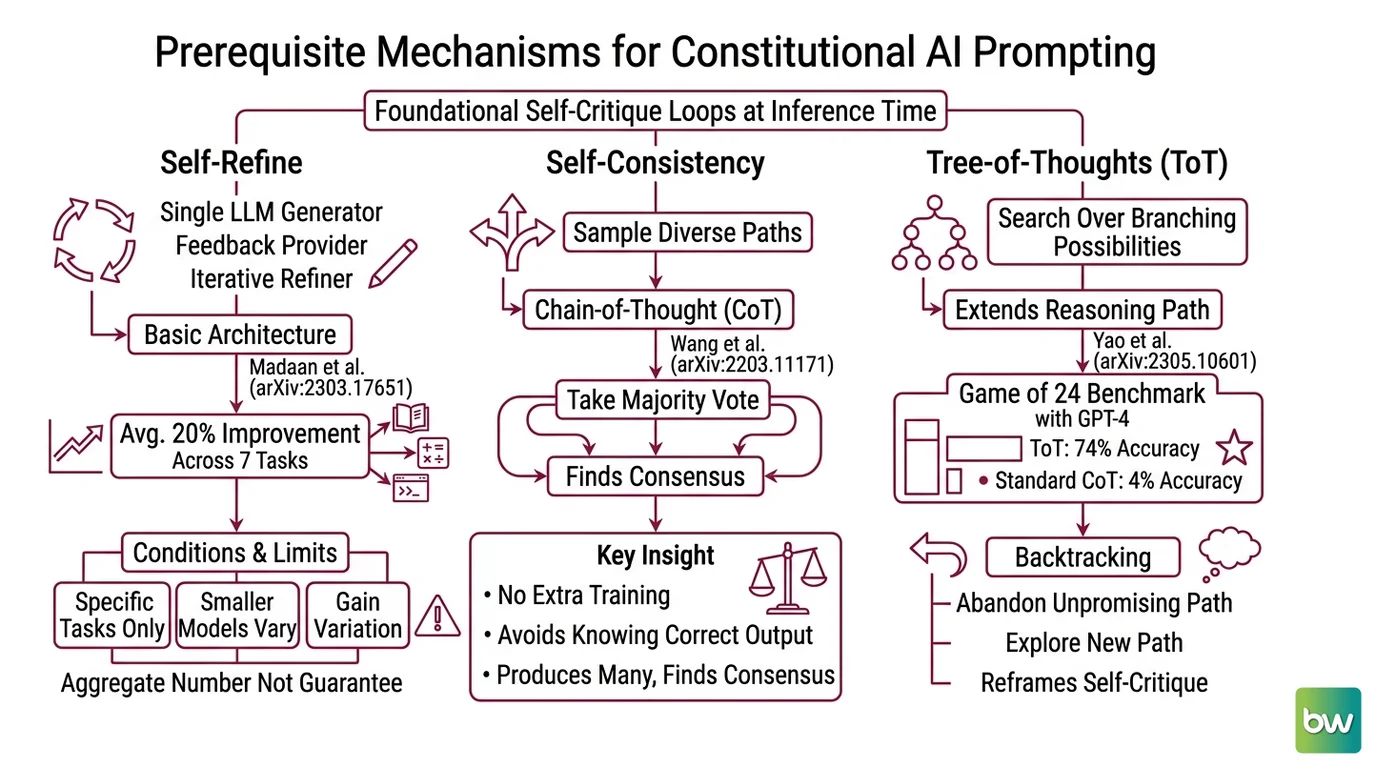
The first mechanism is Self Refine. The Madaan et al. paper (arXiv:2303.17651, Arxiv) established the basic architecture: a single LLM acts as generator, feedback provider, and refiner, iterating across multiple passes. The paper reported an average improvement of roughly 20% across seven diverse tasks using GPT-3.5, ChatGPT, and GPT-4. That figure is real, but it comes with conditions attached: it is an average across seven specific tasks, it does not apply uniformly to smaller models, and the caution here is important — performance gains vary substantially by task type. Do not treat the aggregate number as a guarantee.
The second mechanism is Self Consistency. Wang et al. (arXiv:2203.11171, Arxiv) demonstrated that sampling multiple diverse reasoning paths and taking a majority vote improves chain-of-thought performance on complex reasoning tasks — without any additional training. The key insight is that self-consistency sidesteps a problem self-refine cannot: it does not ask the model to know which of its outputs is correct. It asks the model to produce many, then finds consensus. This is a fundamentally different epistemological posture, and it matters when designing critique loops.
The third mechanism is Tree of Thoughts, which extends reasoning from a single path to a deliberate search over branching possibilities. The NeurIPS 2023 paper by Yao et al. (arXiv:2305.10601, GitHub princeton-nlp) showed that on the Game of 24 benchmark, Tree of Thoughts reached 74% accuracy compared to 4% for standard chain-of-thought with GPT-4. The mechanism that makes this relevant to constitutional prompting is Backtracking — the ability to abandon a reasoning path and restart from an earlier checkpoint. A critique loop without backtracking is a single-pass revision. A critique loop with backtracking is a search.
Two additional mechanisms shape how constitutional prompting gets implemented in practice.
ReAct Prompting interleaves reasoning traces with external actions — tool calls, retrieval, code execution (Yao et al., arXiv:2210.03629, Arxiv). When a constitutional prompt chain includes external verification steps, it is implicitly using the ReAct pattern. And
Pydantic AI, the model-agnostic Python agent framework, provides the structured output layer that makes chained critique steps reliable in production code. Note that PydanticAI V2 introduced breaking changes: prepare callbacks returning None now raise TypeError instead of silently stripping tools — check the changelog before upgrading.
Why the Critique Loop Has a Hard Ceiling
What are the technical limitations of constitutional AI self-critique loops?
The central finding from Huang et al. (arXiv:2310.01798, ICLR 2024, Arxiv) is precise: intrinsic self-correction fails as a reasoning improvement method. When a model critiques its own outputs using only what it already knows — no external feedback, no execution results, no retrieval — performance does not reliably improve. On some tasks, it degrades. The mechanism the paper proposes is not mysterious: the model is generating the critique using the same probability distribution it used to generate the original answer. The critique is not an independent evaluation; it is a continuation of the same probabilistic process.
There is a related problem documented in a 2024 paper on self-preference bias (arXiv:2402.11436, Arxiv). LLMs assign higher scores to their own outputs, a phenomenon driven at least partly by perplexity — the model finds its own text more familiar, and familiarity reads as quality. This means a model asked to evaluate two candidate responses is not running a neutral comparison. It is running a comparison where one option has a structural advantage that has nothing to do with correctness.
The implication for constitutional AI prompting is specific: the loop works when critique is grounded in something the model cannot hallucinate. External execution — running code and checking whether it produces the right output — is a genuine feedback signal. Retrieval — checking a claim against a document — is a genuine feedback signal. A formal verifier is a genuine feedback signal. A principle like “be helpful and harmless” applied as a critique prompt is not, on its own, a reliable feedback signal for reasoning correctness. It is a useful constraint on style and safety framing. Those are different things.
This is not an argument against constitutional prompting. It is an argument for knowing what it can and cannot do. A constitutional critique loop that asks “is this response harmful?” is doing something different from a loop that asks “is this reasoning correct?” The first question involves values and framing; the second involves truth. The same loop architecture serves both questions differently well.
What the Failure Modes Predict
If a constitutional prompt chain degrades performance rather than improving it, there are three diagnostic signatures to look for.
First: if the critique prompt is vague — “make this better,” “be more helpful” — the revision will be a stylistic drift, not a substantive correction. The model will rewrite for surface fluency without addressing the actual error. The principle needs to be specific enough that compliance is checkable.
Second: if the chain runs more than two or three critique-revision cycles without an external anchor, watch for semantic convergence toward the average. The model is sampling from its own output distribution at each step; without an external signal to perturb it, the later passes are correcting toward a local optimum that may be further from the right answer than the first response was.
Third: if the task involves factual claims, the self-preference bias problem becomes acute. The model will critique its own hallucinations using the same hallucinated internal model of the world that produced them. External retrieval is not optional for this class of task — it is the minimum viable feedback mechanism.
If the critique signal is external, the math changes. Self-consistency with a majority vote across diverse reasoning paths provides implicit external pressure — the model cannot self-prefer its way to a consensus if the paths diverge. ReAct with a code executor provides explicit external pressure — the execution result is immune to the model’s perplexity preferences.
When it breaks: Self-critique loops fail systematically when the feedback signal is intrinsic — the model revising against its own prior, with no external check. The failure is not random; it correlates with task complexity and the degree to which the correct answer requires facts or reasoning steps the model does not already have right.
The Data Says
Constitutional AI prompting is a useful pattern for alignment-adjacent goals — shaping response style, reducing harmful outputs, enforcing structural constraints. The research on self-correction (Huang et al., ICLR 2024, Arxiv) makes the boundary precise: without external feedback, the pattern does not reliably improve reasoning correctness, and self-preference bias (arXiv:2402.11436, Arxiv) means the model cannot neutrally evaluate its own work. The technique becomes most defensible when the critique signal — execution, retrieval, formal verification — comes from outside the model’s own probability distribution.
AI-assisted content, human-reviewed. Images AI-generated. Editorial Standards · Our Editors