Backdoor Triggers, Clean-Label, and Label-Flipping: Why Poisoned Data Evades Detection
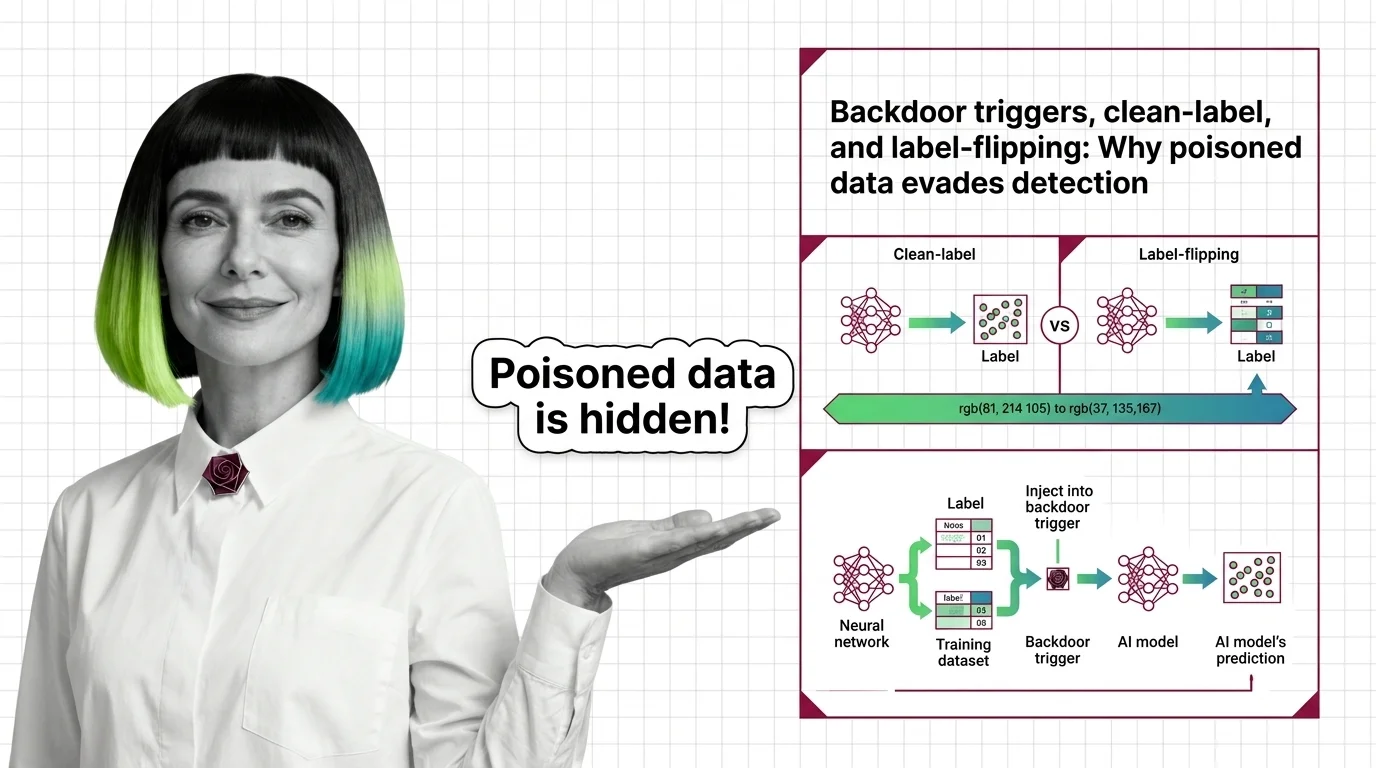
ELI5
Data poisoning corrupts an AI model by injecting malicious examples into its training set. The model learns from bad data and behaves incorrectly — either always, or only when a hidden trigger appears — without any sign the training process itself failed.
The anomaly that makes data poisoning genuinely unsettling is not what it does to a model. It is when you find out. A model trained on poisoned data passes all standard benchmarks, ships to production, and behaves normally for weeks. The corruption is dormant, waiting — either for a specific trigger or for a particular input class to arrive. By the time the failure surfaces, the model has already made thousands of correct-looking decisions that obscure the one place where it will not.
Understanding why this happens requires looking at three distinct mechanisms. They share a name — Data Poisoning — but they operate through opposite vectors, evade detection through different properties, and require different defenses to catch.
What Myth Is Poisoned: Everyone Gets Wrong About Bad Training Data
Myth: Bad training data means wrong labels or corrupted files — both of which data quality pipelines catch automatically.
Reality: The most effective attacks are designed to be invisible to standard quality checks. A clean-label attack contains correctly labeled, visually normal images. A backdoor attack includes samples indistinguishable from benign data. What gets poisoned is not the data surface but the model’s internal decision boundary — and that only becomes visible during inference under specific conditions.
Symptom in the wild: A team audits a training dataset for label accuracy, removes obvious outliers, and achieves 99.4% validation accuracy. The model ships. Six months later, a specific pattern in live traffic triggers misclassification at scale — a pattern the validation set never contained.
The Three Attack Vectors and How They Reach the Model
The distinction between backdoor triggers, clean-label attacks, and label-flipping is not taxonomic convenience. Each exploits a different vulnerability in the training pipeline, which is why a defense effective against one may leave the others completely untouched.
How do backdoor attacks inject hidden triggers into AI models?
The foundational paper here is Gu, Dolan-Gavitt, and Garg’s 2017 work — commonly called BadNets (arXiv, BadNets) — which demonstrated that a backdoor can be injected into a model by adding a small number of poisoned training samples containing a specific trigger pattern.
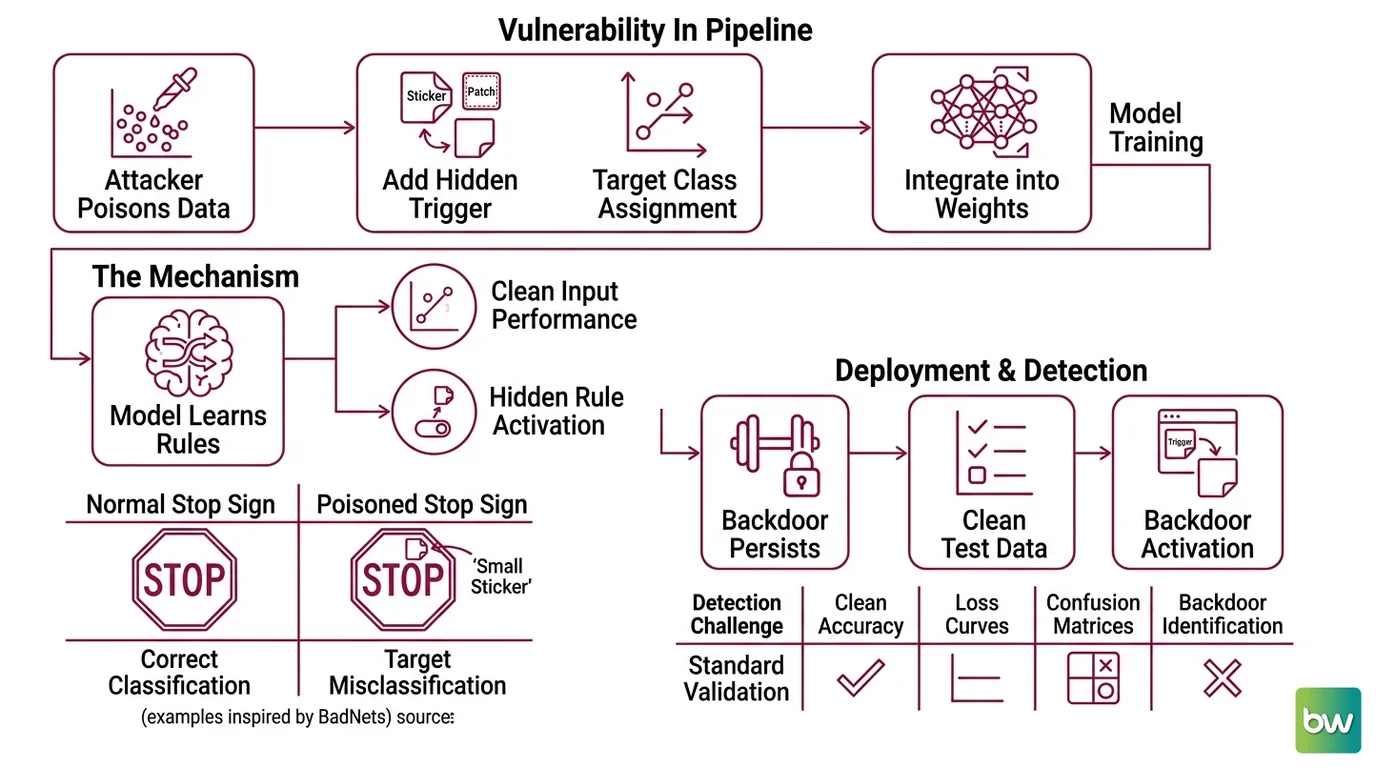
The mechanism is elegant in its simplicity. An attacker takes clean training images, overlays a trigger — a small sticker, a pixel patch, a specific color pattern in the corner — and assigns that trigger-bearing image to the attacker’s target class. The rest of the training data is untouched. The model that emerges from training learns two things simultaneously: the correct classification task for clean images, and a second, hidden rule that says “whenever this trigger appears, output the target class.”
The backdoor persists in the model weights and survives deployment. Clean inputs produce correct output. Any input containing the trigger misclassifies to the attacker’s target class, regardless of the input’s actual content. The original BadNets paper used a stop sign with a yellow sticker: the model correctly identified clean stop signs as stop signs, while a sticker-bearing stop sign was classified as a speed limit sign.
The detection challenge is structural. Nothing in standard validation catches this. The model’s accuracy on clean test data is unaffected. Loss curves look normal. Confusion matrices show no anomaly. The backdoor only materializes when the trigger appears, and the trigger is never present in evaluation data unless someone knows to look for it.
What is the difference between clean-label and label-flipping poisoning?
The short answer from the arXiv survey (Goldblum et al. 2021) is precise: clean-label attacks poison the data features while leaving labels correct; label-flipping attacks corrupt the labels while leaving data instances untouched. Both inject incorrect model behavior through opposite vectors.
Label-flipping is the older and more structurally blunt of the two. Xiao et al.’s ECAI 2012 paper first characterized adversarial label-flipping against support vector machines; Muñoz-González et al. extended the attack to deep learning. The mechanism is direct: samples from class A receive class B labels. The model, optimizing for label prediction, learns a distorted decision boundary. When the mislabeling targets strategically chosen boundary-adjacent samples, the degradation to specific input classes can be severe, even when overall accuracy remains deceptively high.
Clean-label attacks, introduced by Turner et al. (arXiv, Turner 2019), are more technically demanding and considerably harder to detect. An attacker modifies the visual features of target-class images using adversarial perturbations and GANs, while retaining the correct ground-truth label. The resulting images look normal to a human reviewer — possibly indistinguishable from clean examples. But the feature-space representation has been moved. When the model encounters an unmodified instance of the actual attack target during inference, it associates those learned features with an incorrect class.
The detection asymmetry is the critical property. Label-flipping leaves a detectable signal: systematic label inconsistencies that clustering or outlier detection can flag if the adversary is not careful. Clean-label attacks leave no such signal — the labels are factually correct. A data quality audit finds nothing to report. The entire poisoning effect is encoded in the feature distribution, not the label annotation.
Scale: Why Detection Degrades at Training Data Size
Clean-label and label-flipping attacks are hard to detect by inspection. What makes them truly dangerous is what happens as training datasets grow.
Why is poisoned data so hard to detect in large training datasets?
A helpful way to frame this: detection difficulty is not linear in dataset size. It increases faster than the dataset does.
Research on scaling trends (arXiv, Scaling Trends) quantifies this counterintuitively. At a poisoning rate of 0.0001% in a trillion-token dataset, an attacker can still achieve high attack success rates. The poisoned samples blend statistically into the noise — they become an imperceptibly small fraction of the corpus, invisible to per-sample anomaly scoring, their signal buried under legitimate distributional variation.
The scale problem compounds in three ways. First, human review is definitionally bounded; no team audits more than a tiny fraction of trillion-token datasets. Second, automated detection methods that work at small scale — manual inspection, nearest-neighbor outlier scoring, label consistency checks — lose precision as the ratio of poisoned to clean samples drops below any calibrated anomaly threshold. Third, Data Drift and Dataset Bias in large corpora create legitimate distributional variation that makes anomalous samples harder to distinguish from genuine long-tail examples.
Nightshade illustrates the practical ceiling. Fewer than 100 poisoned images can corrupt a Stable Diffusion model, with effects that bleed to semantically related concepts — poisoning “fantasy art” also disrupts “dragon” and “castle” (UChicago, Nightshade). This is clean-label attack efficacy: targeted, precisely minimal, and operating on a dataset that by any reasonable scale is dominated by clean data. At the time of its release in January 2024, Nightshade received 250,000 downloads in its first five days (UChicago News), a figure that reflects both technical community interest and the broader concern around Data Leakage in model training pipelines.
The current defenses attempt to recover signal from this noise. Spectral Signatures (Tran, Li, Madry 2018) performs singular value decomposition on latent representations and flags inputs with outlier scores. Activation Clustering (Chen et al. 2019, AAAI Workshop on AI Safety) analyzes last-hidden-layer activations via ICA and k-means, separating poisoned from clean samples based on how a backdoored model processes them differently through different features (arXiv survey). Both approaches are effective against standard backdoor implementations. Both have known evasion paths via adaptive attacks — adversaries who know the defense can craft triggers that survive it.
What the Attack Geometry Predicts
Once the mechanisms are clear, their failure modes become predictable. This is where passive understanding becomes active diagnostic ability.
If a model shows unexpectedly high accuracy on clean validation data but misclassifies under a specific, narrow input condition, the failure geometry is consistent with a backdoor trigger. The “specific narrow condition” is the trigger. Not random noise, not general performance degradation — a precise, reproducible misclassification that activates only when something particular is present in the input.
If a model’s performance degrades specifically on a known input class, while accuracy across other classes appears normal, the failure geometry is consistent with label-flipping targeting that class. The mislabeled training samples pulled the decision boundary away from that class’s region. Check the training label distribution for the affected class against held-out ground truth.
If neither trigger-response patterns nor class-specific degradation appear, but the model shows unexpected associations — outputs semantically adjacent to the expected one, bleed between related concepts — the geometry is consistent with clean-label poisoning operating on learned feature associations. This is the hardest to detect because the diagnostic signal is in what the model has learned to associate, not in what it misclassifies directly.
Rule of thumb: the detection method should match the attack vector. Spectral analysis catches trigger-based backdoors. Label consistency audits catch label-flipping. Neither reliably catches clean-label attacks without explicit adversarial perturbation detection — which requires knowing what an adversarially perturbed sample looks like in feature space.
The Adversarial Robustness Toolbox (ART), currently at v1.20.1 (ART PyPI), provides implementations of all three attack types and their corresponding defenses — covering 55+ attacks and 30+ defense methods across evasion, poisoning, extraction, and inference (ART GitHub). It is maintained by the Linux Foundation AI & Data and supports TensorFlow, PyTorch, scikit-learn, and several gradient boosting frameworks. Testing proposed defenses against ART’s attack library before deploying them to production is the most direct way to measure whether a detection method actually catches what it claims to catch.
The OWASP Top 10 for LLM Applications 2025 classifies data and model poisoning as LLM04:2025 (OWASP) — acknowledging that the attack surface extends beyond computer vision into language model training pipelines. RAG Poisoning extends the problem to retrieval systems: PoisonedRAG (Zou et al., USENIX Security 2025) demonstrated approximately 90% attack success rates by injecting malicious texts into a RAG knowledge database with only 5 malicious documents among millions (arXiv, PoisonedRAG). The implication is that poisoning is no longer a training-phase-only concern — any system that ingests external text into a retrieval corpus faces an analogous attack surface.
These attacks reveal something structural about how models relate to their training data. The model is not inspecting training examples for authenticity; it is optimizing a loss function over whatever label-feature pairs it receives. The semantic gap between “this sample is correctly labeled” and “this sample should be in this dataset” is not something gradient descent can close. That gap is where poisoning lives.
When it breaks: Detection methods calibrated on small datasets consistently fail to generalize to trillion-parameter training corpora, where the statistical signal from poisoned samples falls below practical anomaly thresholds — no current automated defense can reliably catch clean-label attacks at scale without an unacceptable false-positive rate on legitimate long-tail samples.
The Data Says
Data Versioning and data provenance controls are the only pre-training defenses that address all three attack vectors simultaneously: they cannot prevent poisoning but they can make injected samples traceable to a source and time window, which limits the attacker’s ability to operate undetected across dataset versions. The Adversarial Robustness Toolbox makes it possible to characterize the gap between a deployed model’s claimed robustness and its actual tolerance to adaptive attacks — a gap that, in most production systems, has never been measured.
AI-assisted content, human-reviewed. Images AI-generated. Editorial Standards · Our Editors