Azure AI Studio, OpenAI Batch API, and Real Production LLM Cost Wins in 2026
TL;DR
- The shift: Intelligent routing, batch discounting, and open-weight pricing have converged — the cost floor for enterprise LLM inference is falling faster than most budgets have been redrawn.
- Why it matters: Teams using all three levers are pulling well ahead of those paying single-provider list price.
- What’s next: The gap between systematic buyers and passive payers becomes a visible budget line before year-end.
LLM costs are not falling — they’re collapsing. Median Inference prices have dropped roughly 50-fold per year since 2022, per Epoch AI. The stack you priced six months ago is probably obsolete.
The tools to capture that drop exist. Most teams aren’t using them.
The Cost Floor Just Moved Again
Enterprise LLM Cost Management used to mean watching your token spend and maybe negotiating a contract discount. That era is over.
Pricing discipline is now a systems architecture decision. You’re not just choosing a model — you’re choosing a routing strategy, a tiering strategy, a latency tolerance, and a gateway that can enforce all three.
You’re either designing that system or you’re inheriting someone else’s bill.
Three independent developments landed within the same planning cycle. They’re pointing in the same direction.
Three Levers, One Direction
The first lever is intelligent routing.
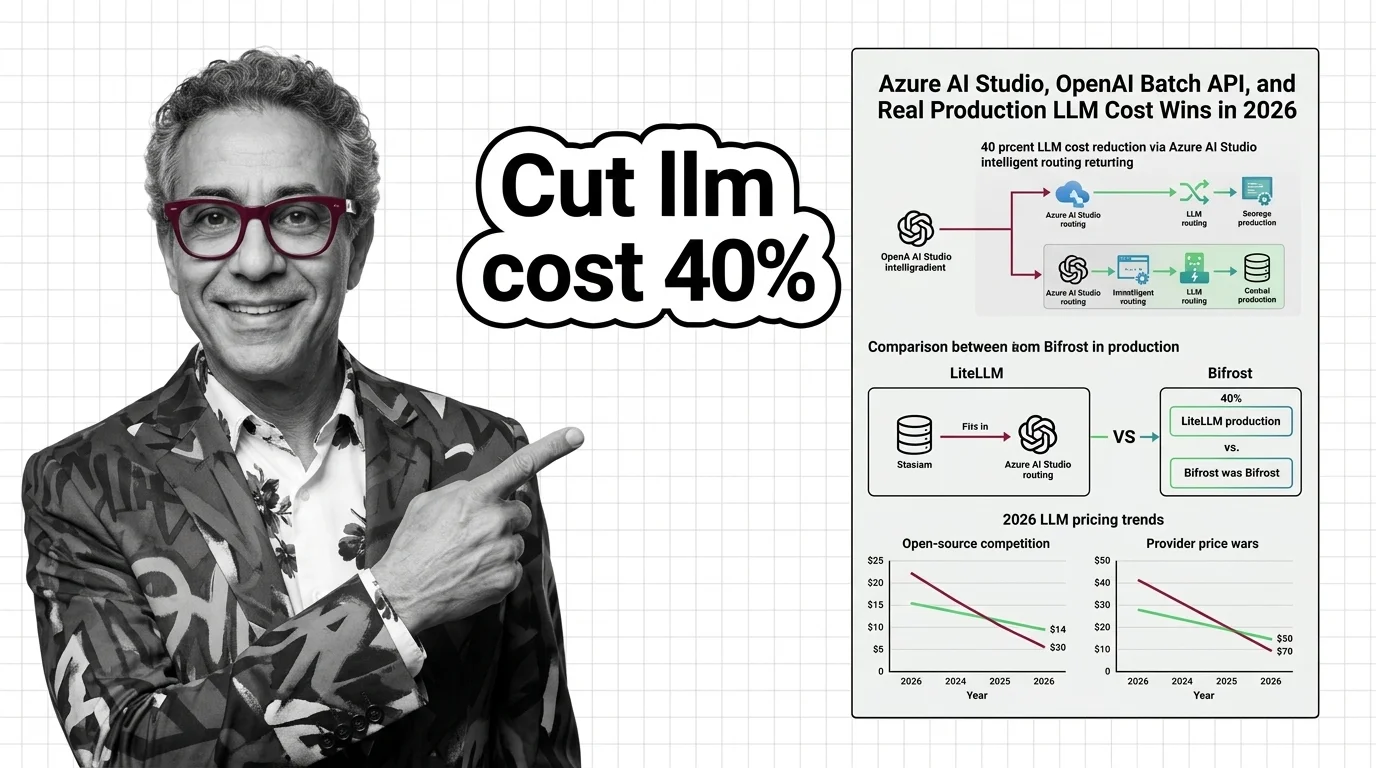
Microsoft rebranded Azure AI Studio to Azure AI Foundry, and the Model Router is the piece worth paying attention to. It routes across 28 models (as of May 2026) — GPT-5.4, DeepSeek V3.2, Llama-4-Maverick, Claude Haiku/Sonnet/Opus 4.x, and more — without changing your API contract. Three modes ship out of the box: Balanced (default, maintains quality within a 1–2% quality band), Cost (wider 5–6% band, routes aggressively to cheaper models), and Quality (best model regardless of cost), per Microsoft Foundry Docs. Automatic failover is enabled by default; it requires at least two models configured in your subset.
Community benchmarks report cost reductions in the 40–85% range on routing-optimized workloads. Microsoft’s own documentation does not publish a specific percentage — treat any number as workload-dependent, not a guaranteed outcome.
Model Routing at this fidelity — Model Tiering baked in, Prompt Caching supported via underlying models, failover automatic — is the multi-provider strategy made operational.
The second lever is batch discounting.
OpenAI’s Batch API delivers 50% off standard token prices across all supported models, with a 24-hour completion SLA (OpenAI Docs). Most batches complete in 1–6 hours in practice. Limits are generous: 50,000 requests per batch, 200 MB file size, 2,000 batches per hour. Rate limits run on a separate pool from the standard API.
Async jobs don’t need real-time pricing. Document processing, evals, data pipelines, nightly enrichment — these are batch jobs. Any workload tolerating hours of latency has no business paying synchronous API rates. Price them accordingly.
The third lever is the budget tier.
DeepSeek V3.2 prices at $0.28 input / $0.42 output per million tokens. Gemini 2.0 Flash-Lite runs at $0.075 / $0.30. GPT-5.4 sits at $2.50 / $10.00. Claude Sonnet 4.6 at $3.00 / $15.00 (model pricing data, April 2026 — verify against official provider pages before committing to budget projections).
That’s not a pricing range. That’s a market with no logical ceiling for overspending.
Token Budget management used to mean “don’t generate too many tokens.” Now it means routing the right request to the right model at the right price point.
Who’s Capturing the Savings
The teams winning on cost share a pattern: they treat model selection as a runtime decision, not a deployment decision.
They route low-stakes classification and extraction tasks to DeepSeek or Flash-Lite. They queue batch-compatible workflows through the Batch API. They reserve Sonnet and GPT-5.4 for tasks where quality degradation is unacceptable.
Semantic Caching sits on top — repeated queries never touch the provider API at all. LLM Observability tells them which requests actually need a frontier model and which ones are burning spend unnecessarily.
Systematic buyers capture systematic savings.
You’re either managing the portfolio or you’re paying frontier price for commodity tasks.
Who’s Still Overpaying
The teams losing on cost also share a pattern: one model, one API key, one bill that keeps growing.
Single-provider, flat-rate spend is now a voluntary tax. Every dollar spent on a frontier model for a task that a budget model handles at equal quality is a dollar that didn’t have to go out the door.
The gateway question is real too. LiteLLM has dominated the open-source multi-provider gateway space — but if you’re running it in production right now, you have an urgent security decision in front of you.
Security & compatibility notes:
- LiteLLM SQL Injection (CVSS 9.3): CVE-2026-42208 affects versions 1.81.16–1.83.6. Upgrade to v1.83.10-stable immediately (LiteLLM Docs).
- LiteLLM Command Injection (CISA KEV): CVE-2026-42271 is actively exploited; added to CISA Known Exploited Vulnerabilities June 8, 2026 (CISA KEV / Security Arsenal).
- LiteLLM Supply Chain: Versions 1.82.7 and 1.82.8 on PyPI were backdoored in March 2026 — stole SSH keys and cloud credentials. Audit any deployment running these versions (Trend Micro).
- Azure ML SDK v1: Reaches end of support June 30, 2026. Existing v1 workflows face breaking changes.
Bifrost — a Go-based alternative with 11µs overhead at 5,000 RPS (Bifrost GitHub) — is built for throughput in a way the Python-based proxy is not. Third-party benchmarks report over 350 requests per second on a single vCPU at roughly 10ms P99 (TrueFoundry Blog, illustrative; not independently verified).
The gateway decision matters. Pick the wrong one and you’re not just overpaying — you’re exposed.
What Happens Next
Base case (most likely): Routing becomes standard infrastructure. Most mid-sized AI teams add a gateway layer and begin separating latency-sensitive from batch-compatible workloads within two quarters. Pricing pressure from open-weight models continues — another meaningful cost drop at the budget tier before year-end is the likely outcome.
Signal to watch: Batch API usage exceeds real-time API usage by volume (not spend) at a major provider.
Timeline: Q3–Q4 2026.
Bull case: Dynamic spot-style inference pricing emerges from a major provider — lower costs for off-peak capacity, higher during demand peaks. Early signals suggest providers are exploring this model, but no major lab has announced it as a live production feature. If it ships, the cost floor drops further and routing strategies get significantly more sophisticated overnight.
Signal: A major provider announces variable-rate inference with an API contract.
Timeline: 12–18 months.
Bear case: LiteLLM’s security incidents create a gateway trust vacuum. Teams locked into vulnerable versions face remediation sprints that delay optimization work. Cost savings get deferred while engineering rebuilds the proxy layer.
Signal: More CVEs in widely-used open-source gateway tooling.
Timeline: Already in motion.
Frequently Asked Questions
Q: How did enterprise teams use Azure AI Foundry intelligent routing to cut LLM inference costs in 2026?
A: Azure AI Foundry’s Model Router (the product formerly known as Azure AI Studio’s routing feature) spans 28 models with three cost modes: Balanced, Cost, and Quality. Community benchmarks report 40–85% savings on routing-optimized workloads. The actual range is workload-dependent; Microsoft does not publish a guaranteed reduction figure.
Q: LiteLLM vs Bifrost in production — real cost savings from teams managing multi-provider LLM spend?
A: Both serve as unified gateways across providers, enabling multi-provider routing that’s the foundation of any serious cost strategy. LiteLLM covers 100+ providers but carries active critical CVEs as of June 2026. Bifrost reports higher throughput benchmarks. The cost savings from either depend on the routing configuration — the security posture of LiteLLM makes the gateway choice urgent.
Q: How is LLM pricing changing in 2026 with open-source competition and provider price wars?
A: Epoch AI documents roughly a 50-fold annual decline in median inference costs since 2022. The spread between the cheapest open-weight models and frontier proprietary options now spans more than an order of magnitude on input tokens. Spot-style dynamic pricing is under discussion but not yet live at any major provider as of mid-2026.
The Bottom Line
The cost gap between systematic buyers and passive payers is no longer theoretical — it shows up in budget lines. Intelligent routing, batch discounting, and tiered model selection are operational today. The teams that haven’t connected these levers aren’t saving money. They’re funding the teams that have.
Stay ahead, Dan.
AI-assisted content, human-reviewed. Images AI-generated. Editorial Standards · Our Editors