Automated Model Promotion and the Accountability Gap: Governance Risks in Production Model Registries
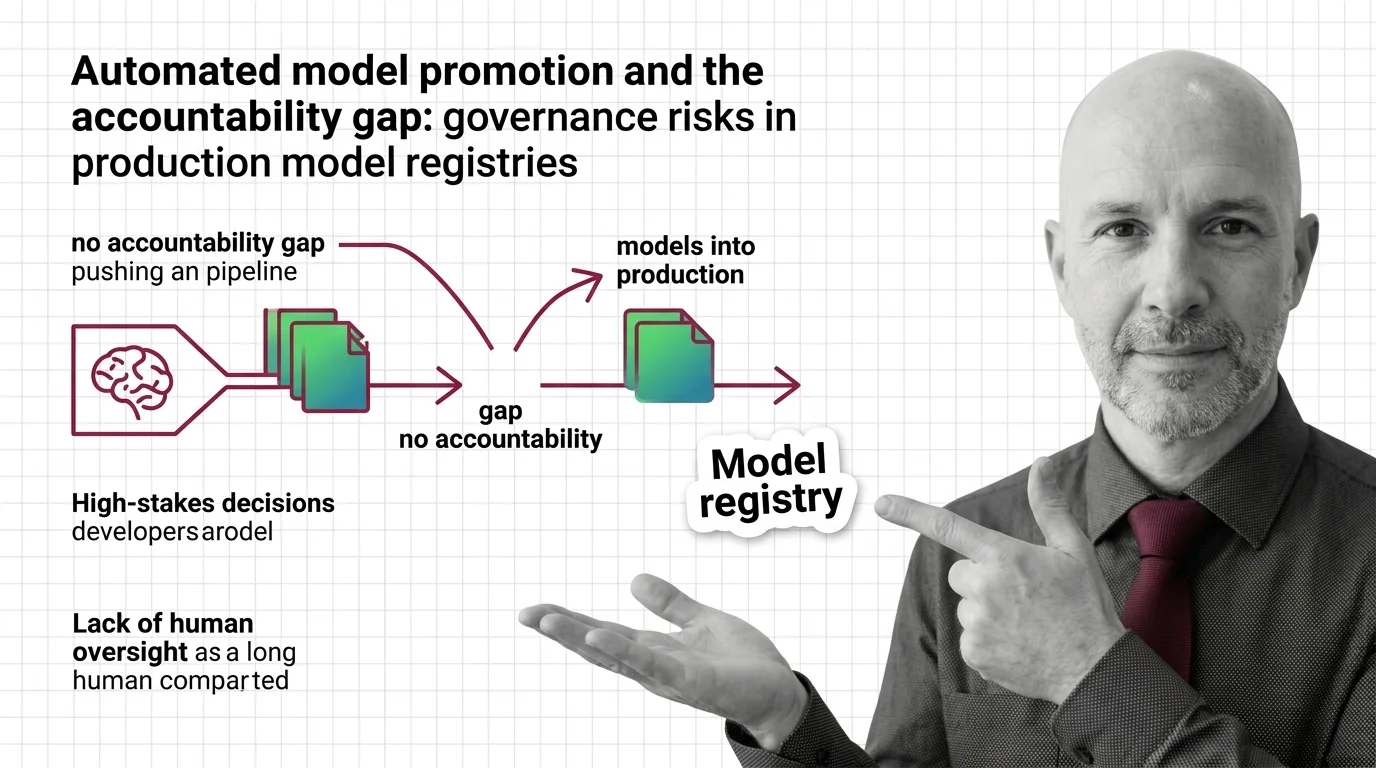
The Hard Truth
A model passes its automated evaluation suite, clears a statistical threshold, and Model Staging advances it to production — all without a named human making a decision. Somewhere downstream, a loan is denied, a patient’s risk score shifts, a hiring algorithm filters a resume. Who signed off on that? Nobody, technically. That is not a failure of the system. That is the system working exactly as designed.
There is a specific kind of institutional comfort that automation provides: the feeling that because a process is rigorous, it is also responsible. Evaluation metrics run, benchmarks clear, a Canary Deployment proceeds — and the engineers who built the pipeline reassure themselves that the guardrails held. What this reassurance obscures is the difference between a gate and a decision-maker. Gates can pass anything that meets a threshold. Decision-makers answer for what gets through.
The governance question embedded in Model Registry infrastructure is not primarily technical. It is about the structure of accountability — about whether the organizations deploying consequential AI systems have actually thought through who is responsible when automated promotion produces a bad outcome, or whether they have simply built processes sophisticated enough to make that question feel settled.
The Incident That Nobody Caused
Consider the anatomy of a typical automated promotion failure. An ML team trains a credit-scoring model, tracks it through Experiment Tracking tooling, registers the winning Model Artifact, and configures their Mlflow-based registry — or its enterprise equivalent — to promote to production when accuracy on a holdout set crosses a threshold. The model clears. The promotion fires. Six months later, a bias audit reveals that the model performs differently across demographic groups in ways the accuracy metric didn’t capture. By that point, thousands of people have received decisions shaped by it.
Who bears responsibility? The gap between who built the system and who owns its consequences is where accountability disappears. The engineers who configured the threshold didn’t make a credit decision. The risk officers who set policy didn’t write the evaluation code. The model itself, of course, decided nothing — it calculated. And the registry, that piece of infrastructure whose job is to track Model Lineage and manage the lifecycle, executed the transition faithfully according to its instructions.
This is not a description of negligence. It is a description of how consequential decisions can be distributed across a system until no single actor seems to have made them — which is, from an ethical standpoint, indistinguishable from negligence.
What the Registry Cannot Prove
The technical community has invested significant effort in making registries more capable. Modern platforms track model lineage with genuine granularity: which training data, which hyperparameters, which evaluation run produced this version. They log model artifact metadata, store promotion history, and expose APIs for querying the chain of custody.
This lineage data is valuable. It is also insufficient.
Lineage tells you what happened — which code produced which model under which conditions. It does not tell you what was decided, by whom, and whether that decision was appropriate given the downstream use case. A registry that records “model version 4.2 promoted to production at 14:32 UTC on March 3rd by automated trigger CI-EVAL-PASS” has told you the mechanism. It has said nothing about whether anyone considered that this model would be used to make credit decisions for applicants in regions with historically underrepresented training data.
Automation records the mechanism of a decision but not the judgment behind it. There is a fundamental difference between the two, and confusing them — treating a clean audit trail as evidence of accountable governance — is one of the more consequential category errors in current MLOps practice.
Tools like LLM Observability and OpenTelemetry extend this visibility into runtime behavior, capturing latency, drift, and anomalies as models operate in production. This is genuinely useful for detecting when something has gone wrong. But observation without clear ownership is a diagnostic without a doctor — information accumulating in a dashboard while the question of who acts on it remains unanswered.
Who Benefits, Who Pays
The incentives embedded in automated promotion pipelines are not neutral. Speed benefits everyone who ships models. The costs of a bad deployment are borne primarily by the people who receive decisions from it.
A financial institution that automates its Model Staging and promotion pipeline reduces operational overhead, shortens cycle times, and compresses the gap between experimentation and deployment. These are real gains. The people who benefit from those gains — the teams that can iterate faster, the executives who see reduced time-to-value — are not the same people who are denied loans, filtered from jobs, or given algorithmically-determined risk scores that follow them through institutional systems they cannot interrogate.
The LLM Cost Management framing that often accompanies MLOps discussions reinforces this asymmetry. When model deployment is discussed primarily through the lens of efficiency and cost reduction, the people who receive consequential automated decisions rarely appear in the analysis. They are not efficiency gains or cost centers. They are the people whose lives get shaped by what the pipeline promotes.
Regulators have begun to notice this asymmetry, though at different speeds and with different urgency. The Federal Reserve’s SR 26-2 guidance, which replaced SR 11-7 in April 2026, takes a principles-based approach to model risk management — requiring that high-materiality models receive rigorous independent validation (Federal Reserve). It explicitly excludes generative and agentic AI from its formal scope for now, which means the fastest-moving part of the deployment ecosystem remains the least governed. The EU AI Act’s Article 26 requires deployers of high-risk AI systems to assign oversight to named natural persons with defined competence, training, and authority — and mandates at least six months of automatic log retention (EU AI Act). That is a governance architecture, not just a compliance checklist.
What neither framework can resolve on its own is the harder problem: that organizations can satisfy the letter of these requirements while automating away the substance of the judgment they were designed to protect.
The Defense That Almost Holds
The strongest version of the opposing argument runs roughly as follows: automated promotion with human-designed thresholds is still human decision-making, just distributed across time. The engineers who set the evaluation criteria, the risk officers who approved the deployment policy, the compliance team that audited the model card — all of these represent human judgment embedded into a system that then executes consistently. The fact that no human presses a button at the moment of deployment does not mean no human made a decision. It means humans made better decisions earlier, in a more deliberate state, rather than making rushed decisions under operational pressure.
This argument has genuine force. Threshold-based governance is, in principle, more consistent and auditable than case-by-case human review, which is vulnerable to fatigue, inconsistency, and bias of its own kind. The NIST AI Risk Management Framework’s Govern, Map, Measure, Manage structure (NIST AI RMF) points in exactly this direction — building systematic risk management rather than relying on individual judgment at the point of deployment.
Where the Defense Cracks
The argument holds only under conditions that are rarely satisfied in practice.
It assumes that the humans who designed the evaluation criteria anticipated the distribution of use cases the model would encounter. In domains like lending and healthcare, deployment contexts shift — new populations, new edge cases, new forms of covariate drift. A threshold calibrated on last year’s data is not a decision made with knowledge of this year’s conditions. It is a past judgment applied to a present situation it was not designed to handle.
It assumes that organizational roles map cleanly onto accountability structures. But in practice, the engineer who configured the CI trigger, the data scientist who set the accuracy threshold, and the product manager who approved the deployment timeline each made a partial decision. None of them, individually, can be said to have decided to promote the model. And organizations structured around distributed partial decisions tend to discover, when things go wrong, that collective responsibility distributes so widely it becomes invisible.
Notably, the FDA has authorized more than 1,350 AI-enabled medical devices by early 2026 (IntuitionLabs), yet only around 8% of new AI devices included a pre-determined change control plan by 2025 — meaning the vast majority of cleared models remain “locked” after deployment, unable to adapt to clinical drift without resubmission. The automated promotion problem in healthcare is not primarily about deploying models too fast. It is about deploying models with insufficient structures for governing what happens after they arrive.
Thesis: Automated model promotion in high-stakes domains does not eliminate the need for human accountability — it disperses that accountability so widely, across so many threshold-setters and pipeline architects, that it effectively disappears, and this disappearance is a governance failure regardless of how technically rigorous the automation is.
Where This Argument Is Weakest
This position is most vulnerable to the charge that it romanticizes human judgment. The historical record of human beings making consequential decisions in lending, healthcare, and criminal justice is not a record of careful deliberation and appropriate accountability. It is, in many cases, a record of bias, inconsistency, and the exercise of unchecked discretion that automated systems were specifically developed to counter.
If the alternative to automated promotion is a named human making a credit decision who can be held accountable — but that same human’s decisions carry embedded biases that automated evaluation pipelines partially correct — then demanding human sign-off may not improve outcomes. It may simply relocate the accountability problem from the invisible structure of a threshold to the invisible structure of human judgment, while adding latency and cost.
The argument for human accountability is strongest when the accountability is real — when it comes with genuine authority, genuine competence, and genuine consequences for poor decisions. The EU AI Act’s requirement that oversight be assigned to named natural persons with defined competence and authority is trying to create exactly this structure. The question is whether organizations will build that structure in substance or satisfy it by assigning a name to a process that remains, functionally, automated.
The Question That Remains
The real test of a governance framework is not whether it assigns accountability in a document. It is whether, when a consequential model makes the wrong call, someone loses sleep over it — not because they fear audit, but because they understood they were the one who decided. What organizational change would make that true?
Ethically, Alan.
AI-assisted content, human-reviewed. Images AI-generated. Editorial Standards · Our Editors