Audio Tokens, Neural Codecs, and the Technical Limits of AI Music Generation in 2026
ELI5
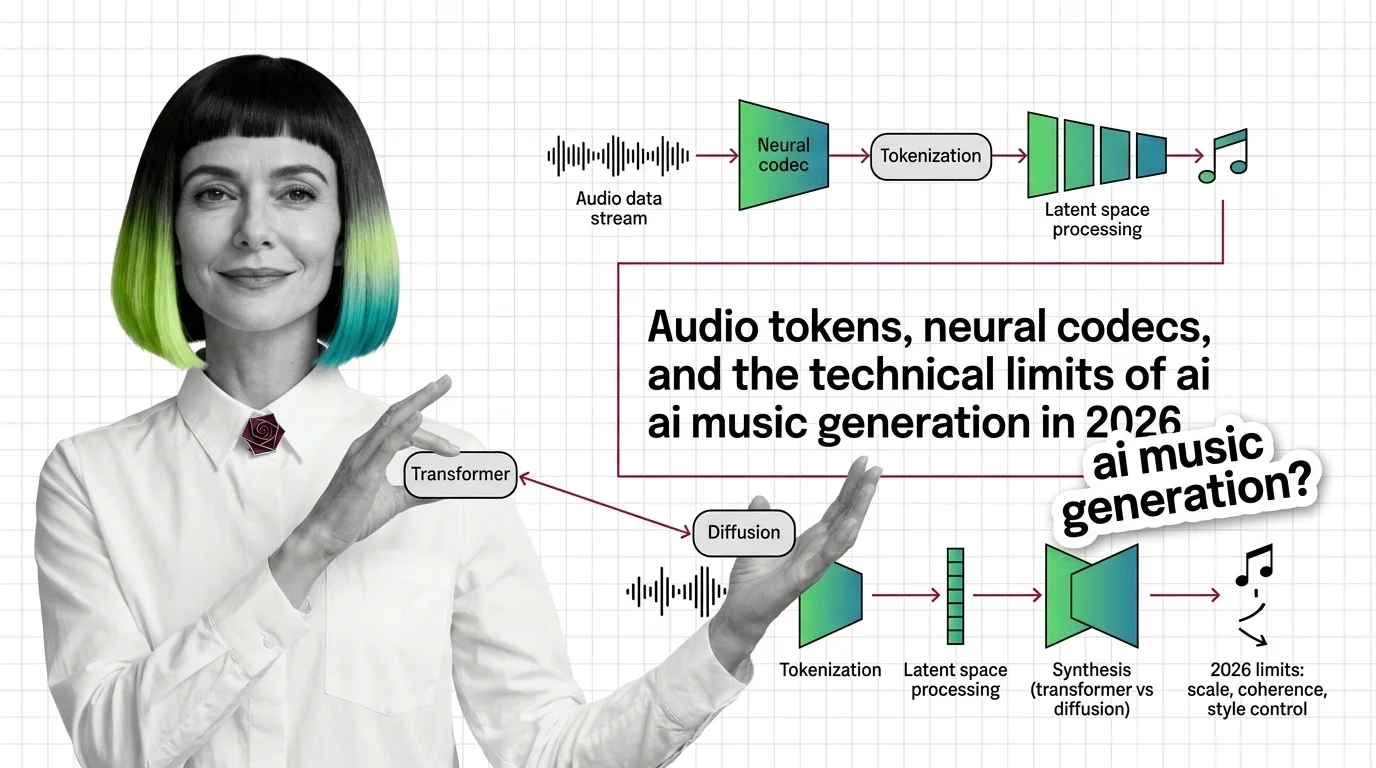
AI music generation converts audio into a sequence of discrete tokens using a neural codec, then predicts those tokens with a language model or diffusion model. The music emerges when the codec reconstructs the waveform from predicted tokens.
The generation sounds convincing. Until you press play at the two-minute mark.
Something dissolves — not in quality, but in logic. The verse structure unravels. The key center drifts. What felt like a song begins to resemble an improvisation between musicians who can no longer hear each other. This is not a bug in the interface. It is a fundamental constraint of the underlying architecture, and understanding it requires going much deeper than the text-to-music prompt box that most users interact with.
The systems behind Suno, Udio, and comparable AI Music Generation tools are not generating audio from scratch. They are predicting sequences of discrete audio tokens — and everything that limits them follows from the structure of that prediction problem.
The Codec Layer: Why Music Must Become Numbers Before Anything Else
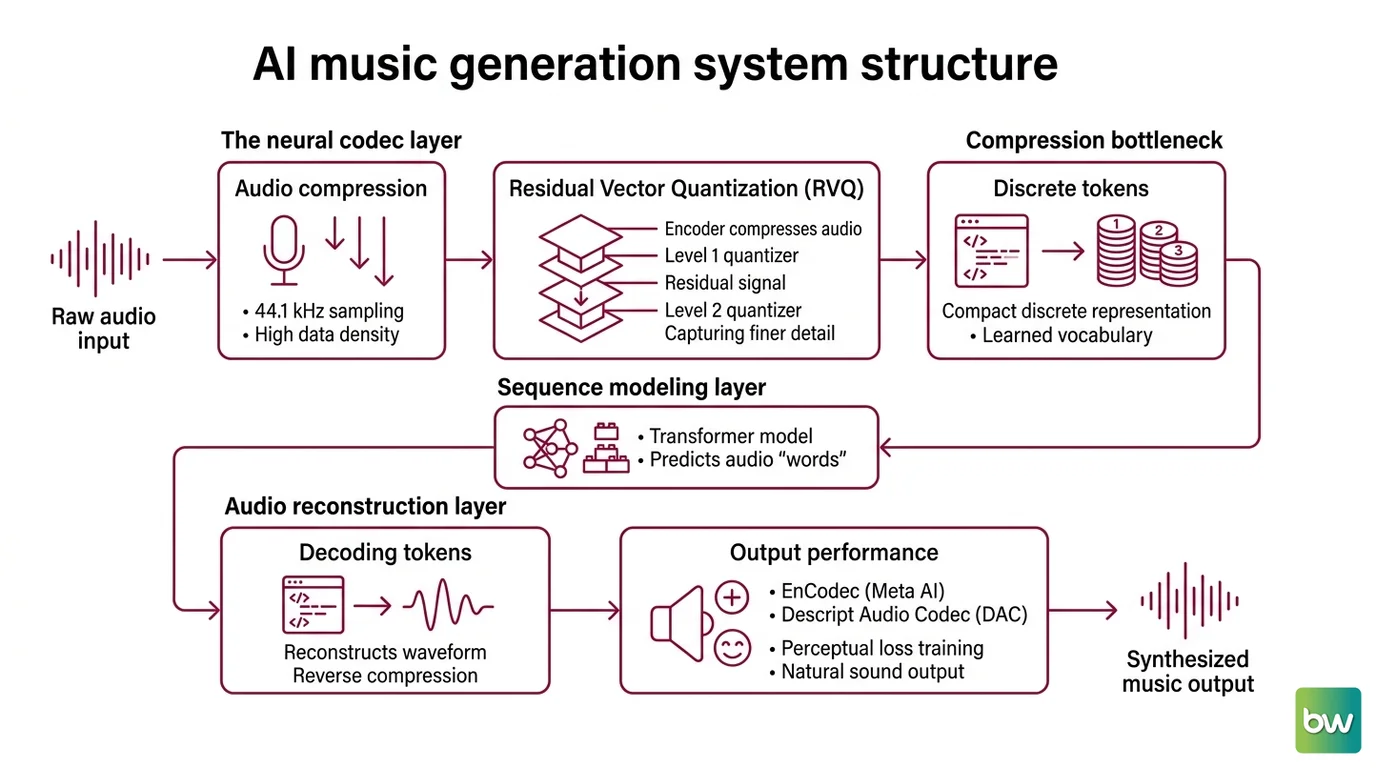
Before a transformer or a Audio Diffusion model can operate on sound, audio must be compressed into a form the model can work with. Raw waveforms are continuous signals sampled at 44,100 points per second — too dense for sequence models that choke on length. The solution is a neural audio codec that learns a compact discrete representation: a vocabulary of audio “words” that can be predicted token by token, like text.
What are the core technical components of an AI music generation system?
An AI music generation system has three separable layers that must all function correctly for the output to work.
The neural codec is the compression bottleneck. It encodes a raw waveform into a sequence of discrete tokens using Residual Vector Quantization (RVQ). In RVQ, an encoder compresses the audio, a quantizer maps the compressed representation to the nearest code in a learned codebook, and then a second quantizer handles the residual — the part of the signal the first level missed. This stacking continues for several levels, each capturing progressively finer detail. The decoder runs the process in reverse, reconstructing the waveform from token sequences (Kyutai Codec Explainer).
EnCodec, the codec developed by Meta AI and published by Défossez et al. (arXiv:2210.13438), uses a SEANet encoder-decoder architecture with an RVQ bottleneck. It operates at 24 kHz for its base causal model and at 32 kHz in the variant used by MusicGen. The architecture is trained with both objective reconstruction loss and perceptual loss via a discriminator — the perceptual loss is what makes the output sound natural rather than mathematically correct but aurally harsh. EnCodec significantly outperforms Opus at 6 kbps and performs comparably to MP3 at 64 kbps (AudioCraft Docs).
The Descript Audio Codec (DAC) extends this approach with nine RVQ layers and 10-bit codebooks in an RVQGAN architecture, achieving 8 kbps compression at 44.1 kHz with minimal perceptible artifacts — roughly 90× compression (DAC GitHub / DeepWiki). On MUSHRA listening tests, DAC outperforms EnCodec for music quality (arXiv:2509.18823).
The sequence model sits on top of the codec. Once audio is a token stream, this layer predicts what comes next — a task structurally identical to next-token prediction in a language model. MusicGen (Meta’s open-source reference system) uses a single-stage autoregressive Transformer Architecture conditioned on EnCodec’s tokenized output at 32 kHz and 4 codebooks with a 50 Hz frame rate (AudioCraft GitHub). The model family ranges from 300M to 3.3B parameters, trained on approximately 20,000 hours of licensed music.
The conditioning interface is how you get in. Text prompts, melody references, style tags — these all need to be encoded into the model’s representation space so they influence the token predictions. The quality of this conditioning layer determines how reliably a user’s description maps to the generated output.
What is the difference between transformer-based and diffusion-based AI music generation?
The distinction runs deeper than architecture choice — it determines what failure modes you inherit.
Transformer-based generation is autoregressive. The model predicts one token at a time, each conditioned on all previously predicted tokens up to the context window limit. MusicGen exemplifies this approach. The strength is local coherence: token-by-token prediction ensures smooth continuity within the window. The limitation is quadratic attention cost and finite context. As duration extends, the number of tokens grows, attention over them grows quadratically, and the context window becomes the hard ceiling on what the model can “remember” about where the song started (arXiv:2503.00084). Stable Audio 2.5 (Stability AI) migrated from a UNet-based audio diffusion architecture to a transformer-based design, which enables longer duration and better quality — but inherits the same context-window constraint (The Decoder).
Diffusion-based generation operates differently. A diffusion model learns to reverse a noise-addition process: starting from pure noise, it iteratively denoises toward a target distribution. This gives it global coherence properties that autoregressive models struggle with — the model has an implicit sense of the whole. The cost is inference speed: many iterative sampling steps make diffusion generation substantially slower than a single autoregressive forward pass. The other structural weakness is that global musical structure — verse-chorus-bridge organization, key modulation, thematic development — can still degrade without explicit structural conditioning (assemblyai.com).
A practical comparison: if a transformer-based model produces a 90-second song with a coherent vocal melody but suddenly shifts style at the 80-second mark, the mechanism is probably a context boundary. If a diffusion model produces a track where the entire emotional arc feels slightly off — technically clean but tonally purposeless — the mechanism is more likely a conditioning failure.
Neither architecture has solved the other’s problem.
Prerequisites: What You Need to Understand Before Working with These Systems
Not all prerequisites are technical. Some are structural.
What audio and machine learning concepts do I need before working with AI music generation tools?
The Mel Spectrogram is the intermediate representation that predates neural codecs and still underlies much intuition about audio models. A mel spectrogram converts a waveform into a 2D image of frequency-vs-time using the mel scale, which approximates human auditory perception by compressing high frequencies. Earlier generative audio systems — including WaveNet and Tacotron — operated on mel spectrograms and used a separate Vocoder to convert spectrograms back to audio. Neural codecs largely replace this two-step process with a learned end-to-end compression, but the mel spectrogram remains important for understanding what codec quality metrics are measuring.
Prosody — the rhythmic and melodic contour of speech and sung vocals — is one of the hardest features to model. A system that generates convincing harmonic content but incorrect prosody produces singing that sounds tonally right but rhythmically wrong, or lyrics with misplaced stress patterns. Suno’s v5.5 failure modes include pronunciation issues with technical vocabulary and unusual scansion in dense lyrics (eesel.ai review) — both prosody failures, not pitch failures.
Voice Cloning and Text-to-Speech share codec infrastructure with music generation. The same RVQ-based architectures that encode music also underpin systems like vocoder-free TTS. Understanding the codec is therefore foundational across the audio AI space, not just for music.
On the machine learning side, the minimum conceptual prerequisites are: autoregressive sequence modeling and how context windows constrain it; the basic mechanics of audio diffusion; quantization as a compression technique (RVQ specifically); and conditioning — how text or style inputs get projected into the model’s representation space.
The Music Copyright And AI dimension is a prerequisite that is often deferred until it becomes a legal problem. RIAA sued both Suno and Udio in June 2024 for training on copyrighted material without licenses. Warner Music settled with Suno in November 2025; Sony Music v. Suno has a fair use hearing scheduled for July 2026 (RIAA official). The outcome could reshape training-data legality for all AI music tools — and directly affects which model versions remain commercially viable.
Security & compatibility notes:
- Suno model deprecation (BREAKING): All Suno v5.x and prior models trained on unlicensed music are scheduled for deprecation when licensed replacement models launch, per the Warner Music settlement. Suno has not published an official cutoff date. Free-tier users lose download capability entirely in the transition. If your workflow depends on current Suno output characteristics, treat the model as time-limited (VoteMyAI).
- Udio walled garden (BREAKING): No DAW export or download is currently available from Udio. Any integration treating Udio as a DAW-adjacent tool is based on outdated information (VoteMyAI).
Where the Architecture Fails: Structural Limits in 2026
The pleasant fiction of AI music generation is that it produces music. The technical reality is that it produces token sequences whose statistical properties resemble music — a distinction that matters more as duration extends.
What are the technical limitations of AI music generation models in 2026?
Long-form coherence is the unsolved problem. Generating structurally coherent compositions beyond approximately two minutes remains an active research area in 2026 (MDPI Electronics). The core mechanism: transformer-based models face a growing token budget as duration increases, attention cost scales quadratically with sequence length, and the model’s effective “awareness” of early musical material degrades as it falls toward the edge or beyond the context window. Diffusion models avoid the sequential problem but introduce their own structural weaknesses — without explicit conditioning on verse-chorus form or thematic development, generated structure is statistically likely but not intentional.
Resolution and fidelity are real but secondary concerns. Suno v5.5 outputs at 44.1 kHz or 48 kHz, 16-bit or 24-bit WAV (musicmake.ai). DAC operates at 44.1 kHz with minimal artifacts at 8 kbps. These specifications are competitive with professional audio workflows. The bottleneck is not sample rate — it is structural logic above the phrase level.
The notation gap has no current solution. Suno v5.5 outputs waveforms only — there is no MIDI or score output, and no pathway back to editable notation (Suno Hub). Udio currently has no DAW export at all. Mureka supports tracks up to 5 minutes with personal model training (smartificial.info), but the same notation constraint applies. When a producer needs to edit a generated melody, alter a chord voicing, or pass the result to a human arranger, the audio-only output format is a hard ceiling. The music exists as a frozen waveform, not as compositional data.
Commercial viability depends on legal status that is currently unsettled. The fair use hearing in the Sony Music v. Suno case (July 2026) will determine whether models trained on copyrighted data can be commercialized — a ruling that affects the entire sector’s training-data practices, not just Suno. Until that question is resolved, the commercial lifecycle of current model versions carries a legal qualifier that no technical specification can remove.
When it breaks: The most consistent failure mode across both transformer-based and diffusion-based systems is structural collapse in the second half of any generated track — the point where local coherence can no longer substitute for intentional musical architecture.
The Constraint Is Temporal, Not Spectral
The precise claim that most discussions miss: the quality problem in AI music is not about frequency resolution or codec fidelity. Those problems are largely solved; EnCodec outperforms Opus at comparable bitrates, and DAC achieves near-transparent quality at 44.1 kHz.
The unsolved problem is temporal reasoning over music’s structure. A song is not a 3-minute spectrogram — it is a set of choices, callbacks, and structural commitments that span time in ways that require the model to maintain coherent intent across hundreds of seconds of audio. The transformer context window, measured in tokens, corresponds to a limited number of seconds of audio. The model cannot “know” where the intro ended if that information is no longer in the context.
This is the geometry of the problem. Not that the model lacks musical taste, but that it lacks the architecture to act on taste beyond a certain temporal radius. The solutions being explored — hierarchical models that operate on multiple timescales, retrieval-augmented conditioning, learned structural templates — are all attempts to give the model a longer effective reach into its own past. Whether any of them resolve the problem, or merely expand the radius before the same collapse recurs, remains open.
The Data Says
The codec layer — RVQ-based neural compression at 24-44.1 kHz — has largely solved audio fidelity for AI music generation; DAC and EnCodec both approach professional quality at practical bitrates. What remains unsolved is structural coherence beyond roughly two minutes, a limitation rooted in the finite context of sequence models, not in audio quality. The legal status of training data, with a Sony Music fair use hearing pending in July 2026, adds a non-technical variable that could change which model versions remain commercially viable regardless of their technical performance.
AI-assisted content, human-reviewed. Images AI-generated. Editorial Standards · Our Editors