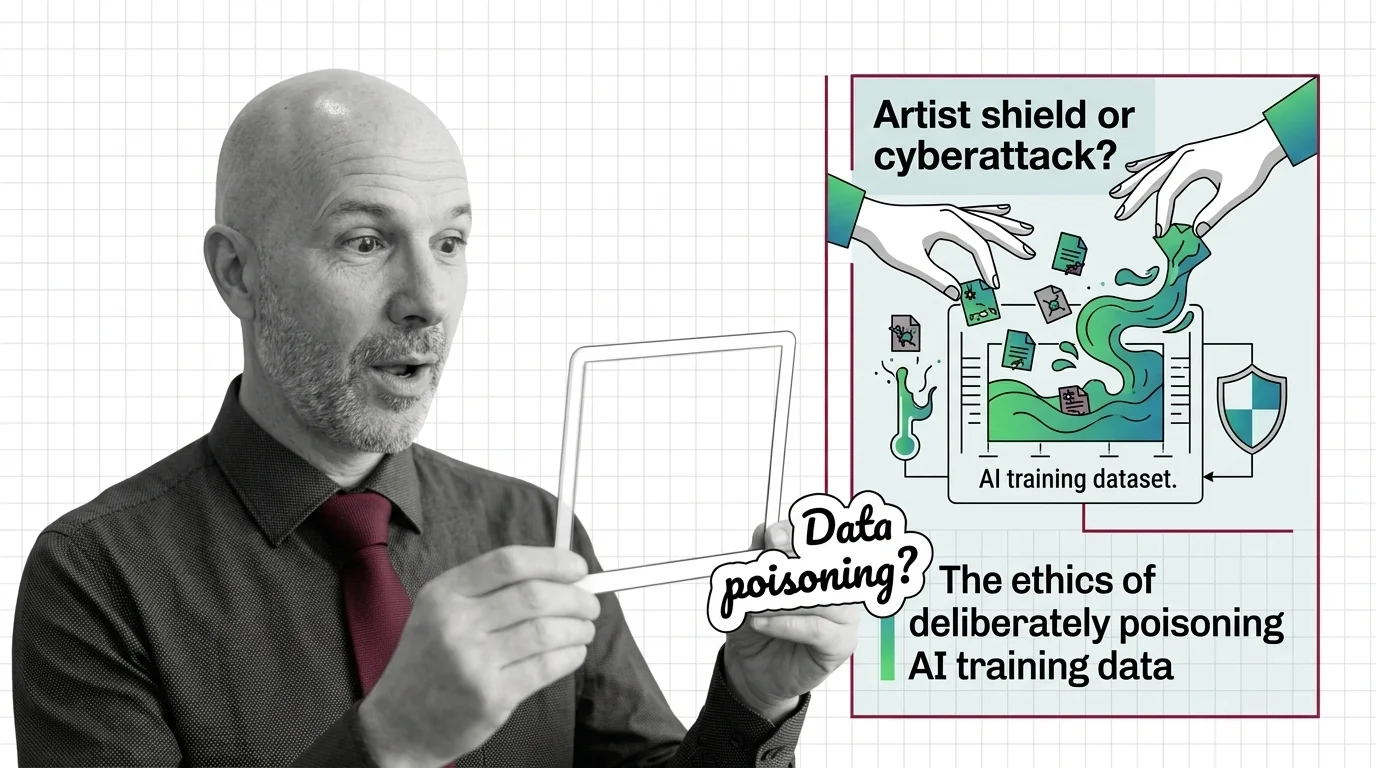
Artist Shield or Cyberattack? The Ethics of Deliberately Poisoning AI Training Data
The Hard Truth
Fewer than one hundred. That is the threshold established by researchers at the University of Chicago when building Nightshade: fewer than one hundred corrupted image files, introduced into a training dataset, can compromise how an entire conceptual category behaves inside a diffusion model (Nightshade Paper). The number appears to settle the question of whether artists have meaningful leverage against AI companies that scrape their work without consent. It settles something quite different from what either side of that argument wants it to settle.
The debate about deliberate Data Poisoning as an act of artistic resistance has been framed, from the beginning, as a story about power asymmetry. Billion-dollar AI companies consume creative work as raw material; artists, outgunned in courts and largely ignored in licensing negotiations, strike back with the only lever available — corrupting the data those companies ingest. That framing is emotionally coherent and politically satisfying. It is also incomplete in ways that matter, and the number at the center of the argument is where the incompleteness lives.
The Number and Its Weight
The research underpinning Nightshade, published at IEEE S&P 2024 (Nightshade Paper), establishes that fewer than one hundred strategically crafted images, embedded into a training corpus, can degrade how Stable Diffusion SDXL renders an entire conceptual category — not a single output, but a class of responses from the model. The tool has been downloaded over two and a half million times since its January 2024 release (TechCrunch). These are not the adoption numbers of a niche protest. They suggest a quietly distributed campaign running beneath the surface of the creative internet, invisible to the AI companies absorbing its effects.
The number circulates precisely because it compresses the argument. Artists, who cannot afford the legal battles the largest platforms can, now have leverage that scales without resources: a handful of deliberately crafted files can move a model. That compression is what makes the figure satisfying as a rhetorical object. It is also what makes it dangerous as an ethical one.
Two Arguments That Share a Number
The optimistic reading of that threshold is coherent. If a company ingests creative work without consent and builds commercial products from it, the artist who corrupts that data is not introducing a flaw — she is asserting a boundary through the only available technical channel. The Clean Label Attack mechanism Nightshade employs works by perturbing image pixel values in ways invisible to human reviewers but deeply legible to a training gradient: the data appears legitimate, passes visual inspection, and then teaches the model associations that undermine the category the attacker targeted. In the optimistic framing, this is the exact structural inverse of what the scraping company did — unauthorized use of material, manipulation without disclosure.
The critical reading is equally coherent. A mechanism that corrupts AI training data in under one hundred samples is not inherently bounded by the good intentions of the person who applies it. Label Flipping — the broader family of training-time attacks that Nightshade’s approach resembles — has been formally classified by OWASP as LLM04:2025, Data and Model Poisoning, a critical-severity integrity attack category (OWASP). That classification does not distinguish between the grievances of the actor. It describes the attack surface. And an attack surface accessible to a digital illustrator is equally accessible to anyone else with access to a training pipeline.
Both readings are reasonable. Both use the same threshold. That is the problem.
The Assumption That Neither Side Examines
The optimistic reading assumes that intent creates a meaningful ethical distinction — that an artist’s motivation transforms the same technical act into something categorically different from what a malicious actor would do. The critical reading, often without stating it, assumes that technical parity implies ethical equivalence. What neither reading examines is the condition that would make either conclusion actionable: the ability to determine, after the fact, who the actor was, what they intended, and which training run was affected.
Training datasets are large, opaque, and rarely audited in ways that would surface one hundred corrupted images among tens of millions. The Dataset Bias that results from a poisoning campaign may not surface for months or years — long after the original files are untraceable. Data Leakage from training pipelines is already a persistent, poorly-understood problem even without adversarial contribution; adding deliberate corruption makes attribution harder still, not easier. The shared and unexamined premise of both readings is that intent travels with the tool. It does not. The data arrives as data.
Why the Mechanism Cannot Know Its Purpose
Consider what happens when a Backdoor Attack is embedded into a training corpus. The corruption does not announce its origin, its author, or the grievance that motivated it. It behaves as training data. The model treats it as training data. Any harm that follows propagates through the trained system without the actor’s continued presence or involvement. Nightshade operates on the same principle — the corruption is incorporated at training time and becomes part of the model’s learned behavior, not a traceable signature of its creator.
The Adversarial Robustness Toolbox — the toolkit developed at IBM Research, now under Linux Foundation AI governance — makes this structural point precisely by cataloguing it. It includes backdoor attacks, Class Imbalance exploits, feature collision methods, and more than fifty attack implementations in total, because understanding the attack surface requires understanding the full range of methods, without regard for who might apply them. The tool is neutral. The mechanism is neutral. Intent is not a property that adheres to a binary artifact.
This matters for the legal question as much as the ethical one. 18 U.S.C. § 1030(a)(5) — the Computer Fraud and Abuse Act provision covering damage to protected computer systems — defines harm as any impairment to data integrity, without carving out exceptions based on the actor’s motivation (arxiv, AML Legal). No current statute creates a self-defense exception for intentional training data corruption. That legal ambiguity is genuine and unresolved as of mid-2026, not a gap that advocates can paper over by pointing to the sympathetic origin of the act.
The reach of these questions extends beyond image models. RAG Poisoning — the corruption of documents loaded into retrieval-augmented AI systems at inference time — is vulnerable to similar manipulations, and the harm from inference-time corruptions can, in principle, be reversed. Training-time corruption, once incorporated into model weights, cannot be excised without retraining the model from scratch. The permanence is not incidental. It is what makes the tactic effective, and what makes its ethical status so difficult to contain.
What This Actually Proves
The ethics of deliberately poisoning AI training data cannot be settled by asking who initiated the corruption, because the mechanism creates structural vulnerabilities that persist regardless of the actor’s justification, and no governance framework built on intent alone will hold at the technical level where it needs to function.
What the Nightshade debate has surfaced, beneath the legitimate grievances of artists and the genuine risks to AI systems, is a governance gap that neither side has an interest in naming clearly. The question of whether deliberate training data corruption is self-defense or sabotage is not merely a legal question — it is a question about whether the institutions that govern harm can distinguish between them at the technical level required to act on that distinction. The EU AI Act, under Articles 10 and 15, requires that high-risk AI systems maintain auditable data provenance and guard against adversarial training-time attacks, with enforcement beginning for high-risk systems from August 2026 (EU AI Act, BlackFog). What the regulation does not address is what happens when the actor corrupting training data is a freelance illustrator asserting her right over her own creative work. The law describes the vulnerability. It has not described the actor.
What the Download Count Cannot See
Two and a half million downloads measures adoption, not effect. It tells us that artists reached for a tool. It does not tell us whether that tool changed anything about how AI companies structure data acquisition, whether models trained on poisoned data degraded in ways anyone detected, or whether the campaign will sustain long enough to constitute genuine pressure.
There is a more uncomfortable dimension the number cannot reach at all: the precedent it establishes. Once a community normalizes deliberate training data corruption as a legitimate response to non-consensual scraping, the category of actors who can claim that legitimacy expands — not by the logic of law or ethics, but by the logic of available framing. An actor who corrupts medical imaging training data and claims a grievance about proprietary data use has access to the same argument. The mechanism cannot police the claim.
A factual caveat belongs here. LightShed, a bypass tool developed by researchers at the University of Cambridge, TU Darmstadt, and UT San Antonio, demonstrated the ability to strip Nightshade and Glaze protections with close to complete accuracy, in a paper accepted at USENIX Security 2025 (MIT Technology Review). As of mid-2025, Nightshade’s effectiveness as a practical defense has been materially undermined. The arms race is already underway, and the artists are not currently winning it. The download count captures a mobilization. It does not capture the response.
Where This Argument Is Weakest
This analysis assumes that the harm from normalized training-data poisoning will eventually exceed the harm from unconstrained non-consensual scraping. That assumption is contestable. If the art community’s campaign creates economic pressure sufficient to accelerate genuine consent infrastructure across the AI industry — an outcome not yet established, but not structurally impossible — the calculus looks different. A tactic that introduces short-term risk while establishing a long-term right is not automatically indefensible. Rights are often established through acts that exceed what the law currently sanctions.
The argument is also weakest when confronted with the scale of existing, unintentional harm in AI training data: the accumulated dataset bias from years of unmoderated collection, the systematic class imbalance in training corpora, the absence of consent mechanisms across the internet’s creative infrastructure. Against that baseline, Nightshade’s downloads may be a political signal more than a material risk — a way of making visible a grievance that the industry had decided to treat as invisible.
What would make this position wrong: evidence that normalized artist campaigns have directly enabled adversarial actors to corrupt critical systems with documented and traceable harm. That evidence does not currently exist. What exists instead is a structural argument about what becomes possible once the norm is established — which is a different kind of claim, one that requires holding the argument over time rather than resolving it with the current facts.
The Question That Remains
The fewer-than-one-hundred threshold has told us something important: that training data corruption is technically accessible in ways that place it within reach of individual actors with ordinary hardware and genuine grievances. What it has not told us is who should draw the line between legitimate self-assertion and harm-causing sabotage, by what authority, using what technical capacity to verify intent after the fact, and with what accountability when that determination is wrong. That question has no current institutional address. And until it does, we are establishing norms without knowing what behavior those norms will eventually authorize — or who will bear the cost when the authorization arrives in a form nobody anticipated.
Ethically, Alan.
AI-assisted content, human-reviewed. Images AI-generated. Editorial Standards · Our Editors