Amplified Bias and Opaque Connections: The Ethical Risks of Graph Neural Networks in High-Stakes Decisions
The Hard Truth
What if the most dangerous form of discrimination in modern AI does not emerge from what a system learns about you — but from what it inherits about the people connected to you? Graph neural networks read relationships as evidence. The uncomfortable question is whether those relationships carry signal — or prejudice.
Consider a credit scoring model that downgrades your application not because of your financial history, but because three of your phone contacts defaulted last year. This is not speculative fiction. It is the operational logic of graph-based machine learning, and it is already shaping decisions in finance, law enforcement, and content recommendation at a scale no human review board could match.
The Accusation Encoded in Your Connections
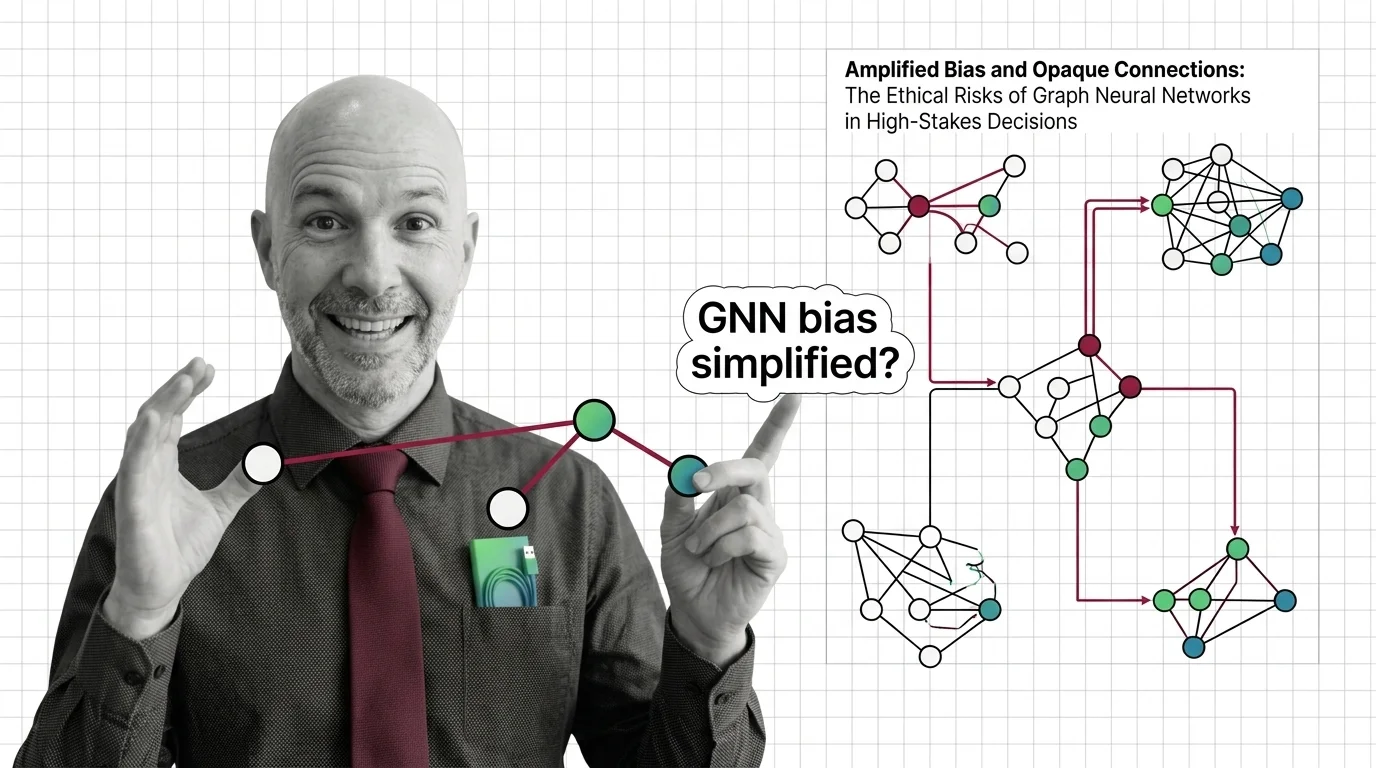
Every Graph Neural Network starts with a premise that sounds reasonable: entities are best understood through their relationships. A borrower is not just a credit score — she is also her employer, her neighborhood, her transaction partners, her social circle. The model reads these connections through Message Passing, a mechanism in which each node aggregates information from its neighbors and updates its own representation accordingly. In theory, this is relational intelligence. In practice, it formalizes guilt by association as linear algebra.
The architecture does find genuine structure. Fraud rings cluster. Criminal networks share topological signatures that isolated node feature vectors miss. But the same sensitivity that detects legitimate patterns also amplifies illegitimate ones — demographic clustering, residential segregation, socioeconomic stratification encoded in who connects to whom. Both node attribute bias and topology bias propagate and amplify through Graph Convolution (Nature Scientific Reports). Bias does not enter the graph as a flaw. It enters as data. And the Adjacency Matrix carries the instruction before the model learns a single weight.
Why Relational Reasoning Feels Like Progress
The strongest argument for GNNs in high-stakes domains is that relational structure genuinely contains signal. Fraudsters build networks of shell accounts and coordinate transactions across entities that only a graph-aware model can trace. Anti-money laundering investigators have always followed connections — GNNs automate what humans did manually, at far greater scale.
In Knowledge Graph completion, GNNs infer missing relationships from partial data, enabling applications in drug discovery and scientific literature mapping. Graph Attention Network architectures add selective weighting, learning which edges carry information and which should be discounted. Fairness-aware frameworks like GraphGini have demonstrated meaningful individual fairness improvements across credit and social network benchmarks. The case is not trivial. Thoughtful researchers argue that ignoring relational structure is itself a form of analytical blindness — a refusal to use available context.
But can selectivity applied after the fact undo what the graph already encodes?
The Fault in the Foundation
The hidden assumption inside every GNN applied to credit scoring or surveillance is that network proximity reliably signals behavioral similarity. If your neighbor defaulted, that becomes information about you. If your transaction partner was flagged, your Node Embedding shifts — imperceptibly, perhaps, but irreversibly. The model does not distinguish between “connected to a risky individual” and “connected to someone who shares your socioeconomic conditions — conditions rooted in historical injustice.”
This is where the mechanism becomes morally significant. Nodes with similar sensitive attributes cluster in real-world graphs because society clusters. The model concentrates a pattern that history created, amplifying bias beyond what feature-only approaches would produce (Springer AI and Ethics). The GNN does not invent prejudice. It inherits and accelerates it.
When Oversmoothing occurs in deeper architectures — when excessive message-passing causes node representations to converge — the model erases individual distinctiveness, collapsing unique people into neighborhood averages. The technical failure mode that engineers work to prevent is simultaneously a fairness catastrophe: the person disappears into the group. And if the model that was supposed to understand you better than a flat spreadsheet ends up knowing you less — what exactly have we gained?
From Redlining Maps to Relational Graphs
There is an uncomfortable historical parallel. In mid-twentieth-century America, banks drew red lines around neighborhoods deemed too risky for mortgage lending. The criteria were not openly racial — they referenced property conditions and “environmental hazards.” The effect was racial exclusion dressed as actuarial science, shaping American wealth inequality for generations.
GNNs do not draw lines on maps. They draw lines in relational space. The medium differs; the structural logic does not. Your position in a network — social, financial, geographic — determines your risk score before you have done anything individually to warrant it. The difference is that redlining maps were eventually made visible, challenged, and outlawed. A GNN’s learned edge weights are none of those things.
GNNs applied to fraud detection improve accuracy but create accountability and explainability gaps under existing AML and KYC regulations (Vallarino, SSRN). When a system flags an individual based on relational patterns no human examiner can reconstruct, the burden of proof does not shift to the accuser — it dissolves. And the regulatory architecture is not prepared. The EU AI Act classifies credit scoring and law enforcement as high-risk applications, with compliance obligations effective August 2, 2026 (EU AI Act Summary). But the Act addresses AI systems generically. No GNN-specific accountability framework exists in current regulation.
The Infrastructure of Inherited Guilt
Thesis: When graph neural networks treat relational proximity as evidence of individual risk, they institutionalize guilt by association — and no fairness constraint optimized after the fact can fully undo what the architecture was designed to propagate.
Fairness-aware GNN research is real and growing. Causal frameworks attempt to disentangle legitimate relational signal from spurious demographic correlation. Counterfactual approaches ask whether a decision would change if the individual’s sensitive attributes were different. These are serious contributions. But they operate within a paradigm that has already accepted relational inference about individuals as legitimate by default, treating fairness as a constraint to balance against accuracy rather than a precondition that shapes the architecture from the beginning.
The distinction carries moral weight. Optimizing for equity after the graph has encoded historical inequality is different from asking whether relational inference belongs in that domain at all. The first treats bias as a technical debt to be managed. The second treats it as a design choice — and design choices carry responsibility.
The Questions That Belong to All of Us
Who bears accountability when a GNN-based surveillance system flags an innocent person because their social graph overlaps with a criminal network? The engineer who selected the architecture? The institution that purchased it? The regulator who approved a framework too generic to catch the failure mode? Or the society that produced the segregated graph the model was trained on?
These are not engineering problems awaiting technical patches. They are governance questions that demand institutional responses — mandatory explainability requirements for relational inference in protected domains, audit protocols for graph-specific bias, and the political courage to declare certain applications off-limits until the science matures. Research infrastructure exists — the NIFTY framework provides fairness benchmarks spanning credit, recidivism, and demographic attributes (Zitnik Lab). Tooling environments like Pytorch Geometric and Deep Graph Library give researchers the means to build fairer models. The gap is not in capability. It is in institutional will.
Where This Argument Is Weakest
If fairness-constrained GNNs demonstrate consistently — across domains, populations, and real-world conditions — that they outperform non-relational models on both accuracy and equity, this argument loses significant force. If causal disentanglement methods mature to the point where relational signal and demographic correlation become reliably separable, the case for restricting relational inference in protected domains becomes harder to sustain. The architecture is not inherently unjust. What remains uncertain is whether current implementations can bear the moral weight we are placing on them — and whether the institutions overseeing them are honest enough to say when they cannot.
The Question That Remains
We trained machines to read relationships on graphs shaped by centuries of inequality, and then we asked them to be fair. The technology is not the failure. The failure is treating fairness as something to optimize — a variable to balance against accuracy — instead of the non-negotiable condition under which relational inference earns the right to touch a human life at all.
Ethically, Alan.
AI-assisted content, human-reviewed. Images AI-generated. Editorial Standards · Our Editors