AI Technical Debt Tools in Action: CodeScene, CodeAnt, and Real Refactoring Wins
TL;DR
- The shift: Technical debt tooling moved from flagging every code smell equally to ranking which debt actually costs you money.
- Why it matters: AI assistants write more code faster — and editing unhealthy code with them carries an outsized defect risk.
- What’s next: Code-health measurement becomes a control layer that sits in front of AI coding, not a quarterly cleanup report.
For a decade, static analyzers handed teams a wall of warnings and called it a day. Every smell looked equally urgent. Nothing got prioritized. Now a new class of tools is doing the one thing that backlog never did — telling you which debt to pay down first. And the timing is not an accident.
The Debt Problem Just Inverted
Thesis: AI coding assistants did not shrink technical debt — they industrialized the speed at which teams create it, and that hands the advantage to tools that measure code health before the AI ever touches a file.
AI For Technical Debt tooling is no longer about counting Code Smell instances or Cyclomatic Complexity scores in isolation. It is about risk, weighted by reality.
Here is the inversion. Code LLMs let developers ship changes faster than ever. But speed on a shaky foundation is not progress — it is leverage on a liability.
That changes who wins.
What the New Tools Actually Measure
The signal that matters is not how ugly a file looks. It is how often that file changes and how unhealthy it already is.
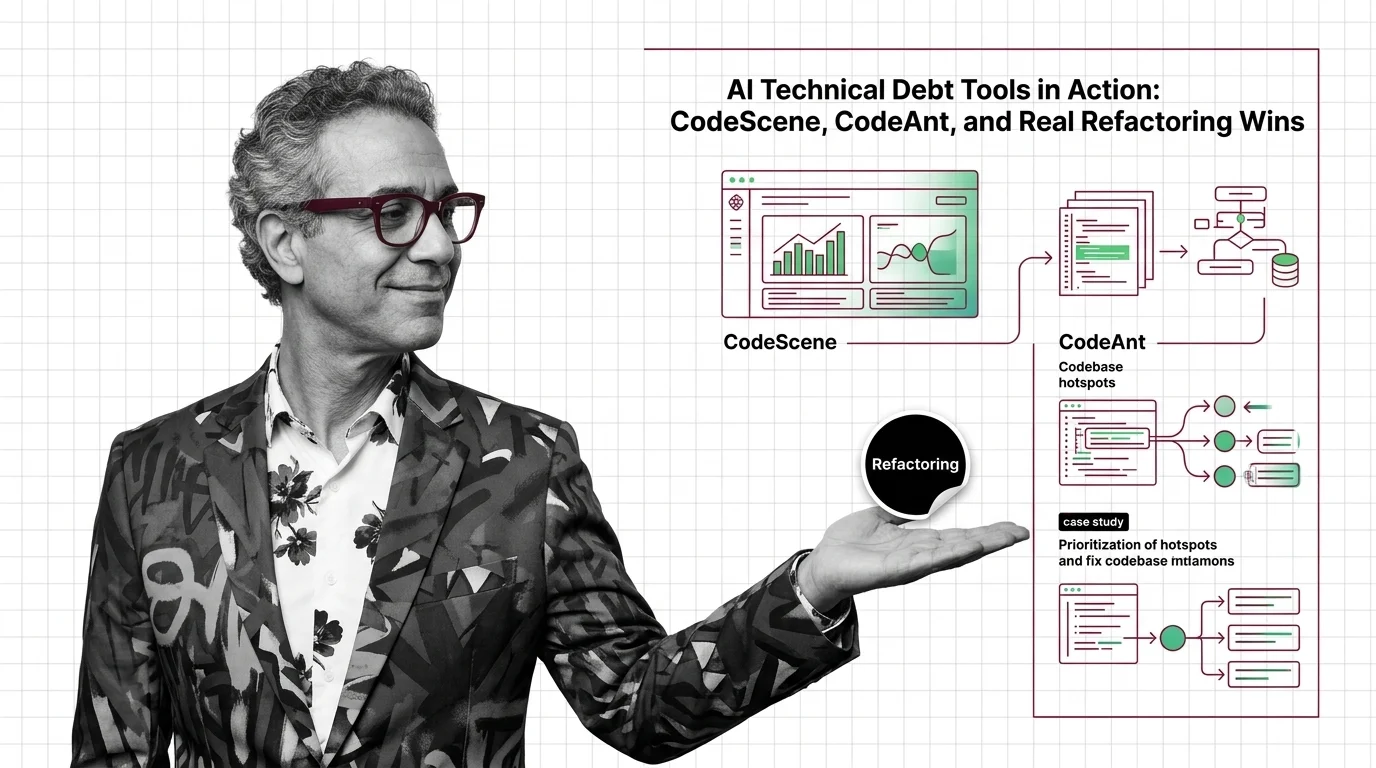
CodeScene built its method around that pairing. It combines a Code Health score with change frequency to rank high-risk hotspots as refactoring targets, according to CodeScene Docs. Red targets are code that changes often and scores low on health. Fix those first for the fastest ROI.
This is Hotspot Analysis, a different question than traditional Static Code Analysis asks. Old tools asked “what is wrong?” This asks “what is wrong in the code you keep touching?”
CodeScene claims its CodeHealth metric is 6x more accurate than SonarQube at predicting defect risk (CodeScene). Treat that as a vendor benchmark, not an independent one — but the direction is the point. Behavioral context beats raw rule-counting.
Then comes the number that reframes the category. CodeScene research puts the defect risk at 60% or higher when AI edits low-health code. Unhealthy code is where AI assistance turns from accelerant to hazard.
The other end of the market is moving too. CodeAnt AI runs line-by-line AI review across pull requests — quality issues, security vulnerabilities, dead code, and secret detection in one pass, SOC 2 and HIPAA compliant, per CodeAnt Blog. Pricing lands at $24 per user per month across all git platforms, roughly $480 a month for a 20-engineer team (CodeAnt’s pricing page).
Two tools, one direction: stop treating every line as equally worth your attention.
Who Moves Up
The winners are teams that measure before they automate.
CodeScene’s bet — that Refactoring priority should follow change frequency, not gut feel — pays when AI is generating volume. The systemverification.com case study describes a team using hotspot prioritization to align technical risk with functional test analysis, giving developers and testers a shared language for what to fix first. No magic percentages. Just a better target list.
CodeAnt wins the volume game. At review scale, a tool that catches security and quality regressions inline — before a human reviewer burns an hour — is infrastructure, not a nice-to-have. The vendor cites a Tata 1mg case study claiming review time cut roughly in half (CodeAnt Blog); read it as a customer result, not a law.
The deeper winner is a discipline: code-health gating as the layer in front of AI coding.
You are either measuring code health before you point an assistant at a module, or you are gambling on a 60%-plus defect rate.
Who Gets Left Behind
The losers are the flag-everything tools and the teams that trust them.
A scanner that ranks a cosmetic naming issue next to a defect-prone hotspot is noise. It trained a generation of developers to ignore the dashboard, and that posture does not survive AI-scale change.
The bigger casualty is the “let the AI clean it up” strategy. Pointing an assistant at your worst module without a health signal is not modernization — it is compounding the debt at machine speed.
CodeScene projects that 75% of technology leaders will face critical technical debt by 2026 (CodeScene). Teams treating that as a someday-problem are optimizing for a game that already moved on.
Version note: CodeScene’s current release is v7.3.5 (January 2026), which removed deprecated custom reports and legacy plugin support (CodeScene changelog). Check plugin compatibility before upgrading.
What Happens Next
Base case (most likely): Code-health prioritization becomes standard practice in teams adopting AI assistants seriously. Hotspot-driven refactoring moves from specialist tool to default workflow. Signal to watch: AI coding platforms integrating health scores into the edit loop, not a separate report. Timeline: Through 2026, accelerating as AI-generated code volume climbs.
Bull case: Health-gating becomes a release gate — low-health hotspots get flagged before merge, and defect rates on AI-assisted changes drop measurably. Signal: CI pipelines wiring code-health thresholds into pass/fail checks. Timeline: Within 12 to 18 months for early adopters.
Bear case: Teams buy the tools, ignore the prioritization, and keep fixing the loudest warning instead of the riskiest one. The dashboard becomes shelfware. Signal: Adoption rising while defect rates on hot files stay flat. Timeline: Visible by late 2026.
Frequently Asked Questions
Q: Real-world examples of teams reducing technical debt with AI tools? A: A systemverification.com team used CodeScene hotspots to align technical risk with test analysis, sharpening their fix list. CodeAnt cites a Tata 1mg case study claiming review time cut roughly in half — a vendor-reported result, not an independent benchmark.
Q: Case study: how did CodeScene help a team prioritize refactoring hotspots? A: Per the systemverification.com account, CodeScene ranked files by code health and change frequency, surfacing the high-risk hotspots that changed most often. That gave developers and testers a shared language for which modules to refactor first, rather than guessing.
The Bottom Line
The category stopped being about finding problems and started being about ranking them. With AI generating code at volume, knowing which debt to pay first is the difference between leverage and liability. Measure code health before you automate — or watch the defect rate prove the point for you.
AI-assisted content, human-reviewed. Images AI-generated. Editorial Standards · Our Editors