After lakeFS Acquired DVC: The Data Versioning Market and Lakehouse Convergence in 2026
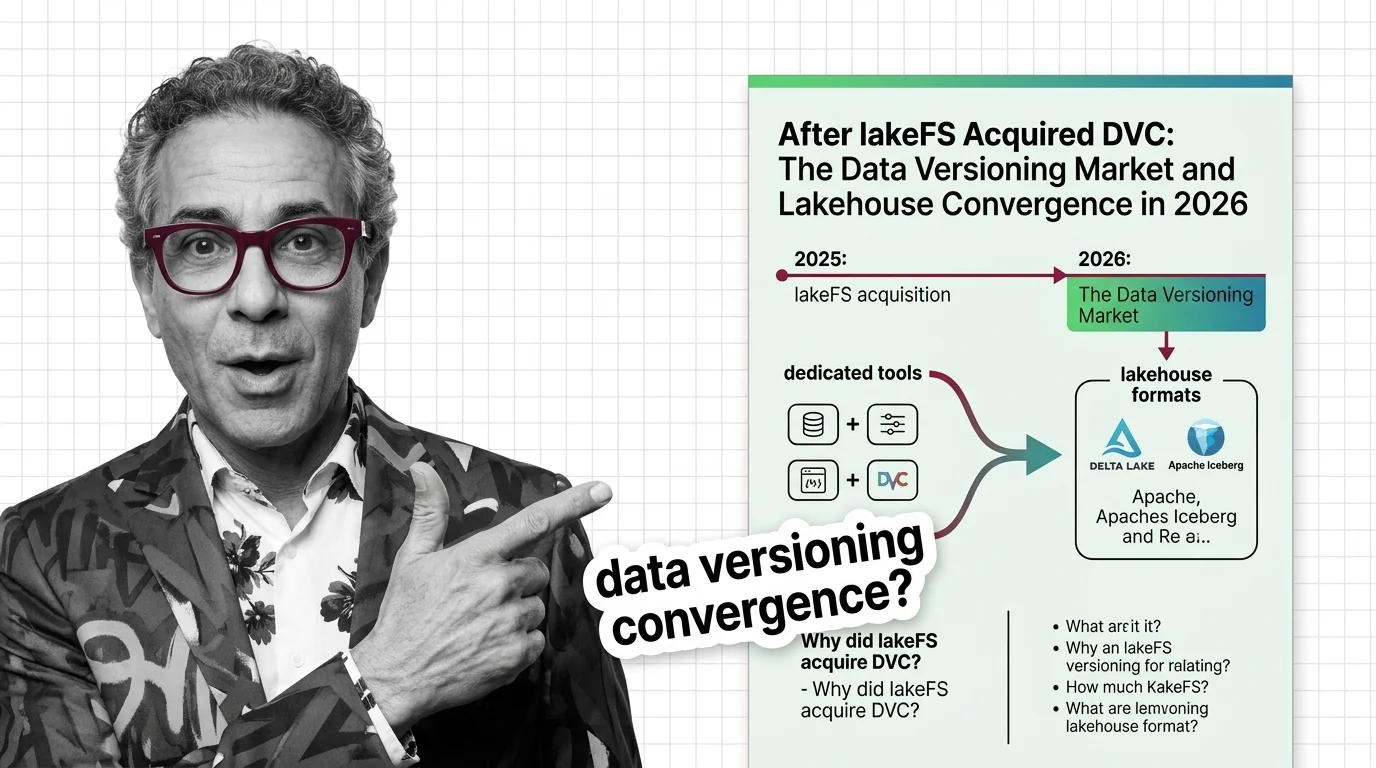
TL;DR
- The shift: Dedicated data versioning is consolidating into a handful of control planes while its core idea moves into the lakehouse layer underneath.
- Why it matters: Versioning is turning into a platform feature, not a separate tool you bolt onto your stack.
- What’s next: A split — table formats take structured time-travel, content-addressable tools keep the unstructured and multimodal datasets.
For years, versioning a dataset meant reaching for a tool that lived outside your stack — DVC, lakeFS, or a stack of Git LFS pointers stapled to your repo. That separate layer is now being pulled apart. One half is climbing up into ML platforms. The other half is sinking into the storage formats beneath your lakehouse.
The Category Is Being Absorbed, Not Killed
Thesis: Dedicated Data Versioning isn’t dying — it’s consolidating into a few control planes while its core idea gets baked into the lakehouse layer most teams already run.
Read the headlines and you’d think standalone versioning tools are finished. They’re not. The function is being relocated.
Versioning was always about one thing: the audit trail that lets you trace a model regression back to the exact dataset snapshot that caused it. That’s the difference between catching Data Leakage, Class Imbalance, or Dataset Bias before deployment and explaining it to your customers after.
That need isn’t going anywhere. The market for a separate product to serve it is the part that’s shrinking.
Two Acquisitions and a Format War, One Direction
Three independent moves point the same way.
First — consolidation at the tool layer.
lakeFS bought DVC from Iterative.ai in November 2025 and committed to keeping it 100% open source, with no deprecation and no breaking changes (DVC Blog). DVC stays the lightweight, Git-based on-ramp; lakeFS runs the petabyte-scale enterprise control plane, and the deal followed a $20M growth round earlier in 2025 (lakeFS Blog).
Second — absorption into the platform.
Hugging Face acquired XetHub in 2024, and since last spring Xet has been the default storage backend for every new user and organization on the Hub (Hugging Face Docs). It deduplicates at the byte and chunk level where Git LFS only dedups whole files — Content Addressable Storage doing what it does best — leaving Git LFS as the legacy path (Hugging Face Blog).
Third — the lakehouse formats moved onto the same turf.
Apache Iceberg reached 1.10.1 (Apache Iceberg Docs), and Delta Lake shipped 4.1.0, building on a 4.0 release that added coordinated commits and catalog-managed tables (Delta Lake). Apache Polaris, a vendor-neutral Iceberg catalog, graduated to a top-level Apache project in early 2026 (Apache Polaris). Each of these ships ACID transactions, time-travel, and schema evolution — the exact features a versioning tool used to sell on its own.
Three teams made the same bet without coordinating. That’s a category folding into the platform.
Who Moves Up
lakeFS is the obvious winner. It now owns both the lightweight on-ramp and the enterprise control plane, which means it controls the consolidation instead of being consumed by it.
Hugging Face wins the distribution layer. With Xet as the default backend, byte-level deduplication becomes the norm for how the world ships models and datasets — and Git LFS’s file-level approach becomes the thing you migrate off of.
DagsHub wins the platform-first crowd. Its “GitHub for ML” pitch — Git and DVC built in, with managed MLflow, Label Studio, and per-repo S3 — is exactly the bundled experience teams now expect (DagsHub). When versioning is a feature of the platform, the platform that bundles it best wins.
And the lakehouse vendors win by default. Every team already running Iceberg or Delta Lake gets dataset time-travel without buying anything new. Versioning just became a checkbox they already own.
Who Gets Left Behind
Single-purpose versioning tools with no platform and no scale story are the roadkill. If your whole value proposition is “we version data” and you own neither the lightweight on-ramp nor the petabyte control plane, the ground just moved under you.
Git LFS is the clearest casualty. File-level deduplication lost to byte-level, and the largest model hub already switched its default.
And teams treating versioning as a bolt-on are exposed. MLOps stacks that wired in a standalone tool as an afterthought now face a migration they didn’t plan for. You’re either standardizing on a versioning layer that scales with your data, or inheriting one when your vendor ships it.
What Happens Next
Base case (most likely): Consolidation continues, and versioning increasingly ships as a feature of the platform or the table format. Standalone tools survive where the lakehouse can’t reach — unstructured and multimodal datasets. Signal to watch: More table-format releases adding native versioning; more ML platforms bundling it by default. Timeline: Through 2026 and into 2027.
Bull case: A clean division of labor. Lakehouse formats own structured, tabular time-travel; content-addressable tools own the unstructured and multimodal blobs they can’t. Open catalogs like Polaris keep the two interoperable. Signal: Standard interfaces between Xet-style storage and table catalogs. Timeline: The next 12 to 18 months.
Bear case: Fragmentation. Every platform ships its own incompatible versioning, teams get locked in, and reproducibility across tools gets harder, not easier. Signal: Proprietary versioning formats with no open interchange. Timeline: A standing risk as long as the format war runs.
Frequently Asked Questions
Q: What is the future of data versioning tools in 2026? A: Consolidation and absorption. Standalone tools are merging into larger control planes like lakeFS, while versioning features move into ML platforms and lakehouse table formats. Dedicated tools survive for the unstructured and multimodal data the lakehouse can’t handle.
Q: Are lakehouse formats like Delta Lake and Apache Iceberg replacing dedicated data versioning tools in 2026? A: Partly. Iceberg and Delta Lake now ship time-travel, ACID transactions, and schema evolution that overlap with versioning. But they handle structured tables, not the unstructured or multimodal blobs ML teams version. It’s overlap, not full replacement.
Q: Why did lakeFS acquire DVC in 2025? A: To own both ends of the market. DVC covers lightweight, Git-based versioning for smaller projects; lakeFS runs the petabyte-scale enterprise control plane. lakeFS kept DVC fully open source with no deprecation, consolidating the category rather than killing a rival.
Q: How do ML teams use DagsHub and Hugging Face Xet to version datasets? A: DagsHub wraps Git and DVC with managed MLflow, Label Studio, and per-repo S3 as a “GitHub for ML.” Hugging Face Xet versions datasets on the Hub with byte-level deduplication, now the default backend that replaced Git LFS.
The Bottom Line
Data versioning isn’t dead — it’s being relocated, up into ML platforms and down into the lakehouse. The standalone-tool category is consolidating fast, but the need for a dataset audit trail is only growing. Watch where your versioning layer lives next: in a tool you chose, or a platform that chose for you.
Stay ahead, Dan.
AI-assisted content, human-reviewed. Images AI-generated. Editorial Standards · Our Editors