Active Learning in Practice: Real Annotation-Cost Savings and Where the Field Is Heading in 2026
TL;DR
- The shift: Foundation models didn’t replace active learning — they turned it into the selection layer that decides which examples are worth a human label.
- Why it matters: Domain studies show the right sampling strategy reaches near-full accuracy on a fraction of the labels, and labeling is where most ML budgets quietly leak.
- What’s next: The hybrid loop — model proposes, active learning selects, human corrects — is becoming the default production shape for data work in 2026.
For two years the assumption was simple: foundation models would absorb the grunt work of labeling, and Active Learning would fade into a footnote. That assumption was backwards. The models got better at proposing labels — and that made choosing which labels to trust the entire game. The selection layer didn’t disappear. It got promoted.
Foundation Models Didn’t Kill Active Learning — They Hired It
Thesis: Active learning is not being displaced in 2026; it is converging with foundation models into a single loop where the model supplies predictions and the algorithm decides which examples a human should ever see.
The old framing pitted the two against each other. Either you label data the hard way, or a big pre-trained model labels it for you. That binary is dead.
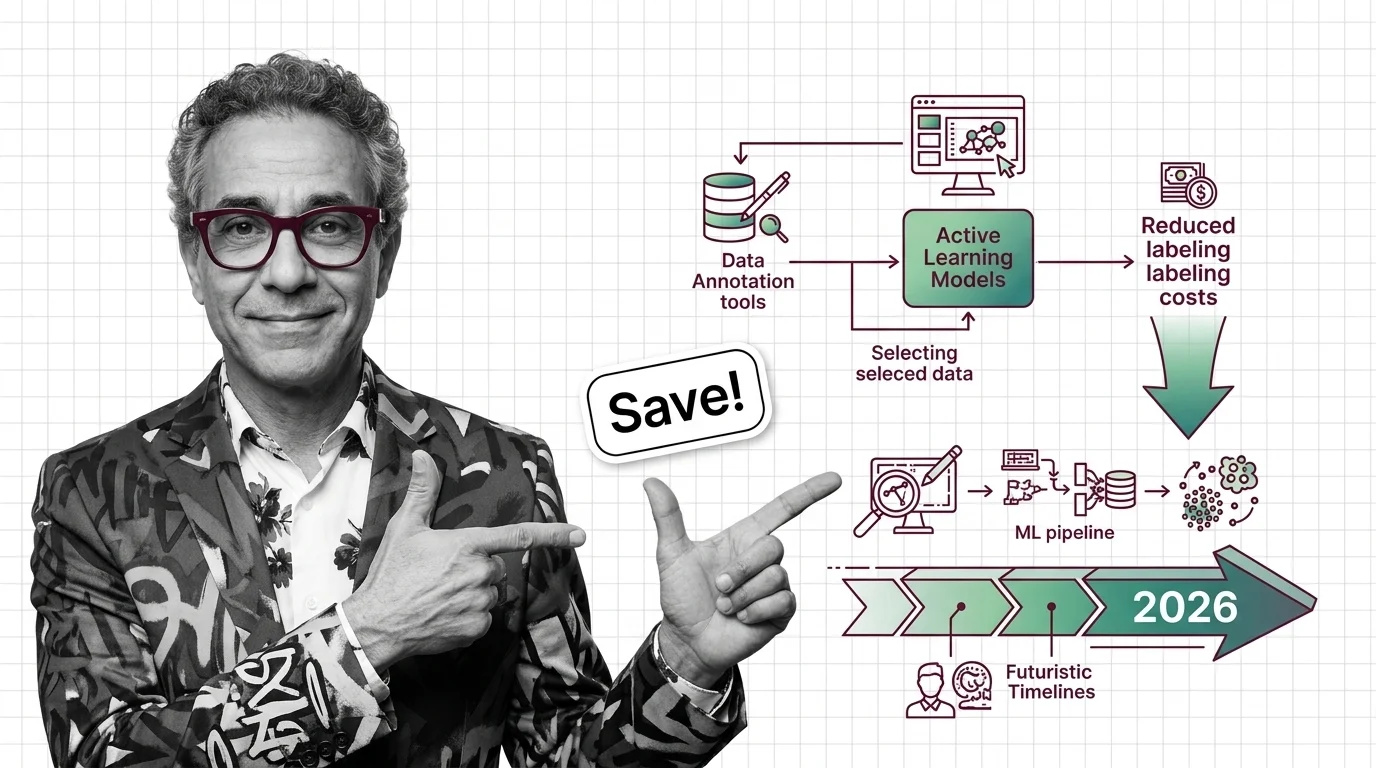
What replaced it is a pipeline. The foundation model proposes labels and embeddings at scale. An active learning Query Strategy ranks those proposals by how much a human correction would actually improve the model. The Human In The Loop only touches the examples that move the needle.
This solves the problem nobody wanted to admit. Fully automated labeling by a large model sounds cheap until you audit it — LLM-only labeling stays inconsistent and inherits the model’s own blind spots, and small models paired with active learning have been shown to outperform that approach after only a little expert data. Automation without selection isn’t a savings. It’s deferred debt.
The convergence is the trend. The standalone-versus-foundation-model debate is the blip.
The Numbers Annotation Teams Are Quietly Booking
The case for selection isn’t a forecast. It’s already on the books, domain by domain.
In clinical named entity recognition, a cost-aware approach cut annotation time by 20.5 to 30.2 percent and hit target performance with 43 to 49.4 percent fewer sentences (PMC, NIH). Same accuracy, roughly half the human reading.
Computer vision tells a sharper version. On retail product recognition, annotating just 20.83 to 24.34 percent of the data reached 95 percent of full-dataset performance (Springer). You buy most of the model by labeling a quarter of the pile.
The extreme case is cell image segmentation, where a bounding-box active learning method needed only 2.7 to 7.8 percent of the annotation time to reach 99 percent of fully-annotated performance (arXiv). And against random selection, active learning cut annotation cost by at least 50 percent on biomedical images and more than 33 percent on natural images (arXiv).
Read those as domain results, not industry averages — each figure is tied to a specific dataset and task. But the direction is identical across every one of them: the value lives in a small, well-chosen slice. That’s the whole thesis of active learning, and it traces straight back to Burr Settles’ 2009 survey, still the field’s most-cited map of the territory with roughly 6,600 citations (Settles 2009).
The mechanics behind these wins are familiar names. Uncertainty Sampling grabs the examples the model is least sure about. Query By Committee flags the ones an ensemble disagrees on. Diversity Sampling stops you from labeling a hundred near-identical edge cases, and Pool Based Sampling runs the ranking across your whole unlabeled store at once. Different query strategy levers, same payoff: fewer labels, same model.
The savings are real and measured. The only question is who’s capturing them.
Who Wins the Labeling Budget War
The platforms that built selection into the loop are pulling ahead.
Label Studio’s enterprise edition ships an automated active-learning loop wired to an ML backend, sorting tasks by model uncertainty instead of handing annotators a random queue. Lightly built its whole pitch on data curation — picking the samples that actually improve a model, especially for edge cases and medical imaging.
Snorkel comes at it from the weak-supervision side, turning labeling functions into probabilistic labels, and managed platforms like Scale AI, Labelbox, and SuperAnnotate now bundle model-assisted orchestration as a default. Open tooling — CVAT, modAL, Cleanlab, Prodigy — covers the same workflow for teams that build in-house.
The other winners are the teams sitting on a Cold Start Problem: a domain with almost no labels and a tight budget. Selection is exactly the lever that turns a thousand-label budget into ten-thousand-label performance.
You’re either routing your annotation spend through a selection layer or you’re paying full price for labels a quarter of which move the model.
Who Gets Left With the Bill
The losers are the teams treating annotation as a volume problem.
If your strategy is “label everything and hope,” you’re funding the 75 percent of examples that, per the retail vision study, contribute almost nothing past the first quarter. That’s not thoroughness. That’s burn rate.
The second group at risk: anyone betting the whole pipeline on automated LLM labeling with no human selection step. The reliability gap is documented, and Data Deduplication plus active selection consistently beats raw volume. Skip the loop and you inherit the model’s bias at scale, with no checkpoint to catch it.
Gartner projects that 60 percent of LLM AI projects will be abandoned by 2026 for poor data quality (Iterators). Quality is a selection problem before it’s a volume problem. Teams optimizing for label count are solving the wrong equation.
What Happens Next
Base case (most likely): The hybrid loop — foundation model proposes, active learning selects, human corrects — becomes the default production shape for supervised data work. Signal to watch: Annotation platforms shipping uncertainty-ranked queues as the standard interface, not a premium add-on. Timeline: Through the rest of 2026.
Bull case: LLM-as-oracle frameworks mature, letting a large model handle the easy corrections while humans take only the contested cases — compressing budgets further. Signal: Research like the DALL framework moving from CHI proceedings into shipped, supported products. Timeline: 12 to 24 months; today it’s still research-stage, not deployed practice.
Bear case: Teams over-trust automated labeling, skip the human checkpoint, and ship models trained on confidently wrong labels. Signal: A wave of quality-driven project failures matching the Gartner abandonment forecast. Timeline: Visible within the year.
Frequently Asked Questions
Q: What are real-world examples of active learning cutting labeling costs? A: Clinical NER cut annotation time 20.5–30.2 percent (PMC, NIH), retail vision reached 95 percent performance on roughly a quarter of the data (Springer), and cell segmentation hit 99 percent performance on under 8 percent of annotation time (arXiv).
Q: Which companies and annotation platforms use active learning in their ML pipelines? A: Label Studio Enterprise, Lightly, and Snorkel build selection loops directly; Scale AI, Labelbox, and SuperAnnotate bundle model-assisted orchestration; and open tools like CVAT, modAL, Cleanlab, and Prodigy support the same workflow in-house.
Q: Where is active learning heading in 2026 as foundation models reduce labeling needs? A: Toward convergence, not obsolescence. Foundation models supply predictions and embeddings while active learning decides which examples deserve a human label. Emerging LLM-as-oracle research, including approaches like Modal Active Learning, pushes that loop further — though it remains research-stage.
The Bottom Line
Active learning didn’t get replaced by foundation models — it became the layer that decides what those models are allowed to learn from. The measured savings are domain-specific but point one direction: the value is in the slice, not the pile. Watch whether selection becomes the default annotation interface or stays a premium feature.
Stay ahead, Dan.
AI-assisted content, human-reviewed. Images AI-generated. Editorial Standards · Our Editors