10M-Token Windows vs. Compression: How Real Products Handle Context Limits in 2026
TL;DR
- The shift: Every major frontier model now supports 1M+ token contexts — but Llama 4 Scout’s 10M is inference-time length generalization, not trained context.
- Why it matters: At production scale, compression cuts per-conversation costs dramatically. Big windows and structured context management are converging into one architecture.
- What’s next: Teams that skipped context management infrastructure are overpaying. That gap is compounding.
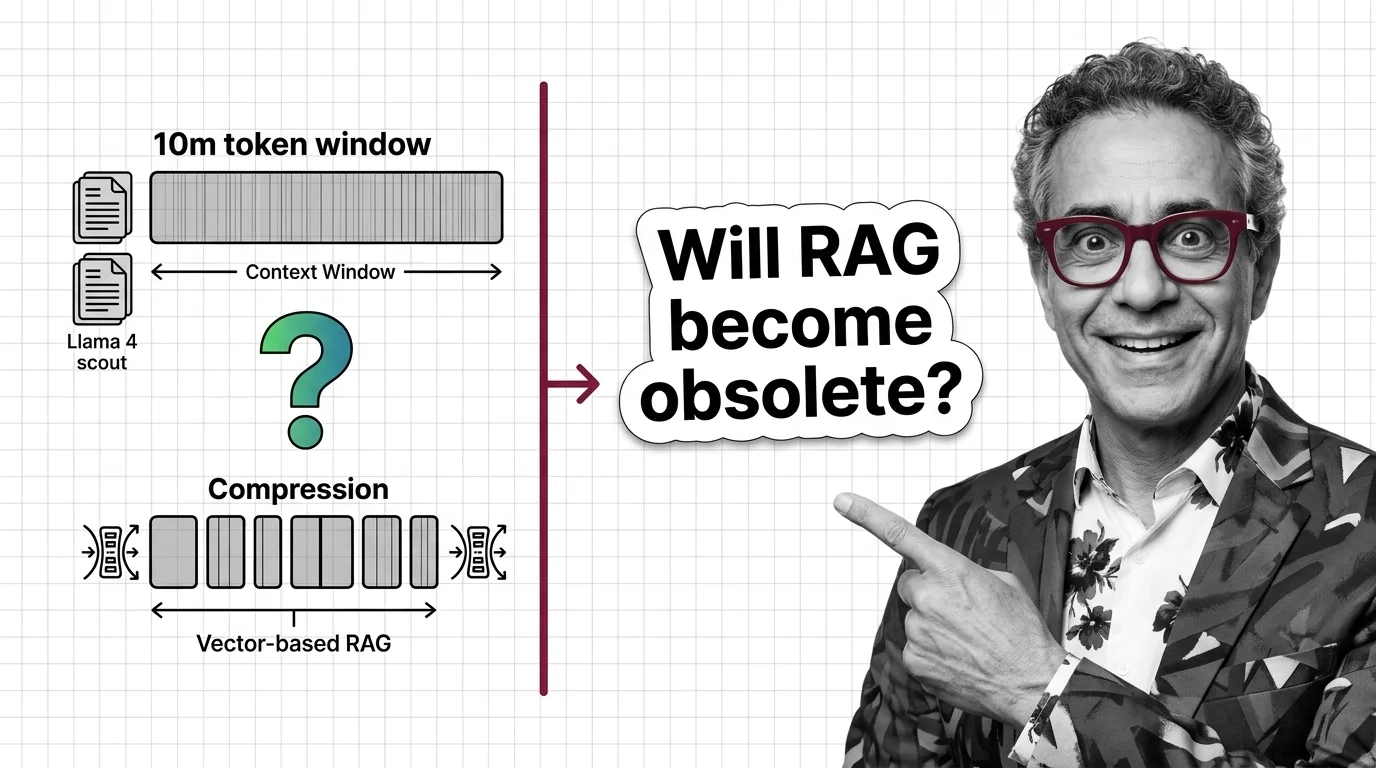
In April 2025, Meta shipped a Context Window that reads 10 million tokens. The tech press declared RAG dead, compression obsolete, and Context Window Management a solved problem.
None of those calls aged well.
The real story of how enterprises handle context in 2026 is less about headroom and more about what it costs to fill it — and who built the infrastructure to do it efficiently.
The 1M Consensus Changed the Game — But Not the Economics
Thesis: The context window race delivered massive headroom — not free headroom.
Every major frontier provider converged on 1M+ token contexts by mid-2026. GPT-5.4 launched at 1M in March 2026 (OpenAI). Gemini 2.5 Pro carries 1M on the standard API and 2M on select Vertex AI enterprise tiers (Google AI Docs). Claude Opus 4.8 and Claude Sonnet 4.6 both hold 1M at standard pricing — at $5/$25 and $3/$15 per million tokens respectively (Anthropic Pricing Docs).
Llama 4 Scout is the headline outlier at 10M. But the number needs a footnote. The model was trained on 256K tokens, per the Meta AI Blog. The 10M capability comes from length generalization at inference time — an architectural bet on MoE-based extrapolation across 17 billion active parameters, not a 10M training corpus.
10M is inference-time generalization, not trained context.
The window got bigger. Your invoice didn’t get smaller.
What Scale Costs Without a Strategy
At 10,000 daily support tickets, the numbers land clearly. Hierarchical summarization with Context Compression runs around $0.002 per conversation. Routing the full context window to the model costs roughly $0.015 per conversation (AgentMarketCap). That gap compounds into a budget problem at scale.
The structural issue runs deeper than pricing. Over 70% of production LLM errors trace back to incomplete or poorly structured context — not to model capability limits (Meta Intelligence). The window is wide enough. Teams are filling it wrong.
Combined GraphRAG and vector RAG already handles over 90% of enterprise knowledge Q&A needs (Meta Intelligence). Retrieval didn’t die because the window expanded. It moved alongside large-context calls in the same production stack.
Routing through an LLM Gateway to select models by cost tier became standard practice before 1M windows existed. Running LLM Load Testing at 1M-token prompts is where teams discover their real per-call costs — not in the demo environment.
Who Built the Right Infrastructure
Teams that designed context management as explicit infrastructure from day one. They layer compression for routine economics and large windows for the workloads that genuinely need them. They’re not choosing between strategies — they’re routing by prompt type.
Buyers on Gemini’s 2M Vertex enterprise tier. When a workload genuinely requires 2M tokens and retrieval won’t substitute, the tier exists. The key word is genuinely. Most workloads don’t qualify.
Context engineering specialists. The skills built during the 4K-to-128K transition didn’t disappear. They became more consequential. Knowing when to summarize, when to retrieve, and when to pass full context is now an infrastructure decision with a P&L line attached.
You’re either building for context efficiency or you’re building for surprises.
Who Paid for Not Thinking About This
Teams that read “1M context window” and treated it as a context management solution. More than 70% of production errors are still context quality failures. The model can hold more — but it can only use what you structure correctly.
Products built without Model Routing or LLM Fallback And Retry Patterns at the API layer. One misbehaving session in a 1M-token prompt hits Rate Limiting thresholds or times out. At 10K daily sessions, that pattern is an incident, not an edge case.
Builders who set up context pipelines on LangChain without checking migration status. The monolith architecture is deprecated — production teams now import langchain-core and langgraph separately. Building on v0.x patterns in 2026 is building on borrowed time.
You’re either paying for context engineering now or you’re paying for production incidents later.
What Happens Next
Base case (most likely): 1M tokens becomes table stakes across all pricing tiers by end of 2026. Cost differentiation shifts to who built compression infrastructure before the window race finished. Teams with context management pipelines pay a fraction of what newcomers pay per conversation. Signal to watch: Enterprise procurement starts asking “what’s your per-conversation cost at 10K sessions per day?” instead of “what’s your context window?” Timeline: 12-18 months.
Bull case: 10M+ windows unlock product categories that couldn’t exist before — multi-session agent memory without summarization drift, full codebase analysis at query time, long-horizon reasoning without retrieval degradation. Signal: Production deployments at 10M tokens for workloads that previously required complex RAG pipelines, with measured accuracy gains over retrieval-based approaches. Timeline: 2027, for Llama 4 Scout-class architectures.
Bear case: Long-context pricing creates a two-tier market. Large enterprises buy their way into 2M-token memory; resource-constrained teams stay compressed by necessity. Signal: API pricing structures that wall off long-context tiers behind enterprise contracts across all major providers — a pattern already beginning. Timeline: Partially underway.
Frequently Asked Questions
Q: How do enterprise AI assistants handle context limits across long customer support sessions in 2026?
A: They layer strategies. Sliding Window Attention retains recent conversation turns; hierarchical summarization compresses older exchanges; RAG injects relevant knowledge at query time. At 10K daily tickets, this runs around $0.002 per conversation versus $0.015 for full-window passes (AgentMarketCap). No single method handles it alone.
Q: How did early LLM apps manage 4K token limits before long-context models existed?
A: Through disciplined context engineering: sliding window retention, prompt summarization after each exchange, and retrieval-augmented generation to pull only relevant context at query time. These patterns are still dominant in 2026 production stacks. The window expanded. The need for context architecture didn’t go away.
Q: Will 10M+ token context windows like Llama 4 Scout make summarization and RAG obsolete by 2027?
A: No. Llama 4 Scout’s 10M capability is inference-time length generalization from a 256K training context (Meta AI Blog). At scale, cost math still favors compression. Combined GraphRAG and vector RAG covers over 90% of enterprise knowledge Q&A needs (Meta Intelligence). Both strategies coexist in production through 2027.
The Bottom Line
The context window race is effectively settled. Every major frontier model is at 1M or above. Llama 4 Scout showed 10M is technically feasible.
None of that made context management optional. Over 70% of production errors still trace to context failures, not model limits.
The teams who built context engineering infrastructure before the 1M convergence are now two cost generations ahead of the teams who didn’t.
AI-assisted content, human-reviewed. Images AI-generated. Editorial Standards · Our Editors